AEO visibility describes how frequently and how accurately AI answer engines mention your brand, cite your pages, and recommend you for the prompts your buyers ask. Measure it by setting a prompt list, repeatedly sampling each engine, and recording mention rate, citation rate, and answer share of voice as ranges instead of single results. Use these as leading indicators; Sona AI Visibility links prompts and citations to pipeline and revenue while tracking AI crawler and agent activity at the start of that path. Audit a baseline first.
What is AEO visibility, and how is it different from search rankings and GEO?
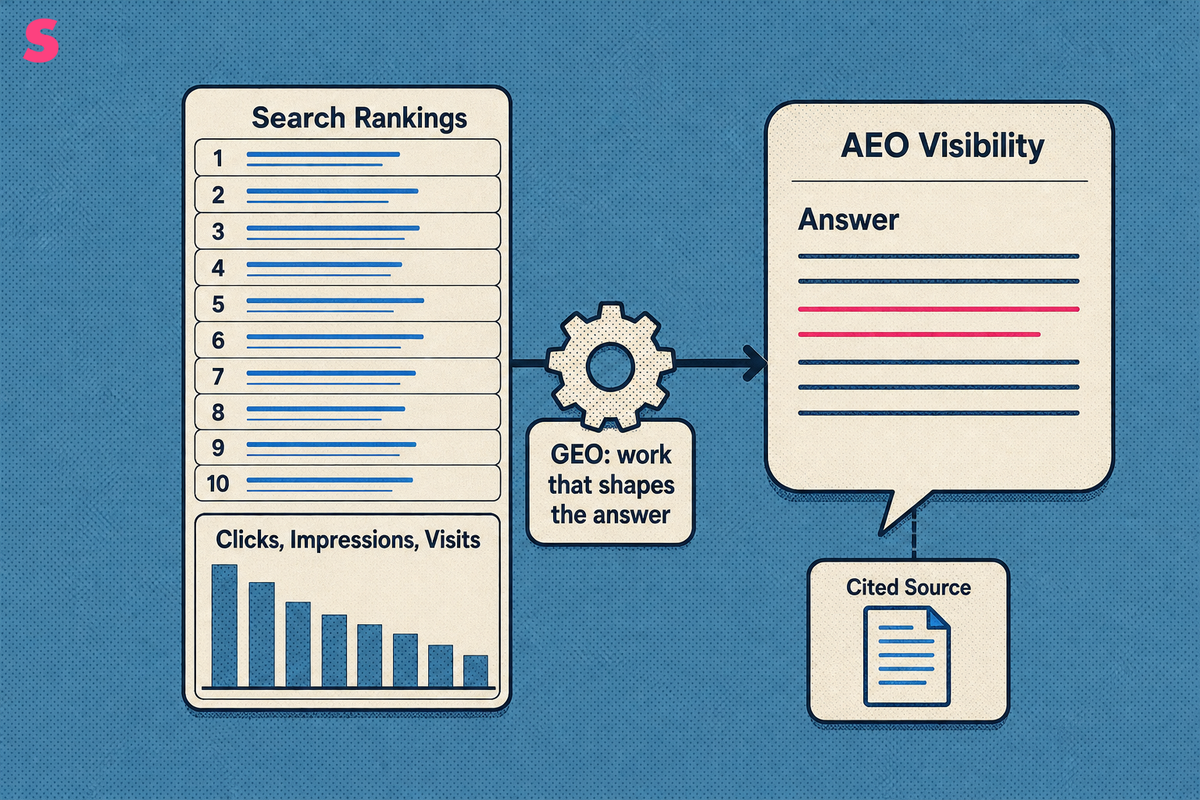
AEO, or answer engine optimization, is the practice of making a brand, its content, and supporting evidence eligible to be found, understood, cited, and included in generated answers. AEO visibility measures whether those answers name, cite, recommend, or accurately describe your brand when buyers ask relevant questions. It measures presence within answers, not only traffic from a results page.
Traditional SEO measures rankings, clicks, impressions, and visits from search results. AEO seeks answer inclusion in conversational and zero-click experiences, where buyers can receive a recommendation without visiting a website. GEO, or generative engine optimization, overlaps with AEO and describes work intended to improve presence in generated answers. AEO visibility measures whether that work changed the answers.
For example, a B2B software buyer might ask ChatGPT for tools that solve a reporting problem. Useful measurement records whether the answer names your company, where it appears, which source pages it cites, whether the description is accurate, and whether the recommendation suits the buyer’s question.
Generative search visibility describes the same operating problem from the engine perspective. It is evidence of how a set of answer engines responds to defined buyer prompts, not a Google ranking, domain authority metric, or single brand score.
Why does AEO visibility matter to a B2B marketing team?
AEO visibility matters because B2B buyers can research categories, compare vendors, and form shortlists inside AI answers before a measurable website visit. Marketing teams need to know whether their brand appears during that research and whether resulting activity contributes to pipeline.
A mention has different commercial value at different buyer stages. Appearing in an informational category question differs from appearing in a decision-stage comparison prompt. Measurement should preserve that distinction.
Answer engines can shape the language buyers use when they later search, visit directly, request a demo, or explain their research to a sales representative. AI visibility is therefore a leading indicator, not proof that visibility converts.
Sona AI Visibility connects citations and AI-referred visits to pipeline and revenue on one account timeline, while tracking which AI crawlers reach the site. Marketing teams can evaluate AI search as a measurable channel rather than treating brand mentions as the final result.
Which AEO visibility metrics should you track, and what does each one show?
AEO visibility measurement should combine answer-level evidence with business outcomes. Core metrics show whether a brand appears, how it is represented, which sources support that representation, and whether AI research produces qualified demand.
| Metric | What to record | What it shows | Useful decision |
|---|---|---|---|
| Answer inclusion rate | Whether the brand appears in each tracked answer | Coverage across the prompt set | Which topics need attention |
| Position or prominence | Where the brand appears in a list or recommendation | Whether the brand is central or incidental | Which comparisons deserve deeper analysis |
| Source citations | Domains and pages cited beside the answer | What evidence the engine selected | Which pages or third-party sources influence answers |
| Accuracy | Product description, category fit, and factual claims | Whether the answer represents the brand correctly | What factual gaps need correction |
| Referral and pipeline outcomes | AI-referred visits, opportunities, and revenue | Commercial value beyond visibility | Which prompts merit investment |
A composite score can summarize the data, but it is a dated snapshot. The underlying prompt record is more useful because it preserves the question, engine, cited sources, and response behind the score.
A brand-level number is not a work item. Sona AI Visibility shows prompt-level visibility, position, mentions, sources, intent, and buying stage, so teams can identify the prompts and cited pages behind a change instead of reacting to an aggregate score.
How do you build a prompt set that represents real buyers?
A prompt set should represent questions buyers ask across categories, use cases, competitor comparisons, and buying stages. Start with commercial questions, then add informational prompts that shape early research and implementation prompts that influence evaluation.
- List the products, categories, use cases, and customer problems your company addresses.
- Group the questions by Awareness, Consideration, Decision, and Purchase intent.
- Include neutral category prompts, comparison prompts, alternative prompts, and problem-led prompts.
- Write each prompt as a natural buyer question, then freeze the wording for measurement.
- Tag every prompt with an owner, business priority, and expected landing page or source page.
A useful set contains prompts that could lead a buyer toward a shortlist, not only prompts that include the brand name. A branded prompt tests factual representation. A non-branded comparison tests whether the engine considers the brand relevant when the buyer has not supplied the answer.
Run the same prompt list daily. Daily measurement exposes changes that a weekly snapshot can average away, including shifts caused by retrieval indexes, model updates, and newly published competitor material. Retain the prompt version, engine, country, date, and answer text for every run.
Sona AI Visibility uses AI Search Insights to connect keywords, buyer prompts, rankings, and cited sources at the prompt level. That structure moves teams from keyword demand to the questions buyers ask answer engines.
How do you audit your brand's current AEO visibility before optimizing anything?
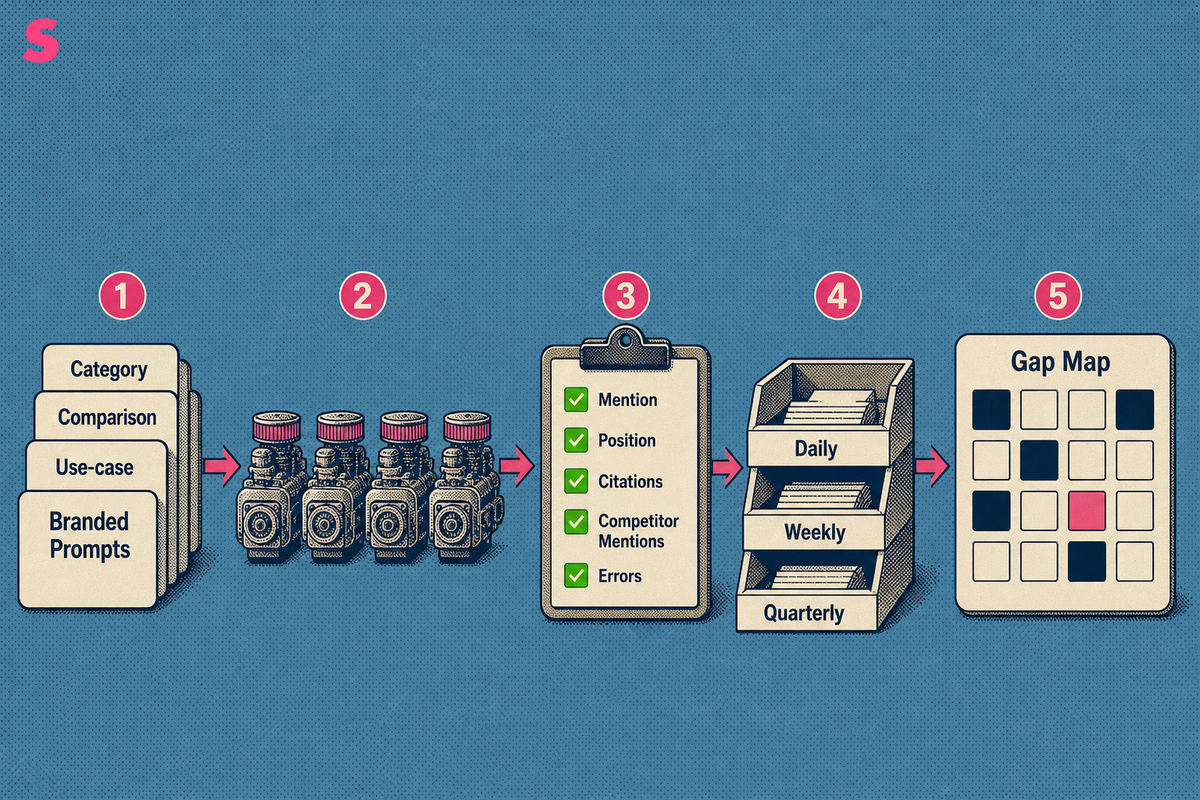
An AEO visibility audit establishes a documented baseline before content, technical, or distribution changes begin. The audit should show what each engine says, which sources it cites, whether the response is accurate, and where the brand fails to appear.
- Choose a fixed prompt set with category, comparison, use-case, and branded questions.
- Run each prompt across ChatGPT, Perplexity, Gemini, Claude, and other answer engines.
- Capture the full answer, brand mention, relative position, citations, competitor mentions, and factual errors.
- Classify each result by buyer stage and commercial importance.
- Repeat the prompt set daily, then review the pattern weekly and the strategic story quarterly.
Keep the raw answer, not only a pass or fail. A brand can appear but be described inaccurately, named without a citation, or positioned for the wrong use case. For every prompt cluster, compare each competitor’s inclusion, prominence, cited domains and pages, represented use cases, factual claims, and buyer-stage coverage. Produce a gap map showing where competitors appear and your brand does not, which sources repeatedly support them, and whether each gap is content, messaging, earned visibility, or technical access.
The Free AI Readiness Checker provides a separate technical baseline. It tests technical readiness and whether AI systems can read the site, not whether the brand appears in answers.
What does an AI engine check before it can find, parse and trust your page?
An AI engine must reach, parse, and assess a page before that page can support an answer. A practical audit examines crawl access, rendered content, canonical signals, structured data, factual clarity, and the page’s ability to answer a specific question directly.
Start with crawlability. Check robots.txt directives, WAF rules, rate limits, canonical tags, indexability, and server responses. A page that an AI crawler cannot retrieve cannot serve as retrieval evidence. The Sona AI Crawl Checker checks AI crawler access and identifies causes such as robots.txt blocks, WAF errors, rate limiting, and cloaking.
Then inspect parseability. Server-rendered HTML, semantic headings, Schema.org markup, concise definitions, current factual claims, and accessible images help systems interpret the page. Content for AI search visibility should be structured, fact-based, and semantically rich.
Technical work needs its own cadence. Re-audit important pages monthly or after significant releases, while the prompt list runs daily. A recurring page audit should retain issue history and attach severity-ranked fixes to each page, so teams can assess whether remediation changed the underlying condition.
How comparable are results across ChatGPT, Gemini, Perplexity, Google AI Overviews, and other answer engines?
Results across ChatGPT, Gemini, Perplexity, Google AI Overviews, and other answer engines are comparable only when the prompt, date, location, and recording method remain controlled. The engines use different interfaces and can present brands, citations, and recommendations in different formats.
| Answer surface | What to capture | Comparable measurement | Interpretation risk |
|---|---|---|---|
| ChatGPT | Brand mention, answer text, cited sources, referral behavior | Inclusion rate by fixed prompt | Answer wording can change between runs |
| Gemini | Brand mention, source treatment, factual accuracy | Position and accuracy by prompt | Response format can differ by query context |
| Perplexity | Brand mention, cited pages, source prominence | Citation presence and answer inclusion | Source selection can alter the response |
| Google AI Overviews | Brand mention, linked sources, result-page context | Inclusion within a defined search environment | Search context and query wording affect output |
Sona’s own AI visibility data, September 2026, covers 8 answer surfaces: ChatGPT, Google AI Overviews, Perplexity, Google AI Mode, Gemini, Mistral, Qwen and Claude. That count describes the archive’s measurement coverage, not evidence that one engine’s result is interchangeable with another.
Use a fixed prompt version and timestamp every observation. Report a range or trend across repeated daily runs rather than treating one answer as a stable truth. Define an internal repeated-run threshold that warrants investigation.
How do AEO visibility tools differ on engines, prompts and cost per tracked prompt?
AEO visibility tools differ in engine coverage, daily prompt allowance, refresh cadence, agency support, and their connection between answer data and business outcomes. Compare plans on the same unit, then verify whether the tool tracks the prompts and engines that matter to your buyers.
The public plan details below were checked as of October 2026. Cost per daily tracked prompt uses the listed comparison unit, not a simple division of a monthly subscription by a vendor’s prompt allowance.
| Tool | Starting price | Agency Plans? | # of Answer Engines Tracked | Answer Engines | # of Daily Tracked Prompts (entry plan) | Cost per Daily Tracked Prompt | Differentiation |
|---|---|---|---|---|---|---|---|
| Sona AI Visibility | From $75/month, billed annually | Yes | 11 | ChatGPT, Gemini, Google AI Mode, Google AI Overviews, Perplexity, Claude, DeepSeek, Grok, Copilot, Qwen, Mistral | 5,000 credits/month, about 166 daily tracked prompts on one model or 56 across three | $0.45 per daily tracked prompt | Connects AI citations and prompts to pipeline and revenue on one account timeline |
| Peec AI | From $95/month | Yes | 3 | Not published | 50 prompts daily | $0.63 per daily tracked prompt | AI visibility tracking across self-serve and agency plans |
| Otterly.ai | From $29/month | Yes | 4 | ChatGPT, Google AI Overviews, Perplexity, Microsoft Copilot | 15 prompts daily | $0.48 per daily tracked prompt | Prompt and brand monitoring across listed answer engines |
| PromptWatch | From $95/month | Yes | Not published | Not published | 50 prompts daily | $0.48 per daily tracked prompt | Prompt monitoring with monthly response allowances |
| Goodie | From $295/month | Yes | 5 | Not published | 110 prompts daily | $0.67 per daily tracked prompt | AI visibility measurement across Core and higher plans |
| Scrunch AI | From $250/month | Yes | 4 | ChatGPT, Perplexity, Google AI Overviews, Microsoft Copilot | 125 prompts | No refresh cadence published | AI search visibility analysis across Core and Enterprise plans |
Pricing alone does not determine fit. Test whether the platform preserves raw answers, identifies cited pages, supports the required geography and cadence, and provides a route from prompt data to commercial decisions.
How do you connect AEO visibility to pipeline and revenue?
AEO visibility connects to pipeline and revenue when answer-level observations join referral activity, identified accounts, CRM opportunities, and self-reported attribution. Visibility indicates that a model knows the brand. Revenue measurement shows whether relevant buyers acted.
Start by tagging AI-referred visits as a channel and preserving the engine, landing page, campaign context, and timestamp. Then connect visits to accounts where identity resolution permits, and reconcile the data with demo forms that ask how the buyer heard about the company.
Use prompt tags to make the analysis commercial. A consideration-stage prompt about implementation differs from a purchase-stage prompt asking for alternatives or pricing. Report answer inclusion, AI referrals, opportunities, pipeline, and closed-won revenue by prompt cluster and buyer stage.
Sona AI Visibility connects citations, AI-referred visits, accounts, pipeline, and closed-won revenue on one timeline. Sona Marketing Measurement provides the attribution foundation, with AI search treated as a channel alongside paid and organic activity.
Do not infer revenue from a high visibility rate. Use visibility as a leading indicator, then validate the relationship through assisted conversions, branded demand, sales-qualified opportunities, and revenue records from the same reporting period.
What are the frequently asked questions about AEO visibility?
Is AEO visibility the same as generative search visibility?
In practice, the two phrases describe the same measurement: whether AI-generated answers name, cite, and recommend your brand. AEO emphasizes answer engines and zero-click answers. Generative search visibility emphasizes the systems generating the answer. Both rely on answer inclusion, prominence, citations, accuracy, referral quality, and downstream commercial outcomes.
How many prompts do you need to track AEO visibility?
You need enough prompts to cover each category, use case, competitor comparison, and buying stage that matters to the business. A prompt budget forces prioritization. Entry plans in the approved comparison range from 15 daily prompts on Otterly.ai to 100 daily prompts on Rankability, as of October 2026. Start with questions closest to qualified demand, then expand with evidence.
How often should you re-measure AEO visibility?
Run a fixed prompt list daily and retain timestamps, engine names, locations, and exact prompt versions. Daily repetition helps teams distinguish sustained changes from unstable answers. A full technical re-audit can run monthly, while positioning reviews and competitive benchmark reports fit a quarterly operating rhythm.
Can you check AEO visibility without paying for a tool?
Yes. Create a fixed prompt list, run each question repeatedly across relevant answer engines, and log mentions, citations, accuracy, and position in a spreadsheet. Manual auditing provides useful baseline evidence. It becomes slow as the prompt set, engine count, or reporting requirements expand.
Can you trust a composite AEO visibility score?
Treat a composite score as directional. If the provider does not disclose its prompt set, sample size, scoring rules, and weighting, the score cannot be independently audited. Track the underlying prompt-level metrics because they show what changed and what the marketing team should investigate.
Does a high AEO visibility rate mean more pipeline?
No. A high rate shows that answer engines include the brand for tracked questions, but it does not prove that buyers visit, convert, or create pipeline. Join answer visibility to AI referral traffic, branded demand, assisted conversions, sales-qualified opportunities, and closed-won revenue before making a commercial claim.
Summarize this article with AI: ChatGPT · Claude · Perplexity · Google AI Mode
Last updated: October 2026