For B2B lead generation, AEO versus SEO is about citations versus clicks: SEO secures rankings that capture existing demand, whereas AEO secures cited mentions within AI answers that influence which vendors make the shortlist. Treat them as two layers of one system and fund the one your metrics show is generating pipeline. Sona AI Visibility connects prompts and citations to pipeline and revenue, so the AEO layer is evaluated by deals rather than mention counts.
What actually separates AEO from SEO in a B2B buyer journey?
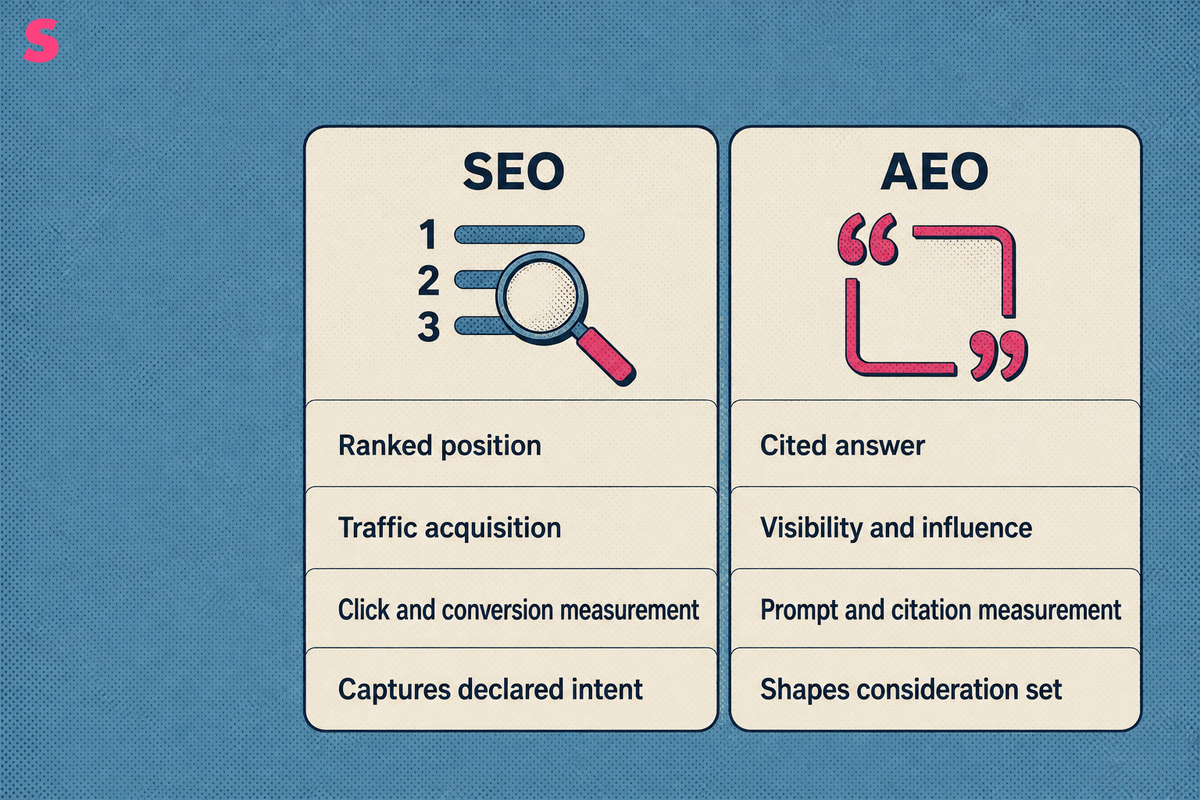
The core difference in AEO vs SEO for B2B lead generation is the unit of competition. SEO competes for a ranked position that earns a click. Answer engine optimization (AEO) competes for a cited answer inside an AI-generated response. SEO captures declared demand, while AEO can influence a buyer's shortlist before the buyer reaches a search result.
That difference changes how B2B teams interpret buyer behavior. An SEO page aims to appear when someone searches a keyword and visits the site. An AEO-ready page aims to become supporting evidence when a buyer asks how to compare vendors, solve a technical problem, or build a business case.
AEO is not a rebrand of SEO. Technical SEO, topical authority, clear information architecture, and structured content remain the foundation. AEO adds prompt coverage, answer-level visibility, citation analysis, and measurement of whether an AI system recommends, cites, or omits the company.
- SEO: ranked position, traffic acquisition, click and conversion measurement.
- AEO: cited answer, visibility and influence, prompt and citation measurement.
- B2B implication: SEO captures declared intent, while AEO can shape the consideration set before a buyer clicks.
How do AEO and SEO compare side by side for B2B lead generation?
AEO and SEO serve different moments in B2B lead generation. SEO is strongest when a buyer searches for a known category, solution, or brand and is ready to visit. AEO is strongest when a buyer asks an answer engine for synthesis, recommendations, comparisons, or explanations.
| Dimension | SEO | AEO |
|---|---|---|
| Type of visibility | Ranked placement in traditional search results. | Citation, mention, or recommendation inside an AI-generated answer. |
| Unit of competition | A ranked position for a keyword or query. | A cited answer for a buyer prompt. |
| Content format | Deep, comprehensive pages built to rank and convert. | Short, extractable answer blocks within credible, detailed pages. |
| Lead-quality signal | Clicks, engaged sessions, form fills, and conversions. | Prompt intent, cited-answer coverage, assisted discovery, and later conversion. |
| Implementation complexity | Technical health, content depth, internal linking, and authority building. | SEO fundamentals plus prompt mapping, citation monitoring, and answer-ready page structure. |
| Timeline to results | Measured through ranking, traffic, and conversion trends. | Measured through repeated prompt runs, citation patterns, and assisted pipeline influence. |
| Best B2B use cases | Direct demand capture, product research, integrations, pricing, and branded search. | Category education, vendor comparison, problem framing, and early-stage evaluation. |
| Measurement approach | Rankings, impressions, clicks, conversion rate, and pipeline. | Prompt coverage, cited sources, answer position, referrals, self-reported influence, and pipeline. |
Strong B2B programs do not force a choice between isolated channels. They use SEO to earn visits from declared demand and AEO to become visible when buyers ask an engine to interpret the market.
Is there evidence that AI search already influences B2B research?
Yes. AI search assistants influenced 12.4% of B2B research journeys in an analysis published June 26, 2026, based on 12,400 Google AI Overviews queries and a survey of 900 SEO practitioners. The figure is volatile, so it should guide measurement priorities rather than function as a universal forecast.
The same June 2026 analysis reported an engine mix led by ChatGPT at 47%, followed by Google AI Overviews at 23%, Perplexity at 18%, Claude at 7%, Gemini at 4%, and other answer engines at 1%. B2B teams should monitor the answer surfaces their buyers use rather than treat one AI engine as the entire market.
Sona's own AI visibility data, September 2026, covers 8 answer surfaces: ChatGPT, Google AI Overviews, Perplexity, Google AI Mode, Gemini, Mistral, Qwen and Claude. An answer that appears in one engine can be absent from another.
AI research belongs in a B2B measurement plan when prospects use synthesized answers to learn categories, compare vendors, and develop a shortlist.
Which SEO fundamentals still decide whether AI engines can find, parse and trust a page?
SEO fundamentals determine whether answer engines can reach, parse, and assess a B2B page. AEO does not replace crawlability, rendered performance, security, structured content, content quality, recency, or accessibility. These foundations make a page usable to both search crawlers and answer-engine retrieval systems.
- Crawlability: answer-engine crawlers need access to the page, its canonical tag, and its intended indexation signals.
- Performance: server-rendered HTML and a dependable rendered experience reduce dependence on JavaScript execution.
- Security: HTTPS and sound response-header hygiene provide baseline trust signals.
- Content structure: descriptive headings, semantic HTML, and schema markup make facts easier to locate and interpret.
- Content quality and recency: accurate, specific, maintained copy gives an engine material worth citing.
- Accessibility: alt text, ARIA attributes, contrast, and explicit image dimensions improve machine readability and user experience.
The Free AI Readiness Checker provides a snapshot of page readiness. Technical teams still need page-level findings to determine the first fix.
For B2B lead generation, the priority is not separate pages for SEO and AEO. It is high-intent pages that are technically reachable, structurally clear, substantively useful, and current enough to earn rankings and citations.
How do you measure AEO beyond rankings and impressions?
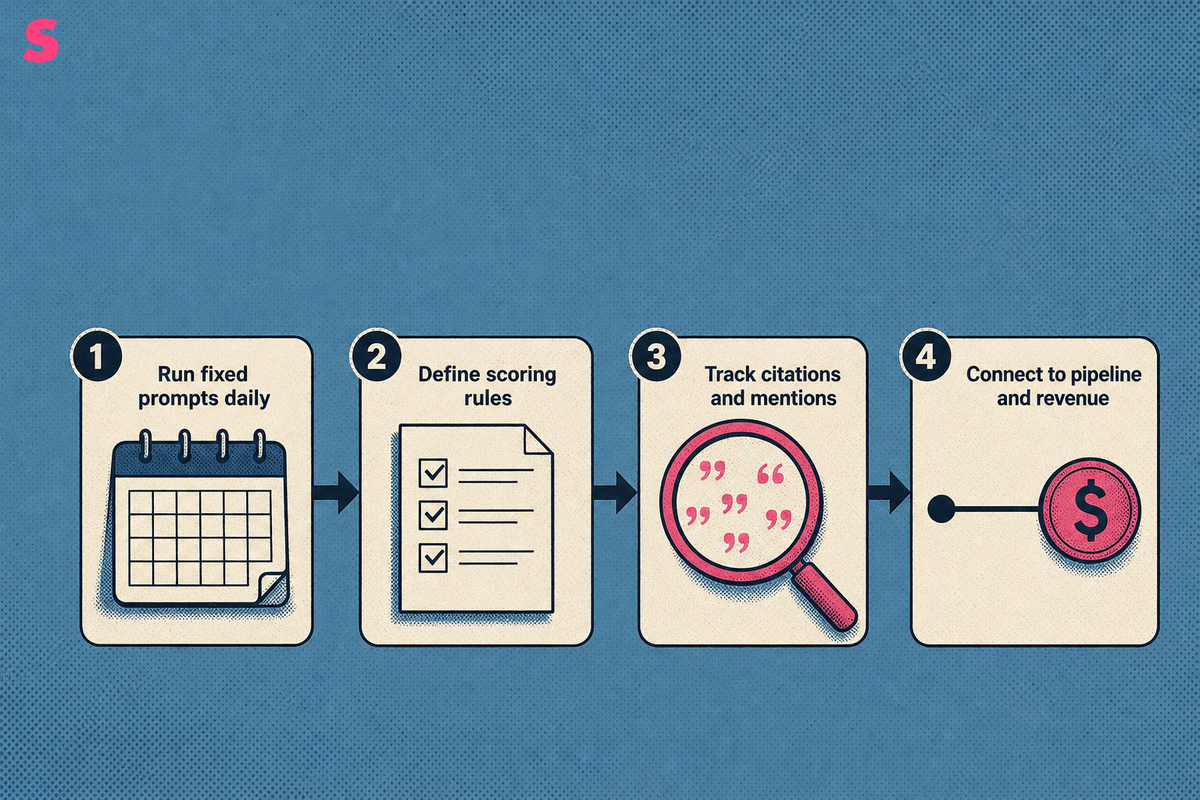
AEO measurement starts with a fixed prompt set and ends with pipeline contribution. Rankings and impressions remain useful SEO signals, but answer-engine measurement requires repeated runs that record brand appearances, answer position, cited sources, and changes over time.
Run the same prompt list daily. An answer engine can change a response because of retrieval-index changes, model updates, or new competitor content. Define and document a persistence threshold before reporting, then classify movement only after it repeats across enough scheduled runs to exceed the team's normal baseline variability.
Document scoring rules before reporting results. Define what counts as a mention, citation, recommendation, and competitor comparison. Record prompt wording, location, engine, date, and confidence range. This produces a defensible measurement series despite variable AI answers.
Clicks do not capture the full effect. A buyer can discover a company in an AI answer, search the brand later, submit a demo form, or report AI research in a self-reported attribution field. Sona AI Visibility connects citations and AI-referred visits to pipeline and revenue, while tracking AI crawler activity as the front of that same path.
AI Attribution connects AI citations to accounts, pipeline, and closed-won revenue on one account timeline. That makes assisted discovery measurable alongside direct AI referrals rather than treating every non-click interaction as untraceable.
Which metrics show whether AEO or SEO is delivering leads for your B2B business?
Priorities should follow measurable lead quality, not channel labels. Set a documented baseline for each metric before making a channel decision. Use the same ideal-customer-profile definition, market scope, CRM opportunity criteria, and reporting window for SEO and AEO cohorts. Define AI influence consistently, such as an AI-referred visit or documented self-reported AI research, and retain that rule for each reporting period.
| Outcome | SEO metric | AEO metric | Decision signal |
|---|---|---|---|
| Lead volume | Cohort: qualified organic-search sessions. Denominator: all organic sessions in the shared reporting window. Attribution source: web analytics and CRM form-source data. | Cohort: qualified accounts with an AI-referred visit or documented AI influence. Denominator: all accounts meeting the documented AI-influence rule in the same window. Attribution source: web analytics, CRM, and self-reported attribution. | Prioritize SEO when qualified organic sessions and organic lead creation fall below the documented baseline. Prioritize AEO experimentation when cited-answer coverage and AI-influenced lead creation rise against baseline. |
| Lead-to-opportunity rate | Cohort: organic-sourced leads. Denominator: organic-sourced leads created in the shared reporting window. Attribution source: CRM source and opportunity records. | Cohort: AI-referred or AI-influenced accounts. Denominator: accounts in the documented AI cohort that entered the funnel in the same window. Attribution source: AI referral records, self-reported attribution, and CRM opportunity records. | Compare opportunity creation rates against each channel's documented baseline. Maintain the hybrid plan when both cohorts create qualified opportunities at different buyer-journey stages. |
| Deal quality | Cohort: opportunities attributed to organic acquisition. Denominator: organic-attributed opportunities created in the shared reporting window. Attribution source: CRM pipeline and closed-won records. | Cohort: opportunities with a documented AI-referred or AI-influenced touch. Denominator: AI cohort opportunities created in the same window. Attribution source: AI Attribution and CRM pipeline records. | Compare pipeline value and closed-won revenue per opportunity against the documented baseline. Do not prioritize raw sessions when the pipeline measures conflict. |
| Sales-cycle length | Cohort: organic-attributed opportunities. Denominator: closed or progressed organic opportunities in the shared reporting window. Attribution source: CRM first-touch and stage-history records. | Cohort: AI-referred or AI-influenced opportunities. Denominator: closed or progressed opportunities in the documented AI cohort during the same window. Attribution source: AI Attribution, CRM stage history, and self-reported attribution. | Compare time from first qualifying touch to opportunity or close against each cohort's baseline. Treat earlier AI research as a journey-stage signal only when the pattern persists under the documented threshold. |
| Demand influence | Cohort: branded-search and returning organic visitors. Denominator: all organic visitors in the shared reporting window. Attribution source: web analytics and search reporting. | Cohort: fixed prompt set and accounts reporting AI research. Denominator: scheduled prompt runs and recorded attribution responses in the same window. Attribution source: prompt monitoring, cited-answer records, and CRM self-reports. | Maintain the hybrid plan when organic demand and AI citation coverage both contribute pipeline through different journey stages. Investigate attribution rules before treating a rise in either signal as channel causation. |
A mismatch between SEO and AEO is informative. Strong rankings with weak cited-answer coverage suggest that a page earns search visibility but does not appear in prompts that shape evaluation. Strong citation coverage with weak clicks suggests assisted discovery, which requires branded search, self-reported attribution, demo conversion, and pipeline contribution to complete measurement.
A single brand-level visibility score is not a work item. A prompt-level view shows which prompts produce visibility, which sources answer engines cite, and which pages need attention. Sona AI Visibility tracks prompts and cited sources at that level, so teams can connect visibility changes to specific pages and buyer questions.
Illustrative B2B scenario: A software company sees stable organic demo volume from integration and pricing pages, while sales calls increasingly include prospects who first learned about the category through AI answers. The company keeps SEO reporting for qualified organic conversion, then adds a fixed prompt set covering problem evaluation, vendor comparison, security review, and purchase-stage questions. The resulting analysis separates direct referral traffic from assisted discovery and identifies where citation coverage needs improvement.
Review prompt results daily and the strategic story quarterly. A technical re-audit and competitive benchmark are periodic decisions. Prompt movement is an operating signal.
How should a B2B team combine AEO and SEO in one plan?
A B2B team should use SEO to capture intent through rankings and clicks, while using AEO to earn recommendation and citation inside synthesized answers. The combined plan starts with the same pages, subject-matter expertise, and conversion goals.
- Identify high-intent pages for categories, use cases, integrations, comparisons, security, pricing, and implementation.
- Add concise answer blocks near the top of each deep page, written to answer a specific buyer question directly.
- Maintain semantic headings, relevant schema markup, descriptive internal links, and current factual content.
- Map prompt coverage to buying stages, from awareness questions through decision and purchase questions.
- Track the prompt set daily, then review content priorities and technical findings on a monthly or quarterly cadence.
Content should remain deep enough to rank and specific enough to cite. A short, extractable answer block gives an engine a clear response. The surrounding page provides evidence, context, and conversion paths for the human buyer.
Sona AI Visibility can connect the prompt, the cited page, and downstream account activity, helping B2B teams prioritize prompts by pipeline relevance rather than search volume alone.
When does the AEO versus SEO distinction stop mattering?
The AEO versus SEO distinction matters less when the same work improves both forms of discovery. Crawlability, page performance, structured content, accessible design, current evidence, and clear explanations help traditional search and answer engines alike.
Small B2B teams with a thin content base should build strong foundational pages rather than create separate AEO and SEO programs. A detailed category page with direct answer blocks, clear headings, supporting evidence, and a useful conversion path can serve ranking and citation goals.
Branded and bottom-funnel searches also reduce the distinction. When a buyer searches for a company name, pricing page, login, product documentation, or direct comparison, clicks often remain the decisive signal. SEO reporting remains central in those journeys.
Some categories have little AI research behavior. If buyers rarely ask ChatGPT, Perplexity, Gemini, Claude, and other answer engines about the category, broad AEO investment has less urgency. SEO reporting still cannot answer whether an AI system cites, recommends, or omits the company when a buyer asks for guidance.
What should an AEO monitoring tool track, and how do plan limits affect the choice?
An AEO monitoring tool should track prompts, answer engines, citations, competitors, sources, and share of voice, then connect visibility to business outcomes. Mention and competitor tracking are the baseline. The more important buying question is whether prompt limits, engine coverage, refresh cadence, and seats match the team’s operating model.
The following product comparison uses published plan information as of October 2026. Prices are monthly unless stated otherwise. Daily prompt allowances and refresh cadence matter because a low headline price can cover a small monitoring set, while broader B2B coverage needs enough prompts across the engines buyers use.
| Tool | Starting price | Agency Plans? (Yes/No) | # of Answer Engines Tracked | Answer Engines | # of Daily Tracked Prompts (entry plan) | Cost per Daily Tracked Prompt | Differentiation |
|---|---|---|---|---|---|---|---|
| Sona AI Visibility | From $75/month, billed annually | Yes | 11 | ChatGPT, Gemini, Google AI Mode, Google AI Overviews, Perplexity, Claude, DeepSeek, Grok, Copilot, Qwen, Mistral | 5,000 credits/month, about 56 daily tracked prompts across 3 engines | $0.45 per daily tracked prompt | Connects AI citations and prompts to pipeline and revenue on one account timeline, while tracking AI crawler activity from server logs or a lightweight edge worker. |
| Peec AI | From $95/month | Yes | 3 | Not published | 50 prompts daily | $0.63 per daily tracked prompt | AI visibility tracking across self-serve and enterprise engine coverage. |
| Otterly.ai | From $29/month | Yes | 4 | ChatGPT, Google AI Overviews, Perplexity, Microsoft Copilot | 15 prompts daily | $0.48 per daily tracked prompt | Prompt monitoring across its Lite entry plan and higher prompt tiers. |
| PromptWatch | From $95/month | Yes | Not published | Not published | 50 prompts daily | $0.48 per daily tracked prompt | Daily prompt tracking with response allowances across plan tiers. |
| Goodie | From $295/month | Yes | 5 | Not published | 110 prompts daily | $0.67 per daily tracked prompt | AI-search monitoring across Core, Pro, and Enterprise plans. |
| Scrunch AI | From $250/month | Yes | 4 | ChatGPT, Perplexity, Google AI Overviews, Microsoft Copilot | 125 prompts | No refresh cadence published | AI visibility monitoring across Core and Enterprise offerings. |
Entry plans begin at $29 per month in this comparison, while daily prompt tracking for broader monitoring ranges from $95 to $295 per month, as of October 2026. Small B2B teams should first select enough daily prompts to cover priority category, comparison, use-case, and purchase-stage questions. Engine coverage and refresh cadence determine whether the data can support a reliable trend.
What are the frequently asked questions about AEO and SEO?
Is AEO just a rebrand of SEO?
No. Technical SEO, authority, and structured content remain the base, but AEO adds answer-level visibility, citation tracking, and prompt coverage. Rankings show where a page appears in search results. They do not show whether an AI answer cites, recommends, or omits the company.
If AI answers reduce clicks, can AEO still generate B2B leads?
Yes, through assisted discovery rather than direct referrals alone. Measure branded search, self-reported AI influence, demo conversion, opportunity creation, and pipeline contribution. A buyer can encounter a company in an answer engine, then return through branded search or a direct visit.
Can AI answer results be measured reliably?
AI answer results can be measured reliably with disciplined methods. Use a fixed prompt set, repeated daily runs, confidence ranges, and written scoring rules. Prompt wording, buyer location, model updates, retrieval changes, and competitor content can all change an answer.
Should a B2B team with weak SEO start with AEO?
Usually not. Fix crawlability, structure, performance, and content quality first because those fundamentals serve both SEO and AEO. Add answer-engine monitoring once the technical base is stable and the team has high-intent pages worth tracking.
Which AI engines matter most for B2B research?
In the June 2026 reported engine mix for B2B research, ChatGPT led at 47%, followed by Google AI Overviews at 23% and Perplexity at 18%. Claude represented 7%, Gemini represented 4%, and other answer engines represented 1%. Check your own audience before assigning monitoring weight.
Are AEO tools too expensive for a small B2B team?
Not necessarily. Entry plans in the October 2026 listings begin around $29 per month, while multi-engine daily tracking with more prompts ranges from $95 to several hundred dollars per month. Prompt limits, engine coverage, response allowances, and refresh cadence matter more than headline price.
Summarize this article with AI: ChatGPT · Claude · Perplexity · Google AI Mode
Last updated: October 2026