Although AEO and GEO overlap, they serve distinct purposes: AEO helps content get chosen as the direct answer, whereas GEO helps a brand be cited as a source within AI-generated responses. Neither replaces SEO; both complement it, and the best place to begin depends on where buyers already discover you. Sona AI Visibility links AI citations and prompts to pipeline and revenue, allowing either investment to be evaluated by outcomes instead of mention counts.
Are AEO and GEO the same thing, or two names for the same work?
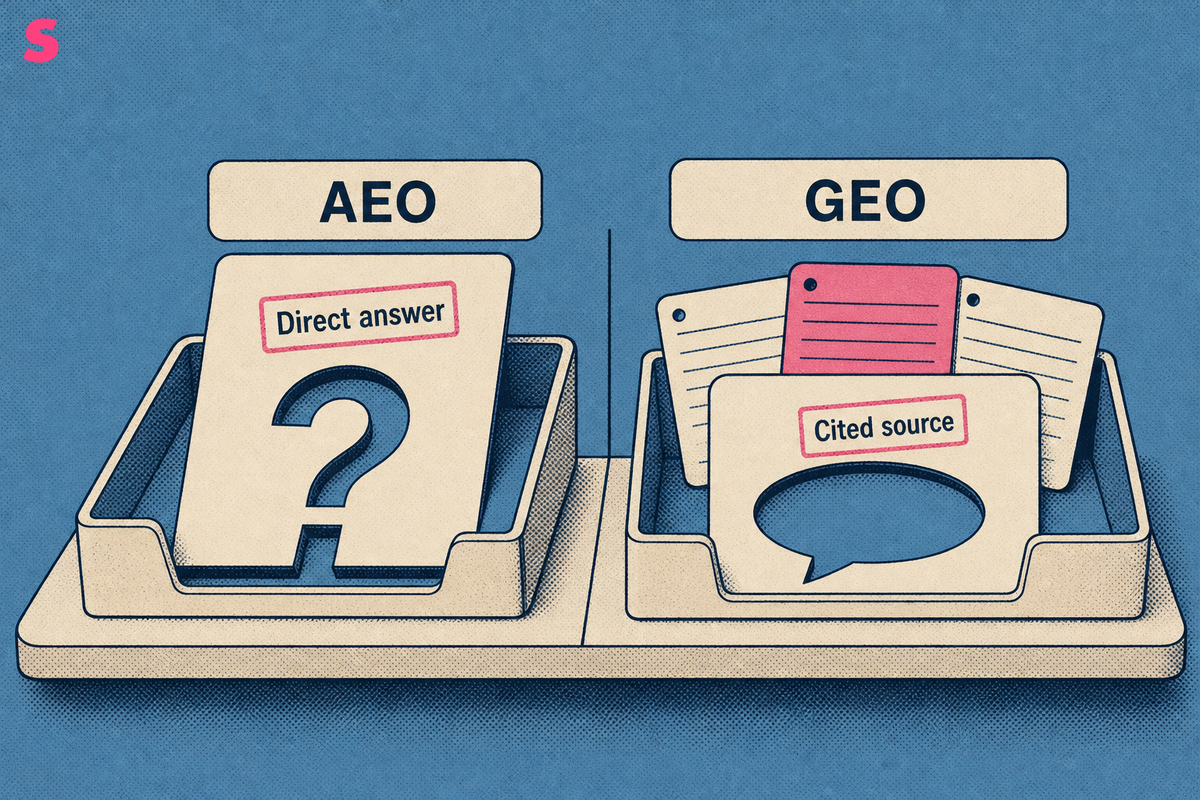
AEO and GEO are related optimization disciplines, but they target different outcomes. AEO focuses on being selected as the direct answer to a question. GEO focuses on being cited, mentioned, or recommended within an AI-generated response.
The terminology remains unsettled. As of October 2026, two dominant models exist: one separates AEO for traditional answer features from GEO for generative-AI answers, while the other uses AEO as an umbrella term that includes GEO. The distinction matters because the work, evidence, and measurement differ.
For marketing leaders, the distinction is operational. A page can win a concise answer placement without becoming a trusted source in a longer AI recommendation. A brand can also be cited by an answer engine without owning the first direct answer on a Google results page.
Sona AI Visibility connects citations to pipeline and revenue on one account timeline, and tracks which AI crawlers reach your pages, so AI visibility becomes a measurable acquisition channel rather than a mention count.
What does AEO stand for, and which answer surfaces does it target?
AEO stands for answer engine optimization. It structures content so an answer engine can select it as a direct, concise response to a user question.
AEO commonly targets three answer-oriented surfaces: featured snippets, People Also Ask, and Google AI Overviews, per an October 2026 industry listing. These surfaces favor pages that answer a specific question clearly, use semantic structure, and present extractable supporting evidence.
Consider a B2B SaaS page answering, “What is account-based marketing attribution?” An AEO-oriented page would open with a precise definition, explain the mechanism, use descriptive headings, and place supporting detail beneath the answer. The goal is direct selection.
- Question alignment: Match the page to a specific buyer question.
- Answer structure: Put the definition or recommendation near the top.
- Supporting context: Add examples, constraints, and terminology that validate the answer.
- Technical accessibility: Ensure answer engines can crawl and parse the page.
AEO is not keyword stuffing or a collection of isolated FAQ pages. A direct answer still needs credible context, clear authorship, and a crawlable technical foundation.
What does GEO stand for in AI, and what is it in an SEO context?
GEO stands for generative engine optimization. In an AI context, it means improving how often and how favorably generative systems use a brand or source in responses to buyer prompts.
GEO definitions commonly refer to ChatGPT, Gemini, Claude, and Perplexity, per a September 2026 industry listing. GEO assesses whether these systems and other answer engines mention a company, cite its pages, describe it accurately, and position it credibly against alternatives.
In an SEO context, GEO extends classic search work into generated answers. Traditional SEO asks whether a page ranks and earns clicks. GEO asks whether a company becomes a trusted source when an engine synthesizes information from pages, brands, reviews, and publications.
GEO is not simply publishing content written for an LLM. Generative engines need accessible source material, but responses can also reflect external mentions, category reputation, and corroborating information beyond the company website.
How do AEO and GEO differ in objectives, content, tactics and measurement?
AEO and GEO differ primarily in the visibility outcome they seek. AEO aims to earn the direct answer. GEO aims to become a trusted source or recommendation within a generated response.
Both disciplines depend on machine-readable content and credible authority. AEO concentrates on answering a defined question on a page. GEO also considers how a brand is represented across the sources an answer engine can use.
| Dimension | AEO | GEO | Traditional SEO | Business question |
|---|---|---|---|---|
| Primary objective | Become the direct answer | Become a cited or recommended source | Earn rankings and clicks | Where will buyers encounter the brand? |
| Primary surfaces | Featured snippets, People Also Ask, Google AI Overviews | ChatGPT, Gemini, Claude, Perplexity, and other answer engines | Traditional search results | Which search experience is being measured? |
| Content emphasis | Direct definitions, structured answers, clear sections | Credible source material, corroboration, category authority | Search intent, pages, links, technical performance | What evidence supports selection? |
| Core measurement | Answer selection and appearance | Citations, mentions, recommendation context | Rankings, impressions, clicks | What form of visibility produced demand? |
Sona AI Visibility measures GEO beyond raw mentions by connecting AI citations and AI-referred visits to pipeline and revenue. That distinction matters when a B2B team must determine whether answer-engine presence produced commercial results.
Are AEO and GEO just new names for SEO?
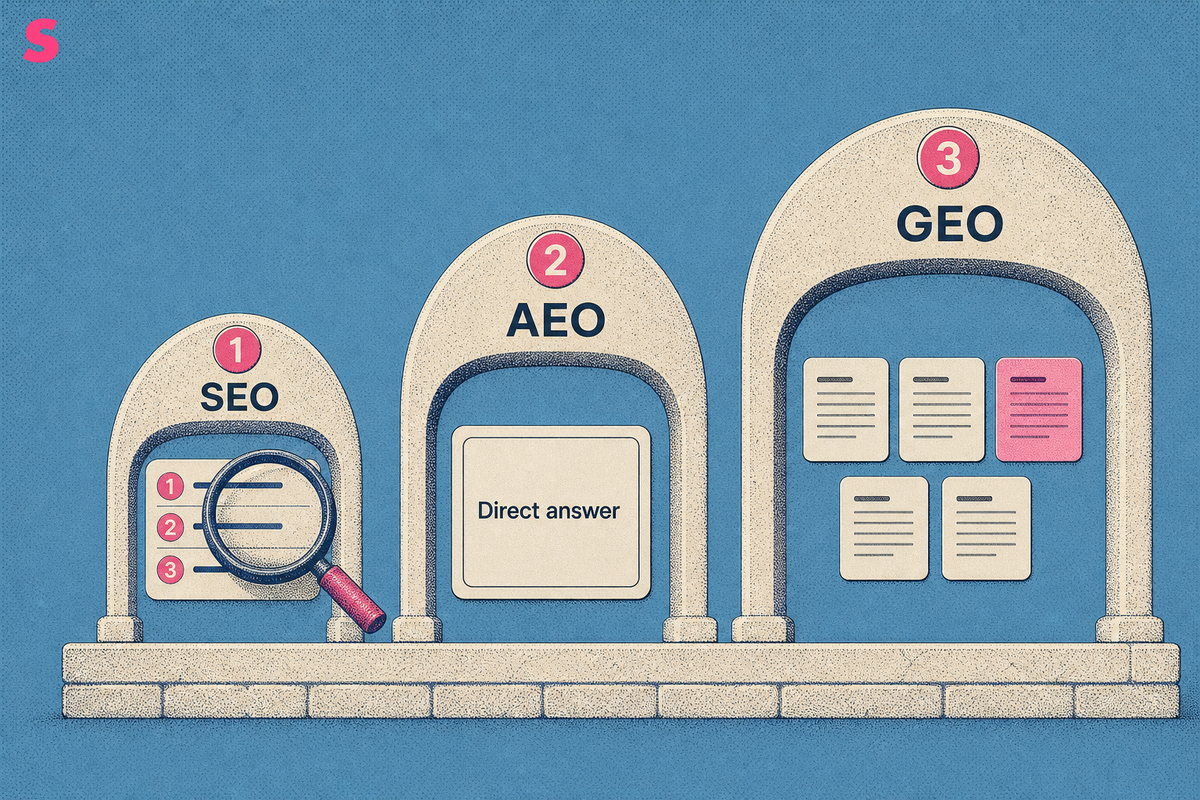
No. AEO and GEO build on SEO, but they optimize and measure different outcomes. SEO improves visibility in traditional search engines, while AEO and GEO extend that work into direct answers and generated responses.
SEO fundamentals still apply: crawlability, server-rendered HTML, canonical tags, semantic headings, useful content, and credible authority. A page an engine cannot access is unlikely to rank, answer a question, or become a cited source.
The difference appears after the crawl. SEO evaluates where a page appears in a result set and whether people click. AEO evaluates whether the page supplies the answer. GEO evaluates whether an AI system uses the page or brand as evidence in a synthesized response.
The practical model is additive: maintain SEO for classic discovery, use AEO to earn answer surfaces, and use GEO to understand source selection in AI answers. None of these disciplines replaces the others.
What makes a page readable and trustworthy to answer engines and generative engines?
A page is more usable to answer engines and generative engines when it is technically accessible, structurally clear, and supported by credible evidence. An engine must crawl and parse the page before it can select or cite the material.
A useful page begins with a direct answer, then develops the reasoning. For example, a software comparison page can define the category, explain evaluation criteria, provide a clear table, and state the limits of each choice. The engine can extract a concise answer while retaining evidence for a fuller response.
- Use descriptive headings: Headings should state the question or decision the section answers.
- Write complete definitions: Define the term before adding nuance or exceptions.
- Support claims: Include dated sources, methods, or concrete operating details.
- Maintain technical access: Check robots.txt, canonical tags, indexability, page performance, and JavaScript dependency.
- Refresh important pages: Reassess material when product facts, buyer questions, or category language change.
The Free AI Readiness Checker evaluates 35 checks across six categories and returns a 0–100 AI readiness score in about 30 seconds, per Sona product documentation. The score reflects a point in time. Teams still need recurring reviews and severity-ranked fixes for pages that need work.
What are the advantages of GEO for a B2B SaaS company?
GEO helps a B2B SaaS company measure and improve its representation when buyers ask AI systems for category education, vendor comparisons, and recommendations. Its advantage is visibility during source selection, before every buyer reaches a website.
A B2B buyer might ask an answer engine which attribution platforms support AI search, which vendors serve mid-market teams, or how account-level measurement differs from web analytics. GEO assesses whether the company appears in the response, whether its positioning is accurate, and which pages or third-party sources support that appearance.
Sona’s own AI visibility data from September 2026 covers eight answer surfaces: ChatGPT, Google AI Overviews, Perplexity, Google AI Mode, Gemini, Mistral, Qwen and Claude. That coverage shows why a single search ranking cannot represent the full answer-engine environment.
GEO also creates a feedback loop for content teams. A team can identify commercially relevant prompts, improve the source page, and observe whether its presence changes across a repeatable prompt list.
Should you prioritize AEO or GEO first?
Most B2B teams should start with AEO when core pages cannot answer buyer questions clearly, then expand into GEO when they need to measure citations, recommendations, and AI-referred demand. The workstreams overlap, but AEO establishes the page-level foundation.
Prioritization depends on the immediate operating problem. A company with weak product education needs direct, extractable answers. A company with strong category content but unexplained AI-referred traffic needs GEO measurement and attribution.
| Situation | Prioritize first | Initial work | Measurement rhythm |
|---|---|---|---|
| Core product pages do not answer buyer questions directly | AEO | Define key terms, improve headings, add direct explanations | Review page structure monthly |
| Brand appears inconsistently in AI recommendations | GEO | Track commercial prompts and assess citation context | Run the same prompt list daily |
| AI-referred visits appear as unattributed demand | GEO | Connect AI visits to accounts and commercial outcomes | Review pipeline impact quarterly |
| Search visibility is weak across every channel | SEO, then AEO and GEO | Fix crawlability, content coverage, and authority foundations | Audit technical health periodically |
A daily prompt list reveals changes that a weekly snapshot can obscure. Answers can shift after retrieval-index changes, model updates, or new competitor material. Repeated measurement separates sustained changes from short-lived variation.
Sona AI Visibility tracks AI answers and the crawler activity behind source access, while Sona Marketing Measurement provides the attribution foundation used to treat AI search as a channel alongside other acquisition sources.
What do AEO and GEO tools and services cost?
AEO and GEO costs range from low-cost monitoring plans to enterprise software and agency retainers. Public entry prices start below $100 per month for several monitoring products, while reported GEO agency retainers span $1,500 to $50,000 per month, per the October 2026 listing of reported ranges.
Most credible mid-market AEO and GEO retainers land between $2,000 and $10,000 per month, per the October 2026 listing of reported ranges. Project fees range from $5,000 to $50,000, per the same October 2026 listing. Buyers should verify scope, prompt volume, engine coverage, technical work, content production, and reporting before signing.
Public pricing and plan details below were reviewed as of October 2026. Cost per daily tracked prompt uses the published comparison figure where refresh cadence permits a comparable calculation.
| Tool | Starting price | Agency Plans? | # of Answer Engines Tracked | Answer Engines | # of Daily Tracked Prompts (entry plan) | Cost per Daily Tracked Prompt | Differentiation |
|---|---|---|---|---|---|---|---|
| Sona AI Visibility | From $75/month, billed annually | Yes | 11 | ChatGPT, Gemini, Google AI Mode, Google AI Overviews, Perplexity, Claude, DeepSeek, Grok, Copilot, Qwen, Mistral | 5,000 credits/month, about 56 prompts tracked daily across three engines | $0.45 per daily tracked prompt | Connects AI citations and prompts to pipeline and revenue on one account timeline |
| Otterly.ai | From $29/month | Yes | 4 | ChatGPT, Google AI Overviews, Perplexity, Microsoft Copilot | 15 prompts daily | $0.48 per daily tracked prompt | Focus: AI visibility monitoring across answer engines |
| Scrunch AI | From $250/month | Yes | 4 | ChatGPT, Perplexity, Google AI Overviews, Microsoft Copilot | 125 prompts, refresh frequency not stated | No refresh cadence published | Focus: AI search visibility and brand intelligence |
| PromptWatch | From $95/month | Yes | Not published | Not published | 50 prompts daily | $0.48 per daily tracked prompt | Focus: prompt and response monitoring across supported models |
Monitoring AI answers that mention a brand is only half the job. Teams also need to connect those mentions to accounts, pipeline, and revenue. Sona AI Visibility closes that loop with AI Attribution, which connects AI citations to accounts, pipeline, and closed-won revenue on one timeline.
What are the frequently asked questions about AEO and GEO?
What does GEO stand for in AI?
GEO stands for generative engine optimization. It means improving how often and how favorably AI systems such as ChatGPT, Gemini, Claude, Perplexity, and other answer engines cite or mention a brand. Some practitioners use GEO more broadly for AI-search optimization.
What does AEO stand for?
AEO stands for answer engine optimization. It structures content so it can be selected as the direct answer in featured snippets, People Also Ask, and Google AI Overviews. Some practitioners also use AEO as an umbrella term that includes GEO.
Is GEO replacing SEO?
No. GEO does not replace SEO. AEO and GEO depend on SEO foundations such as crawlable pages, clear structure, authoritative content, and technical accessibility. They extend visibility into AI answers rather than replacing classic search rankings.
Do AEO and GEO use the same content?
Largely, yes. Both depend on machine-readable content and credible authority. AEO work is mostly on-site, focused on direct answers and page structure. GEO relies more heavily on off-site signals, including third-party mentions, corroboration, and reputation.
Can the SEO tools I already use measure AEO and GEO?
Traditional SEO tools measure performance in classic search engines. AI citation tracking requires repeated prompt testing across answer engines because generated answers vary by prompt, model, retrieval context, and time. A daily prompt list provides a usable trend record.
How much do AEO and GEO agencies charge?
Per the October 2026 listing of reported ranges, GEO retainers run from $1,500 to $50,000 per month and project fees range from $5,000 to $50,000. Most mid-market AEO and GEO retainers land between $2,000 and $10,000 per month. Verify scope directly before signing.
Summarize this article with AI: ChatGPT · Claude · Perplexity · Google AI Mode
Last updated: October 2026