The strongest reported answer engine optimization success case so far involves a B2B SaaS client whose AI-referred trials rose from 575 to more than 3,500 per month within seven weeks, according to an April 2026 agency case study. The campaign also released 66 articles in its first month, meaning publishing volume cannot be separated from AEO. Sona AI Visibility links prompts and citations to pipeline and revenue, while tracking AI crawler and agent activity, evidence these case studies leave out. A credible result specifies its baseline and attribution rule.
What counts as an answer engine optimization success story?
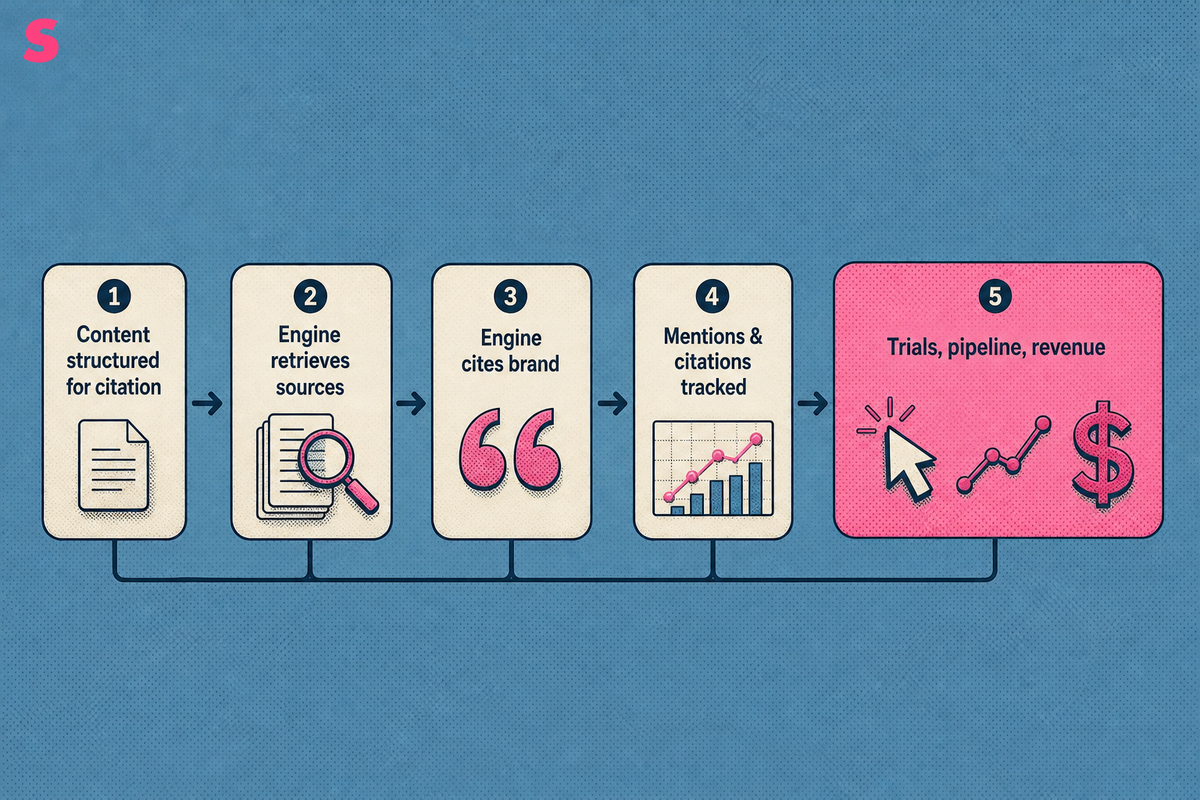
An answer engine optimization success story shows that content was structured for AI engines to quote, summarize, or cite, then connects that visibility to business results. It measures mentions and citations alongside clicks, rankings, trials, pipeline, or revenue.
Answer engines generally interpret a query, retrieve candidate sources from available indexes or other accessible sources, select relevant material, synthesize an answer, and choose citations or source references. Retrieval-backed answers can cite current sources, while model-generated responses may rely more heavily on learned patterns. Outputs can vary by engine, model, location, personalization, date, and retrieval context.
For a marketing leader, the question is whether AI search produces trials, pipeline, and revenue. An answer engine optimization success story is not a ranking gain or a traffic spike without AI attribution. Classic SEO and AEO both depend on useful content and technical access, but AEO measures whether answer engines use the brand in their responses.
Sona AI Visibility provides page-level insights, Agent Analytics, company-level visitor identification, and AI search attribution for teams measuring AI search activity.
What did the B2B SaaS case that took AI-referred trials from 575 to 3,500 report?
An April 2026 agency case study reported that an unnamed B2B SaaS client increased AI-referred trials from 575 to more than 3,500 per month over seven weeks. The reported sixfold increase lacks an identified client and raw analytics in the visible case-study excerpt.
The April 2026 case also reported a 600% citation uplift, a 63% brand citation rate for AI-awareness prompts, and a 36% citation rate for category prompts. Awareness prompts ask broader questions, while category prompts place a brand in a more competitive evaluation set.
The case links an AI-search measure, citations, with a business measure, trials. It shows association within one campaign, not proof that every trial resulted from a citation or that another company would reproduce the result.
Which tactics did the B2B SaaS case disclose?
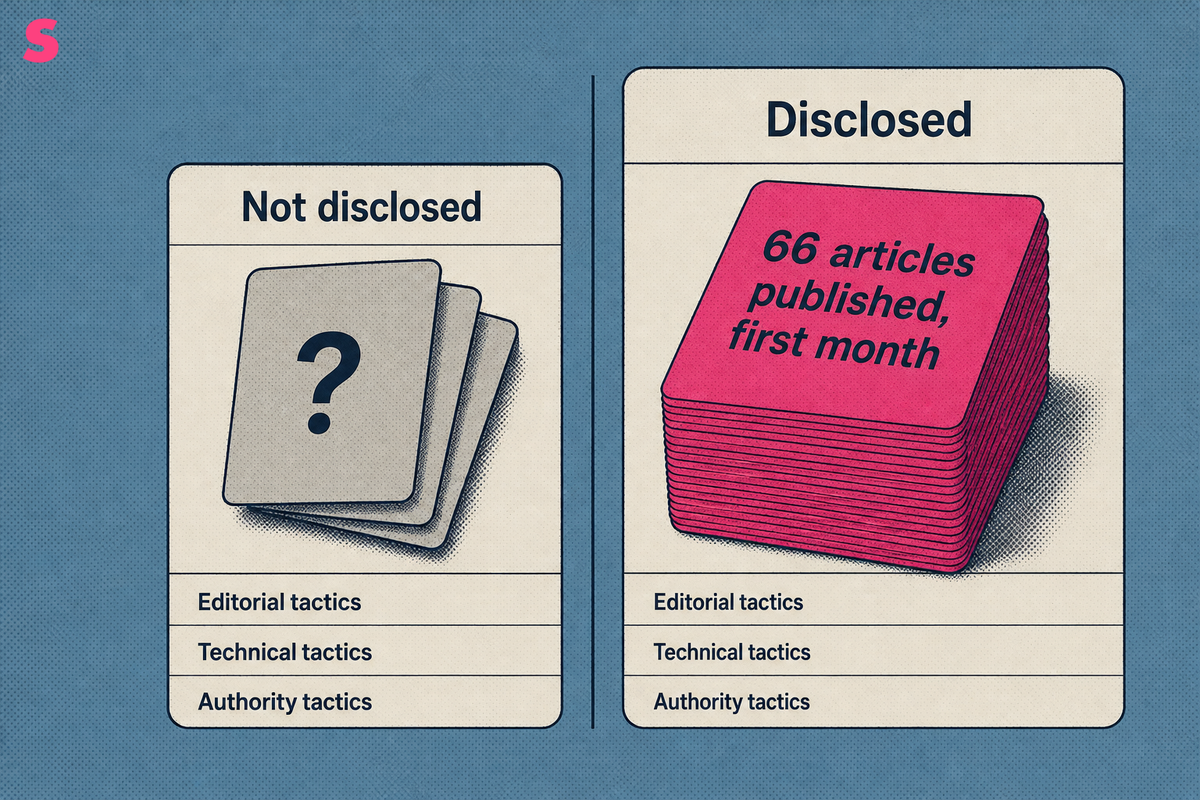
The disclosed tactic was publishing 66 AEO-optimized articles in the first month. The April 2026 case-study excerpt does not disclose detailed editorial, technical, or authority tactics.
Extractability lets an answer engine identify a direct, bounded explanation within a page. Semantic clarity establishes the subject, terms, relationships, and supporting evidence without forcing a model to infer the core answer. Authority signals help an engine assess whether an answer merits citation. These are general AEO practices, rather than verified features of the B2B SaaS campaign.
The April 2026 case-study excerpt does not itemize every technical, editorial, or authority tactic. It cannot support claims about schema implementation, link acquisition, crawler configuration, or editorial review rules. Sona AI Visibility provides page-level insights, but visibility reporting alone does not isolate the tactic behind a gain.
Did publishing 66 articles, rather than AEO, cause the result?
Publishing volume could have contributed substantially to the reported outcome. The campaign published 66 AEO-optimized articles in its first month, compared with the agency’s usual 8–10 monthly posts, according to the April 2026 case-study excerpt.
Publishing volume and AEO treatment cannot be separated without a control. More pages create more opportunities for discovery, traditional organic traffic, citations, and branded demand. Structured content and topical authority also overlap with conventional SEO work, so assigning every gain to AEO would overstate the evidence.
A team testing causality should create matched page groups, apply the AEO treatment to one group, preserve another as a control, and track the same prompt set daily. Daily measurement can reveal patterns that a weekly snapshot averages away. A change that holds for four days is more credible than a one-day spike.
How do the other reported AEO success stories compare?
Other reported AEO cases cover AI-search conversions, LLM-referred traffic, and revenue, but they disclose different metrics and timeframes. They offer directional evidence, not a standardized benchmark.
| Case | Metric | Timeframe | What the summary leaves undisclosed |
|---|---|---|---|
| SteelSeries | 3.2× growth in AI-search conversions, reported in March 2026 | Six months | Baseline conversion count, prompt sample, attribution rules, and control group |
| B2B fintech client | 52.6% organic-traffic growth and 17× conversion-rate improvement, reported in March 2026 | 12 months | AI-referred traffic share, conversion definition, and publishing volume |
| The Optimist B2B technology client | 4,900% revenue increase and 2,622% growth in LLM-referred traffic, reported in March 2026 | 14 months | Revenue baseline, deal attribution method, and non-AEO campaign effects |
| Siege Media Mentimeter case | 124,000 ChatGPT-referred sessions and 3,400 conversions, reported in March 2026 | One month | Prior-period comparison, conversion type, and prompt coverage |
These cases lack a common denominator. A conversion may mean a signup, lead, trial, purchase, or another event. Revenue growth may also reflect sales activity, product changes, paid media, and demand already in market. The most useful comparison is whether each case documents its baseline and attribution method.
How reliable are published AEO case studies, and what should they disclose?
Published AEO case studies can generate useful hypotheses, but they provide weak evidence when they omit baselines, attribution rules, and controls. AI answers vary by model, location, personalization, date, and retrieval context, so a single answer snapshot cannot establish durable visibility.
Sona's own AI visibility data, September 2026, covers eight answer surfaces: ChatGPT, Google AI Overviews, Perplexity, Google AI Mode, Gemini, Mistral, Qwen, and Claude. That range shows why a case study should identify the answer surfaces it measured rather than treating AI search as one uniform channel.
| Disclosure area | What a credible case should show | Why it changes interpretation | Missing disclosure risk |
|---|---|---|---|
| Baseline traffic | Starting sessions, trials, conversions, or revenue before work began | Shows the absolute scale behind percentage growth | Large percentages can begin from a small base |
| Attribution rules | How AI-referred sessions, self-reported discovery, and assisted conversions were credited | Clarifies whether AI influenced or directly sourced the result | Direct traffic can be misclassified |
| Prompt sample | The prompt set, engines, locations, and observation dates | Makes citation-rate claims reproducible | Selective prompts can inflate visibility |
| Control group | Comparable untreated pages, topics, or markets | Separates AEO effects from broader publishing | Causality remains untested |
| Publishing effects | Article count, update schedule, and related SEO work | Measures the contribution of content volume | Volume gets mistaken for optimization |
| Revenue quality | Pipeline stage, deal value, and closed-won treatment | Connects attention to commercial value | Low-value conversions look equivalent to revenue |
A credible result shows a dated baseline, fixed prompt sample, repeated measurement, and transparent attribution rule. It distinguishes cited visibility from referred sessions, and referred sessions from qualified pipeline.
How does AEO differ from traditional SEO, and where do they overlap?
AEO builds on SEO best practices, but prioritizes citation in AI answers while SEO prioritizes clicks and rankings in traditional search results. The disciplines overlap in technical accessibility, useful content, and authority, so a practical program should measure both.
| Area | AEO priority | Traditional SEO priority | Shared operating principle |
|---|---|---|---|
| Success measure | Mentions, citations, AI-referred sessions, trials, and revenue | Clicks, rankings, sessions, and conversions | Measure commercial outcomes, not visibility alone |
| Content design | Extractability and semantic clarity | Keyword targeting and search-intent alignment | Answer the audience’s question directly |
| Authority | Authority signals that support citation | Backlink volume and domain authority signals | Support claims with credible, relevant information |
| Link requirement | A reported need for three times fewer backlinks, per youtube.com | Backlinks remain a major ranking input | Authority still affects discoverability |
The practical boundary is measurement. Traditional SEO can produce content that answer engines cite, but an AEO program adds prompt-level citation and mention tracking. Sona AI Visibility provides page-level insights, Agent Analytics, company-level visitor identification, and AI search attribution for AI search measurement.
How do you measure AEO success and separate AI-referred traffic from organic?
Measure AEO with citation rate, AI-referred sessions, trials, pipeline, and revenue, then keep each measure distinct. Citation rate shows whether a brand appeared for a defined prompt set. Referred sessions show visits. Trials and pipeline show whether those visits produced commercial value.
A B2B SaaS team should start with ChatGPT, Perplexity, Gemini, and Google AI Overviews, then add Claude and other answer engines. The order should follow the sources of buyers’ referred visits. Google AI Overviews requires separate measurement because it is a Google search feature, while other answer engines produce their own AI answers.
Traffic volume can look small while commercial quality remains meaningful. Traffic from ChatGPT-style experiences converts up to nine times better than traditional search, per forbes.com. Teams should judge an AEO program on qualified trials and pipeline, not sessions alone.
Sona AI Visibility provides page-level insights, Agent Analytics, company-level visitor identification, and AI search attribution. Mention and competitor tracking is the baseline for AEO measurement.
Run the same prompt list daily and review commercial outcomes quarterly. A score is a dated snapshot, while repeated observations show whether citation movement persisted through retrieval changes, model updates, and competitor publishing.
What does an AEO implementation roadmap look like, week by week?
An AEO implementation roadmap should establish a baseline, complete content and structural work, then measure results against realistic case-study horizons. The seven-week, six-month, 12-month, and 14-month outcomes below are vendor-reported examples, not guaranteed results.
| Phase | Timing | Effort | What to check |
|---|---|---|---|
| Baseline and prompt set | Week 1 | Define priority categories, buyer stages, and a fixed prompt list | Citation rate, answer surfaces, referred sessions, and current trial volume |
| Content and structure work | Weeks 2–4 | Create or revise pages for extractability, authority signals, and semantic clarity | Whether priority pages answer the prompt directly and can be crawled |
| Early measurement | Weeks 5–7 | Run the same prompt list daily and inspect citation movement | Whether changes persist for several days and whether referred trials move |
| Program review | Month 6 | Review content coverage, citation trends, and conversion quality | Whether AI-search conversions resemble the reported six-month SteelSeries horizon from March 2026 |
| Commercial validation | Months 12–14 | Compare pipeline and revenue against the documented baseline | Whether longer-horizon effects resemble the reported March 2026 fintech and B2B technology cases |
Monitoring which AI answers mention a brand is only half the job. The other half evaluates whether AI-referred activity contributes to qualified commercial outcomes. Sona AI Visibility provides page-level insights, Agent Analytics, company-level visitor identification, and AI search attribution for that evaluation.
Technical reviews should run on a separate clock. Use a periodic page audit to inspect crawlability, server-rendered HTML, canonical tags, and content structure. The Free AI Readiness Checker provides a dated technical snapshot, while ongoing measurement shows how pages and prompts change over time.
What are the frequently asked questions about AEO?
How long does it take to see results from answer engine optimization?
Vendor-reported timelines range from seven weeks for the B2B SaaS trial case reported in April 2026 to six, 12, and 14 months for cases reported in March 2026. Timing depends on the starting baseline, publishing volume, prompt coverage, and whether the brand already has content that answer engines can cite.
Is AI-referred traffic big enough to justify a separate AEO program?
Volume is often smaller than traditional organic traffic, but traffic from ChatGPT-style experiences converts up to nine times better than traditional search, per forbes.com. Judge an AEO program on qualified trials, pipeline, and revenue rather than session volume alone.
Do published AEO case studies prove that AEO works?
Published cases show direction, not proof. Most do not expose raw analytics, control groups, full prompt samples, or audited attribution rules. Treat each result as a hypothesis to test against a fixed baseline and daily prompt-tracking log.
Can traditional SEO alone produce the same results as AEO?
Structured content, topical authority, and technical access help both SEO and AEO, so their effects are difficult to isolate. AEO adds citation and mention measurement to SEO, then evaluates whether those signals lead to AI-referred sessions, trials, and pipeline.
Which answer engines should a B2B SaaS company track first?
Start with ChatGPT, Perplexity, Gemini, and Google AI Overviews, then add Claude and other answer engines. Set the final order according to the sources of buyers’ referred visits, because a broad engine list is less useful than measurement aligned with the company’s buyer journey.
What is a good brand citation rate for AEO?
No universal benchmark exists. The B2B SaaS case reported in April 2026 showed a 63% brand citation rate for AI-awareness prompts and 36% for category prompts. The appropriate target depends on the prompt set, competitive intensity, buyer stage, and answer engines measured.
Summarize this article with AI: ChatGPT · Claude · Perplexity · Google AI Mode
Last updated: October 2026