AEO advertising aims to have a brand cited or recommended in AI-generated responses from ChatGPT, Perplexity, Gemini, Google AI Overviews, and other answer engines, with most visibility earned rather than bought. Unlike SEO, its objective is to become the answer instead of a blue link. Sona AI Visibility links those prompts and citations to pipeline and revenue, reveals AI crawler and agent activity, and evaluates results by deals, not mentions.
What is AEO advertising, in plain terms?
Answer engine optimization (AEO) improves how often and how accurately a business appears in AI-generated answers. AEO advertising is the commercial shorthand for the software, services, content, and technical changes used to earn that visibility.
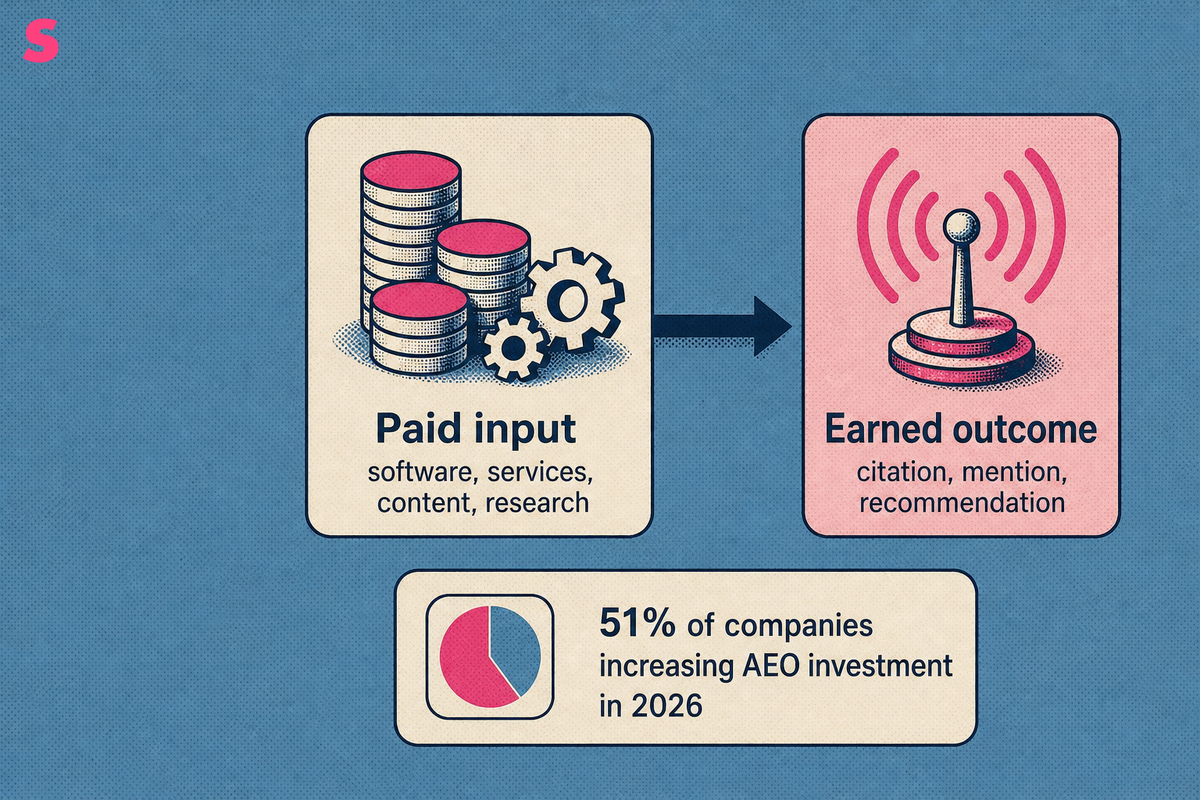
Marketing leaders need to know whether buyers researching a category can find, understand, and trust the company before visiting its website. A September 2026 report stated that 51% of companies planned to increase AEO investment during 2026.
AEO advertising is not paid search, display advertising, or a guaranteed placement in an answer engine. A company can pay for AEO work, but the engine decides whether to cite, recommend, or omit the company in a specific answer.
The term can also cover featured snippets, where a search engine selects a direct response from a page. The goal is to make a useful, technically accessible answer available to systems that select results independently.
Can a brand pay for placement in AI answers, or does it have to earn it?
A brand generally earns AI-answer visibility rather than buying a guaranteed slot. AEO advertising covers investment in research, technical improvements, content production, measurement software, and specialist services, while the answer engine controls the final output.
Organic visibility comes from publishing pages that address buyer questions clearly, establishing credible evidence, maintaining technical accessibility, and creating material an answer engine can retrieve. Measurement tools record citations, mentions, recommendations, source pages, and changes across a defined prompt set.
The paid elements are the operating costs around the work. A company can purchase software, hire an agency, commission expert content, or pay developers to improve rendered HTML and crawlability. None of those purchases guarantees that an engine will select the company for an answer.
Paid search differs because the advertiser buys access to an auction-controlled placement. Traditional advertising differs because the advertiser controls the creative and placement purchased from a publisher. With AEO, the brand optimises for an answer system beyond its control.
- Earned outcome: a citation, mention, recommendation, or selected passage.
- Paid input: software, services, content, research, and implementation.
- Controlled asset: the company’s site, evidence, technical configuration, and CRM process.
How does AEO advertising differ from SEO?
AEO advertising targets AI-generated answers and featured snippets, while SEO targets blue-link rankings. Both disciplines earn visibility from systems the brand does not control, so AEO builds on SEO rather than replacing established search work.
The practical difference is the unit of optimisation. SEO teams often work from keywords, rankings, clicks, and landing pages. AEO teams also work from full buyer prompts, selected passages, citations, answer composition, and whether AI-referred activity becomes measurable demand.
| Dimension | AEO | SEO | Shared operating principle |
|---|---|---|---|
| Primary goal | Appear in AI answers and featured snippets | Rank in blue-link results | Earn qualified discovery |
| Query shape | Conversational prompts with context, constraints, and comparisons | Keywords and shorter search queries | Match search intent |
| Content format | Direct answers, structured passages, evidence, and clear comparisons | Indexable pages targeting search demand | Publish useful, accessible content |
| Selection factors | Answer relevance, source accessibility, clarity, and trust signals | Relevance, crawlability, authority, and result-page competition | Make pages understandable to machines and readers |
| Tooling | Prompt tracking, citation monitoring, source analysis, and answer capture | Rank tracking, keyword research, crawling, and backlink analysis | Use repeatable measurement |
| Measurement | Prompt visibility, citations, referrals, leads, and revenue | Rankings, impressions, clicks, sessions, and conversions | Connect visibility to business outcomes |
SEO for AI is useful shorthand if it does not obscure the distinction. SEO supplies much of the technical and content foundation. AEO adds prompt-level citation measurement, source analysis, and attribution of buyer activity to pipeline.
How do answer engines decide which B2B SaaS brands to cite or recommend?
Answer engines interpret the buyer’s prompt, retrieve relevant material, and select passages that directly support the response. A B2B SaaS brand earns inclusion when its pages provide a clear, accessible, credible answer to the specific problem.
Consider a buyer asking which platform suits a SaaS team that needs to connect AI-search activity to pipeline. An engine can separate that request into AI-answer measurement, attribution, account identification, CRM reporting, and implementation requirements. It then retrieves pages that address those needs before constructing an answer.
- The engine interprets the buyer’s use case and constraints.
- The engine retrieves candidate pages and passages.
- The engine selects material that directly answers the prompt.
- The engine cites, recommends, or omits brands based on the assembled response.
A selectable passage often starts with a direct definition, uses a heading that matches the buyer’s question, and supports claims with named, dated evidence. Broad positioning gives the engine less material to select.
The same prompt can return different answers on different runs because retrieval indexes, models, pages, and competitor content change. Sona’s own AI visibility data, September 2026, covers 8 answer surfaces: ChatGPT, Google AI Overviews, Perplexity, Google AI Mode, Gemini, Mistral, Qwen and Claude.
What do AI engines check before they trust and cite a page?
AI engines need pages they can reach, render, interpret, and trust before those pages can support an answer. AEO advertising therefore includes technical readiness alongside content strategy, because a strong claim on an inaccessible page cannot become a dependable source.
Crawlability comes first. Answer engines and their crawlers need access through robots rules, canonical tags, server responses, and indexable URLs. A rendered page that depends heavily on client-side JavaScript can leave important content unavailable in crawler-retrieved HTML.
Trust signals also matter. Transport security and security headers support a credible web presence. Content structure, semantic headings, and schema markup help systems identify the question, answer, author, and supporting context. Content quality determines whether the copy earns a citation, including whether evidence is specific and current.
Accessibility strengthens the page for people and machines. Useful alt text, ARIA attributes, sufficient contrast, and explicit image dimensions reduce ambiguity in the rendered experience.
A technical checklist is not a universal strategy. AEO work must reflect the industry, competitor set, current digital presence, and business goals, because a category comparison page requires different proof from a technical implementation guide.
How do you implement AEO inside a CMS or development workflow?
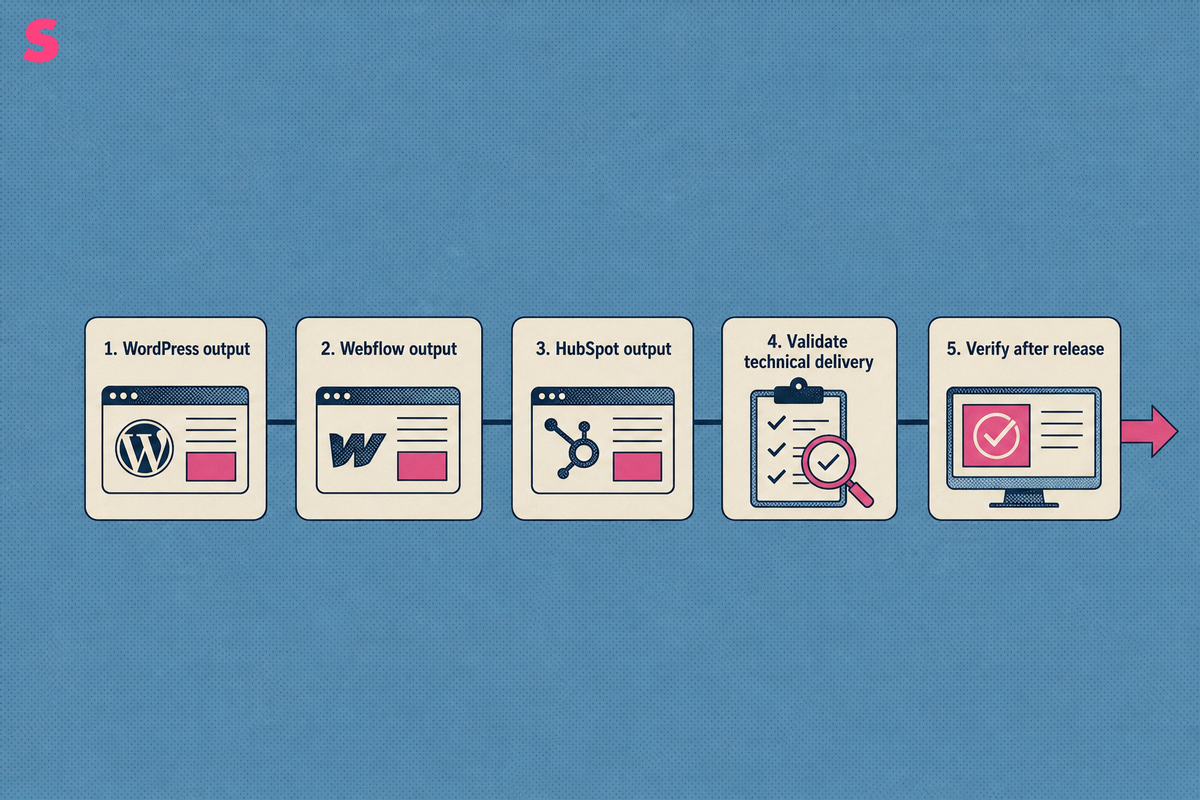
AEO implementation requires platform-specific publishing controls and a development workflow that verifies the delivered page rather than the editor preview. In every CMS, the essential answer must appear in rendered HTML, match visible content, and remain accessible to crawlers.
- Implement WordPress output. Identify the theme template, template part, or block responsible for the page. Place the direct answer and semantic headings in the block output, add schema in the approved theme or plugin location, inspect rendered source, then clear page cache and CDN cache before checking the published URL.
- Implement Webflow output. Map the answer, heading, and evidence to Collection-template fields and reusable components. Add custom schema in the project’s approved code placement, publish the Collection item, and inspect the rendered output rather than relying on Designer preview.
- Implement HubSpot output. Define the answer, heading, and evidence fields in the module or template. Confirm that HubL renders those fields into the published HTML, place schema in the template or page-head area, test in staging, then validate the live page after publication.
- Validate technical delivery. Create tickets that specify the buyer prompt, page location, required copy, markup, and crawler-access criteria. Use code review, rendered-HTML testing, schema validation, and crawler-access testing before deployment.
- Verify after release. Check server responses, robots rules, canonical tags, CDN controls, and firewall behavior after deployment. Confirm that the live URL contains the answer, headings, evidence, and markup that passed review.
- Refresh priority pages. Show a visible update date where editorially appropriate, then update evidence, product details, and dated claims on pages that support high-value prompts.
Run the same prompt list daily, but schedule full technical re-audits monthly or quarterly. Compare repeated, timestamped observations and treat persistent movement as more meaningful than an isolated result.
Which metrics show whether AEO advertising is working?
AEO advertising works when visibility progresses into measurable buyer activity, not when a dashboard reports mentions alone. The metric ladder starts with prompt visibility and ends with CRM opportunities and revenue, with each stage showing whether the previous stage produced commercial value.
- Prompt visibility: how often the brand appears for the fixed set of buyer prompts.
- Share of voice: the brand’s presence relative to other cited brands across those prompts.
- Citations and sentiment: which sources appear, what the answer says, and whether the brand is framed appropriately.
- Referral traffic and leads: whether answer-driven visits produce identifiable conversions.
- CRM opportunities and revenue: whether those conversions progress into qualified pipeline and closed business.
AI answers are unstable, but that variation is measurable. Use a fixed prompt set, repeated observations, timestamps, and a transparent scoring rule. A score is a dated snapshot. A series of comparable results distinguishes lasting movement from answer variation.
A single brand-level visibility number does not identify which prompts and sources produced the result, and a citation can produce no click, qualified lead, or revenue. A prompt-level view shows where the brand appeared, which source was cited, and which question needs a stronger page. Sona AI Visibility uses AI Attribution to connect prompt and citation evidence to accounts, pipeline, and closed-won revenue on one account timeline.
What should you check before trusting an AEO tracking tool's engine coverage?
An AEO tracking tool’s claim to track all engines requires scrutiny because coverage can vary by plan, prompt allowance, refresh cadence, and collection method. A useful evaluation starts with the named answer engines and ends with whether the tool connects visibility to commercial outcomes.
- Named engines: confirm whether ChatGPT, Perplexity, Gemini, Google AI Overviews, and other answer engines are included on the plan under review.
- Prompt capacity: check how many prompts run at the entry tier and whether limits apply across engines or per engine.
- Refresh cadence: verify whether the prompt set runs daily, weekly, or on another schedule.
- Answer capture: establish whether the tool records citations, cited sources, competitors, answer text, and historical changes.
- Measurement depth: check whether referrals, conversions, CRM opportunities, and revenue can be connected to answer visibility.
Different collection methods can produce different outputs. Some tools capture answers as a person sees them on screen. Others pull answers from an AI vendor’s API, which can return a different result.
Pricing varies widely. techradar.com, published July 30, 2026 and updated October 19, 2026, reported published prices ranging from about $29 per month for lightweight monitors to more than $2,000 per month for enterprise platforms. Price alone does not establish engine coverage, prompt capacity, or attribution depth.
How does Sona AI Visibility connect AI citations to pipeline and revenue?
Sona AI Visibility connects prompts and citations to pipeline and revenue on one account timeline, rather than stopping at mention counts. The product treats AI search as a measurable source of buyer activity, evaluating citations, visits, account activity, deals, and revenue together.
Mention and competitor tracking remain the category baseline. Sona AI Visibility uses AI Attribution to connect AI-referred visits to account-level activity, pipeline, and closed-won revenue.
What are the frequently asked questions about AEO advertising?
Is AEO advertising the same as running paid ads inside ChatGPT?
No. AEO advertising mostly means earning citations and recommendations in AI-generated answers through content, technical readiness, and measurement. It does not mean buying a guaranteed placement because answer engines control which sources and brands appear in each response.
Does AEO replace SEO?
No. AEO is often described as SEO for AI. SEO targets blue-link rankings, while AEO targets AI answers and featured snippets. Both disciplines earn visibility in systems the brand does not control and rely on accessible, useful, credible pages.
Why does the same prompt give different answers each time?
AI answers vary because retrieval indexes, models, source material, and competing content change. Measure that variation with repeated observations, a fixed prompt set, timestamped results, and a clear scoring rule. Daily prompt tracking exposes patterns that a weekly snapshot can obscure.
Does an AI citation or mention lead to pipeline?
Not automatically. A mention can create no click, lead, opportunity, or revenue. Measure citations alongside referral traffic, conversions, CRM opportunities, and closed-won revenue to determine whether answer visibility produced commercial value.
What does tracks all engines actually mean in an AEO tool?
The phrase can hide paid add-ons, limited engine access, low prompt caps, or different tracking methods across ChatGPT, Perplexity, Gemini, Google AI Overviews, and other answer engines. Check which engines each plan includes, how many prompts it runs, and how frequently it repeats them.
What proof should I ask an AEO agency to show?
Ask for dated screenshots showing visibility in named AI engines, including ChatGPT, Gemini, Perplexity, Google AI Overviews, and other answer engines. Ask the agency to show the prompt set, citation evidence, source pages, measurement period, and how reported visibility connects to leads, opportunities, or revenue.
Summarize this article with AI: ChatGPT · Claude · Perplexity · Google AI Mode
Last updated: October 2026