Generative engine optimization (GEO) became a named discipline on 16 November 2023, when Pranjal Aggarwal and fellow authors uploaded GEO: Generative Engine Optimization to arXiv. A presentation at KDD 2024 conferred academic legitimacy, while the growth of synthesized AI answers created practical urgency. Many prominent lift statistics originate in vendor summaries and should be treated as reported outcomes. Sona AI Visibility links the prompts and citations driving that visibility with pipeline and revenue.
When was the term generative engine optimization first used, and by whom?

Generative engine optimization (GEO) is the practice of improving a page’s chance of inclusion or citation in an AI-generated answer. The earliest documented use of the term appears in GEO: Generative Engine Optimization, first posted to arXiv on 16 November 2023.
Pranjal Aggarwal and co-authors introduced Generative Engine Optimization in that November 2023 research paper. The paper named a visibility problem that conventional SEO did not fully describe: inclusion in synthesized responses from generative engines.
The question when did GEO generative engine optimization emerge has two answers. The term entered the documented research record on 16 November 2023. GEO became a marketing discipline during 2024 through 2026 as AI answers became a practical channel for acquisition and brand discovery.
What did the original GEO paper define, and how did it differ from conventional search?
The original GEO paper defined a shift from optimizing for ranked links to optimizing for visibility in generative-engine responses. Princeton’s research record describes GEO as a move from traditional search rankings toward visibility in generated responses.
Conventional SEO asks whether a page can rank for a query and earn a click. GEO asks whether an answer engine can retrieve, interpret, trust, and incorporate that page into a synthesized answer. The target is inclusion, citation, or a brand mention within the response.
A buyer searching for a B2B analytics platform illustrates the distinction. In conventional search, a marketer seeks a strong position for a commercial keyword. In GEO, the marketer creates a credible source page that supports an answer comparing measurement methods, attribution requirements, and implementation questions.
- SEO output: a ranked result and potential click.
- GEO output: a citation, reference, mention, or source contribution inside an AI answer.
- Shared foundations: relevance, authority, technical accessibility, and useful page structure.
What is the documented timeline of GEO from the first paper to today?
GEO emerged as a named research concept in November 2023, gained formal academic standing in 2024, and gained traction as an emerging digital-marketing discipline during 2025 and 2026. The timeline follows the growth of answer engines and the need to measure visibility beyond traditional rankings.
| Date | Event | Documented evidence | What changed for marketers |
|---|---|---|---|
| 16 November 2023 | GEO enters the research record | GEO: Generative Engine Optimization was first posted to arXiv, per the 16 November 2023 listing. | Generative-answer visibility received a distinct name. |
| 2024 | Formal conference publication | The original GEO paper was presented at ACM SIGKDD, per agentswelcome.dev, 17 June 2026. | GEO gained an academic foundation beyond practitioner terminology. |
| August 2024 | Early marketing treatment | An industry GEO article was originally published in August 2024 and refreshed in February 2026, per an October 2026 listing. | Practitioners had a documented marketing publication discussing GEO. |
| 2025 | Google AI Overviews expand | Google AI Overviews appeared on roughly 13–16% of U.S. desktop searches during 2025, compared with 6.49% in January 2025, per the January 2025 listing. | Search visibility increasingly included answer surfaces, not only link rankings. |
| 2026 | Answer engines become a large discovery surface | Google AI Overviews reportedly served more than 2 billion monthly users in 2026, per the 5 July 2026 listing. | Marketing teams needed repeatable measurement for citations and AI-referred visits. |
The timeline does not mean SEO ended. It means SEO gained another output to measure. Sona AI Visibility connects citations to pipeline and revenue on one account timeline while tracking which AI crawlers reach pages, allowing teams to assess commercial outcomes from AI visibility.
Sona's own AI visibility data, September 2026 covers 8 answer surfaces: ChatGPT, Google AI Overviews, Perplexity, Google AI Mode, Gemini, Mistral, Qwen and Claude. That coverage reflects a practical GEO requirement: answer visibility is distributed across interfaces with different retrieval and synthesis behavior.
Why did synthesized AI answers force a new kind of optimization?
Synthesized AI answers require a new kind of optimization because the engine selects and combines sources before the user sees a response. A page can help an answer engine without ranking near the top of conventional results, while a high-ranking page can fail to supply a citable answer.
Google AI Overviews reportedly appeared on 30% of Google searches by October 2026, per the October 2026 listing. ChatGPT reportedly reached 900 million weekly active users in February 2026, per the February 2026 listing. Those figures explain why answer inclusion became a demand generation, content, and marketing operations concern. Sona AI Visibility connects AI citations and AI-referred visits to pipeline and revenue on an account timeline.
GEO is not simply publishing more pages or adding AI language to existing SEO work. It requires a page to answer a specific question with evidence an answer engine can retrieve and represent accurately. A comparison page, for example, needs clear criteria, supported claims, and direct explanations rather than broad category language.
- Identify the buyer question behind a topic.
- Build a page that answers the question directly.
- Support material claims with attributable evidence.
- Make the page accessible to crawlers and parsable in HTML.
- Track whether answer engines cite the page over time.
How does GEO relate to answer engine optimization, AI search optimization and LLM optimization?
GEO, answer engine optimization (AEO), AI search optimization, and LLM optimization overlap, but each emphasizes a different part of the same operational problem. GEO comes from the 2023 research term and centers on visibility within generative-engine responses.
| Term | Primary focus | Typical success signal | Boundary |
|---|---|---|---|
| GEO | Visibility in generated answers | Citations, mentions, and source inclusion | Derived from research on generative engines. |
| AEO | Being selected as the answer | Answer inclusion and answer quality | Broader practitioner term for answer-oriented optimization. |
| AI search optimization | Discovery through AI-assisted search experiences | AI-referred visits and answer visibility | Often includes Google AI Overviews and other answer engines. |
| LLM optimization | How large language models retrieve and represent information | Accurate representation in model outputs | Can include model behavior beyond search and retrieval. |
No settled industry standard assigns a rigid technical boundary to each label. In practice, AEO often serves as the wider business label, while GEO describes optimization for generated responses. AI search optimization is useful when work includes referrals, search interfaces, and answer engines such as ChatGPT, Perplexity, Gemini, Claude, and other answer engines. Sona AI Visibility connects the resulting citations and referrals to pipeline and revenue.
The labels do not remove the measurement requirement. A team can call the work GEO or AEO, but it still needs to know which buyer prompts produce citations, which cited pages receive AI-referred visits, and whether those visits progress through a buying journey.
What evidence shows that citations, statistics and quotations improve AI visibility?
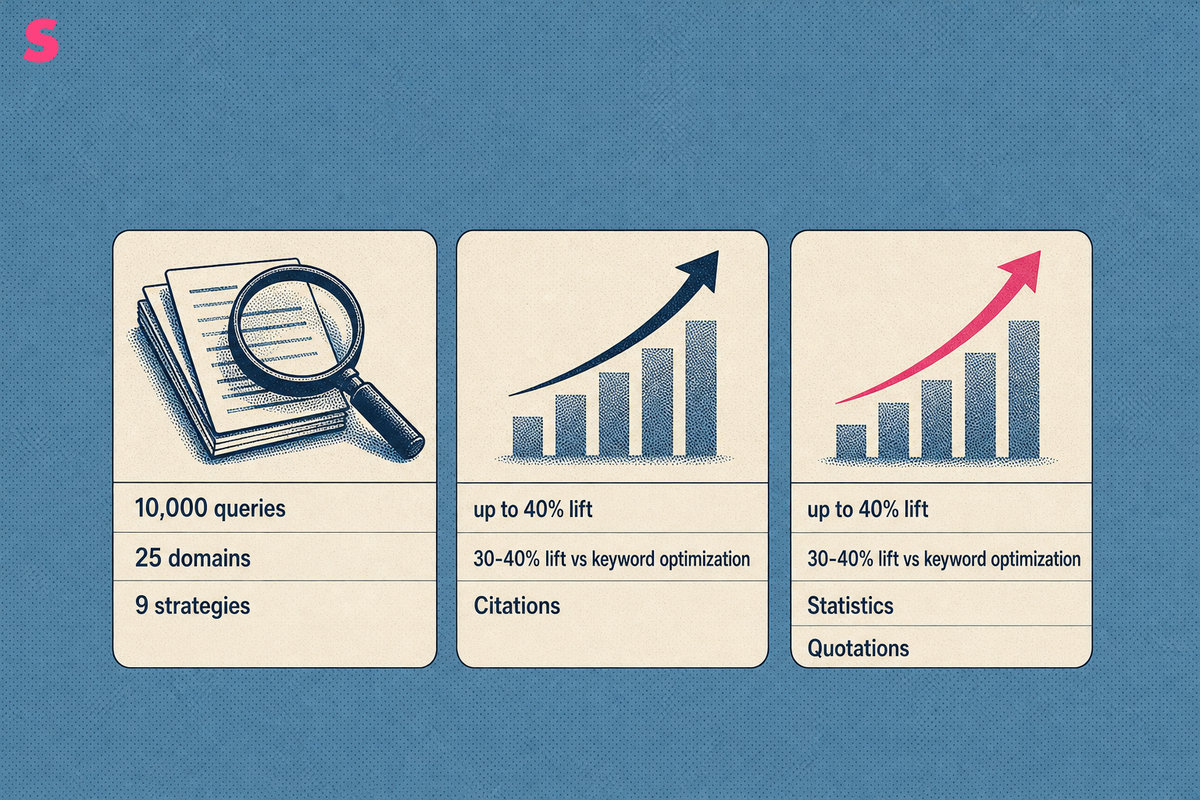
The original GEO research tested nine content-optimization strategies across 10,000 queries and 25 domains. The 25-domain coverage and nine strategies appear in thegeocommunity.com, 24 April 2026, while the 10,000-query evaluation appears in a 3 September 2026 listing.
Later summaries report that some strategies improved generative visibility by up to 40%, per a 28 September 2025 Wikipedia entry. A separate 2026 industry summary reported a 30–40% lift from citations, statistics, and quotations compared with keyword optimization, per the 5 July 2026 listing. These findings are not universal benchmarks for every site, engine, topic, or prompt set.
The mechanism is direct. A citation gives an answer engine a traceable source. A statistic makes a claim more specific. A relevant quotation preserves an attributable expert position. Together, these elements reduce ambiguity when an engine selects sources for a synthesized statement.
Sona AI Visibility helps teams observe where a brand is cited and connect those citations to commercial outcomes. The useful workflow is to add evidence where a buyer needs proof: pricing pages, implementation guides, comparison pages, research summaries, and technical documentation.
What makes a page findable and citable by a generative engine?
A page becomes findable and citable when crawlers can access it, the HTML exposes its meaning clearly, and the content answers a specific question with supportable detail. GEO requires technical accessibility and editorial usefulness.
Start with crawlability. Robots.txt rules, canonical tags, indexability, server-rendered HTML, performance, and security headers affect whether a crawler can reach and process a page. Sona product documentation describes checks for crawler access, robots.txt restrictions, firewall blocks, indexability, and page structure.
Then make the page citation-ready. Use descriptive headings, direct answers near the top, factual definitions, named entities, structured data where appropriate, and evidence adjacent to the claim it supports. A page about attribution should explain the attribution model, the relevant buyer question, and the operational implication without forcing an engine to infer missing context.
- Publish one primary answer per page.
- Use headings that match real buyer questions.
- Place evidence beside the supported statement.
- Keep facts current and identify their source date.
- Review technical findings periodically, separate from daily prompt tracking.
Sona product documentation describes tests for crawler access, including blocks created by robots.txt or a web application firewall. Crawl access does not guarantee a citation, but a page that cannot be retrieved cannot contribute evidence to a live answer.
Does being cited in an AI answer lead to pipeline and revenue?
Being cited in an AI answer can contribute to pipeline and revenue, but a citation alone does not prove causation. A citation is a visibility event. Revenue attribution requires a connection between answer exposure, subsequent account activity, and the commercial record.
A practical measurement model follows the path from prompt to page, then from referral to account, opportunity, and closed-won revenue. Self-reported attribution can also capture research that produced no measurable click, including a buyer who learned about a vendor in an AI answer before later visiting directly.
Sona AI Visibility provides AI Attribution, which connects AI citations to accounts, pipeline, and closed-won revenue on one timeline. That connection matters because a marketing leader cannot allocate budget from mention counts alone.
Run the same prompt list daily. Daily measurement can reveal changes that a weekly snapshot obscures because retrieval indexes, model updates, and competitor publishing can change an answer from one day to the next. A sustained change carries more weight than a one-day spike.
Where is generative engine optimization heading for B2B digital marketing?
GEO is an emerging B2B marketing discipline gaining traction during 2025 and 2026, per the October 2026 listing. It combines technical readiness, evidence-backed content, prompt measurement, and revenue attribution. It does not replace SEO. It broadens how teams measure buyer discovery, evaluation, and vendor shortlisting.
Teams will operate on two clocks. They will track high-value prompts daily to distinguish sustained changes from answer volatility, then review positioning, competitive coverage, and full technical audits monthly or quarterly. The output is a dated record, because comparable snapshots reveal sustained movement.
Monitoring which AI answers mention a brand is only half the job. The other half is connecting those mentions to accounts, pipeline, and revenue. Sona AI Visibility closes that loop by linking AI citations and AI-referred visits to commercial outcomes on an account timeline.
GEO will also make content operations more selective. The priority will be pages that answer commercial questions with accessible structure and credible evidence, rather than a larger inventory of loosely related keyword pages. That shifts content planning closer to product marketing and revenue operations.
What are the frequently asked questions?
Who first used the term generative engine optimization?
Pranjal Aggarwal and co-authors introduced the term in the paper GEO: Generative Engine Optimization, first posted to arXiv on 16 November 2023. That is the earliest documented use identified in the available sources. A Wikipedia entry also describes the November 2023 paper as the formal introduction of the term.
Where was the original GEO paper presented?
The original GEO paper was presented at the ACM SIGKDD conference, also called KDD 2024, per agentswelcome.dev, 17 June 2026. The ACM Digital Library lists 406 citations for the research paper. Conference publication gave GEO a formal academic foundation and a practitioner audience.
Is GEO just rebranded SEO?
GEO overlaps with SEO, but it is not identical. Authority, relevance, technical structure, and useful content still matter. GEO targets inclusion and citation within synthesized answers, while SEO traditionally targets visibility and clicks from ranked search results.
How is GEO different from answer engine optimization?
The terms overlap heavily. GEO comes from 2023 research and centers on generative-engine responses. AEO is the wider practice label for being selected as the answer. Marketers use both terms for related work, and no settled standard assigns a strict boundary between them.
How much can GEO improve visibility in AI answers?
The original research has been summarized as finding gains of up to 40% for some strategies, per a 28 September 2025 Wikipedia entry. A 2026 industry summary reported a 30–40% lift for citations, statistics, and quotations versus keyword optimization, per the 5 July 2026 listing. Those results depend on the tested prompts, content, and engines.
Can the market statistics about AI search adoption be trusted?
Market statistics require qualification. Vendor-reported figures use different samples, definitions, and measurement windows, so they should not be combined into one adoption number. Date each figure, identify what it measures, and distinguish reported user counts from observed search-surface prevalence.
Summarize this article with AI: ChatGPT · Claude · Perplexity · Google AI Mode
Last updated: October 2026