LLM SEO is the practice of making a website and its content easy for large language models to retrieve, understand and cite, so a brand is mentioned or recommended in AI-generated answers. It builds on crawlability, structure and authority, then adds outcomes to measure: mentions, citations and recommendation rank. Test with a fixed prompt set across several engines. Sona AI Visibility connects prompts and citations to pipeline and revenue, and tracks the AI crawler activity at the front of that path.
What is LLM SEO and what outcomes does it aim for?
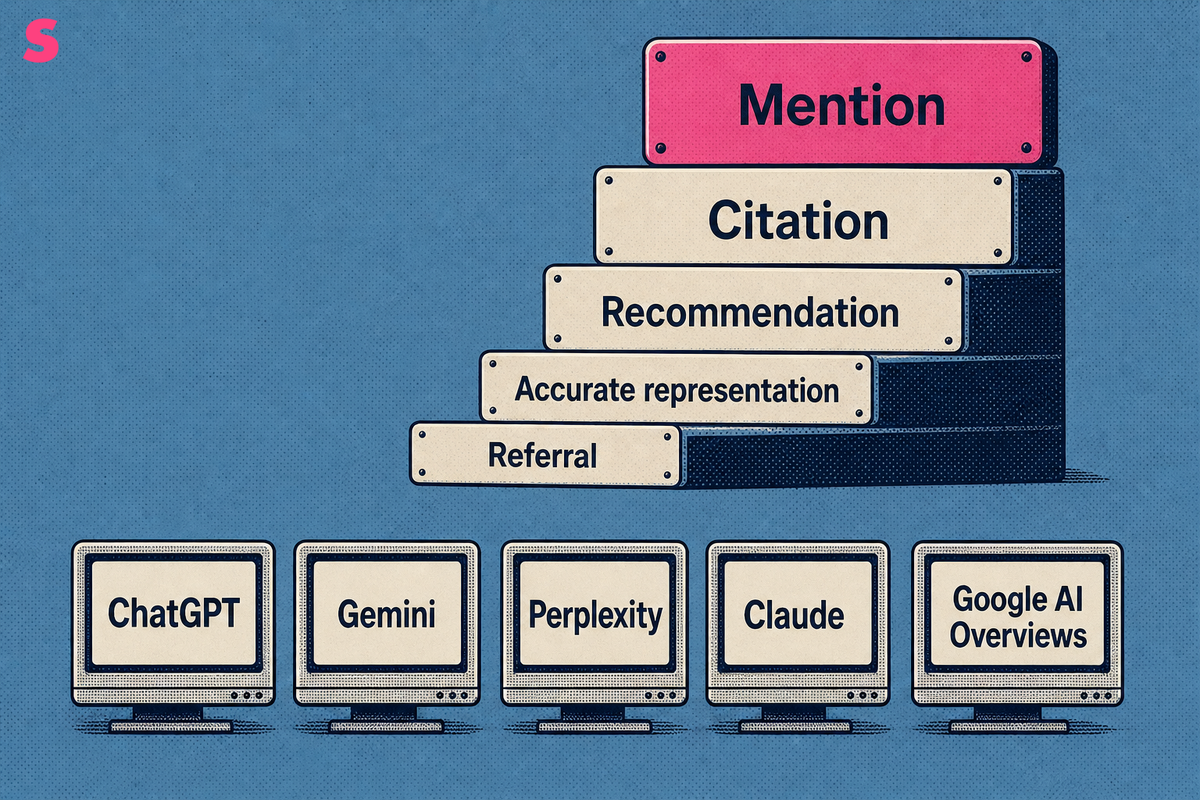
LLM SEO is the practice of making a brand's website and content retrievable, quotable and accurately described in answers produced by AI answer systems that run on large language models. ChatGPT, Gemini, Perplexity, Claude and Google AI Overviews are examples of those systems. The goal is inclusion in the answer itself, not only a ranked link.
It matters because buyers now ask an AI engine for a shortlist before they open a results page. If the prompt is "what is the best attribution software for B2B?", the vendors named in the answer get considered. The rest are invisible, and no keyword report shows it.
LLM SEO aims for five outcomes, in rising order of value:
- Mention: the brand name appears in the answer.
- Citation: the answer names one of the brand's pages as a source.
- Recommendation: the brand is offered as a fit for the buyer's stated need.
- Accurate representation: pricing, category and capabilities are described correctly.
- Referral: the answer sends a visit that can be traced.
Sona AI Visibility connects those citations to pipeline and revenue on one account timeline, and tracks which AI crawlers reach your pages. A mention becomes something you can measure, not just a number to report.
How is LLM SEO different from traditional SEO, AEO and GEO?
LLM SEO extends traditional SEO rather than replacing it. Traditional SEO competes for ranked links and clicks. LLM SEO competes for inclusion inside a generated answer, where the user may never click. AEO and GEO are overlapping labels for the same goal.
- Traditional SEO: targets a ranking position on a results page; the metrics are rank, impressions and clicks.
- LLM SEO: targets a mention, citation or recommendation inside a language model's answer; the metrics are visibility, share of voice and cited sources.
- Answer engine optimization (AEO): targets being the answer an answer engine returns.
- Generative engine optimization (GEO): targets visibility in the responses of generative engines.
The foundations are shared. Crawlability, topical relevance and authority still decide whether a page enters the candidate set the engine retrieves. What changes is the output being measured. A page can rank on the first results page and be absent from a ChatGPT answer, and the reverse also happens.
In practice, treat the three terms as one workstream with three vocabularies, and pick the label your stakeholders search for.
How do AI systems choose which brands to mention, recommend or cite?
AI systems draw on two sources: what the model absorbed during training, and what it retrieves from live pages when it answers. A brand appears when the web describes it consistently and its pages are among those an engine fetches for that prompt.
Retrieval works on a question, not a keyword. An engine expands one prompt into many related queries, a pattern called query fanout, then reads the pages those queries return. A page that answers only the literal phrasing of the prompt misses the variations.
Four factors move the odds that a retrieved page gets cited:
- Access: the engine's crawler can fetch the page.
- Clarity: the page states the answer, definition or figure in extractable form.
- Corroboration: independent sources describe the brand the same way.
- Freshness: engines with web retrieval weight recency, so a stale page loses to a newer source on the same topic.
Engines differ, which is why single-engine checks mislead. Sona's own AI visibility data, September 2026, covers eight answer surfaces: ChatGPT, Google AI Overviews, Perplexity, Google AI Mode, Gemini, Mistral, Qwen and Claude. A brand strong on one surface can be absent on another.
How do you make a website discoverable and readable by AI crawlers?
Allow the right AI crawlers, confirm nothing upstream blocks them, and serve content as server-rendered HTML that a bot can parse without running JavaScript. Crawl access comes first in the chain: if a bot never reaches a page, there is no citation, no visit and no revenue.
- Sort agents by documented purpose. Training crawlers such as GPTBot, ClaudeBot and CCBot collect content for model development. Search and retrieval crawlers such as OAI-SearchBot and PerplexityBot index pages so an engine can surface them in answers. User-triggered agents such as ChatGPT-User fetch a page only when a person asks. Google-Extended is not a bot; it is a robots.txt control token that tells Google whether its crawled content may be used for its generative models.
- Set robots.txt per category. Search, retrieval and user-triggered agents decide whether a brand can be cited today; training crawlers and the Google-Extended token decide whether a model learns the brand later. Many sites block one category and not the other by accident.
- Check upstream blocks. A WAF that returns 403 or rate-limits can lock out a bot that robots.txt allows.
- Check rendering. Server-rendered HTML removes the JavaScript dependency for content you want quoted.
- Confirm canonical tags and indexability on every page you want cited.
The Sona AI Crawl Checker tests whether AI crawlers can reach a URL. It returns pass or fail per bot, gives the reason each blocked bot fails, and supplies a copy-paste fix for the CDN or firewall. Sona Agent Analytics then shows which AI bots actually crawl the site, read from server logs or a lightweight edge worker with no JavaScript tag, so ad blockers cannot hide the traffic.
Which content, entity and schema signals help a brand appear in AI answers?
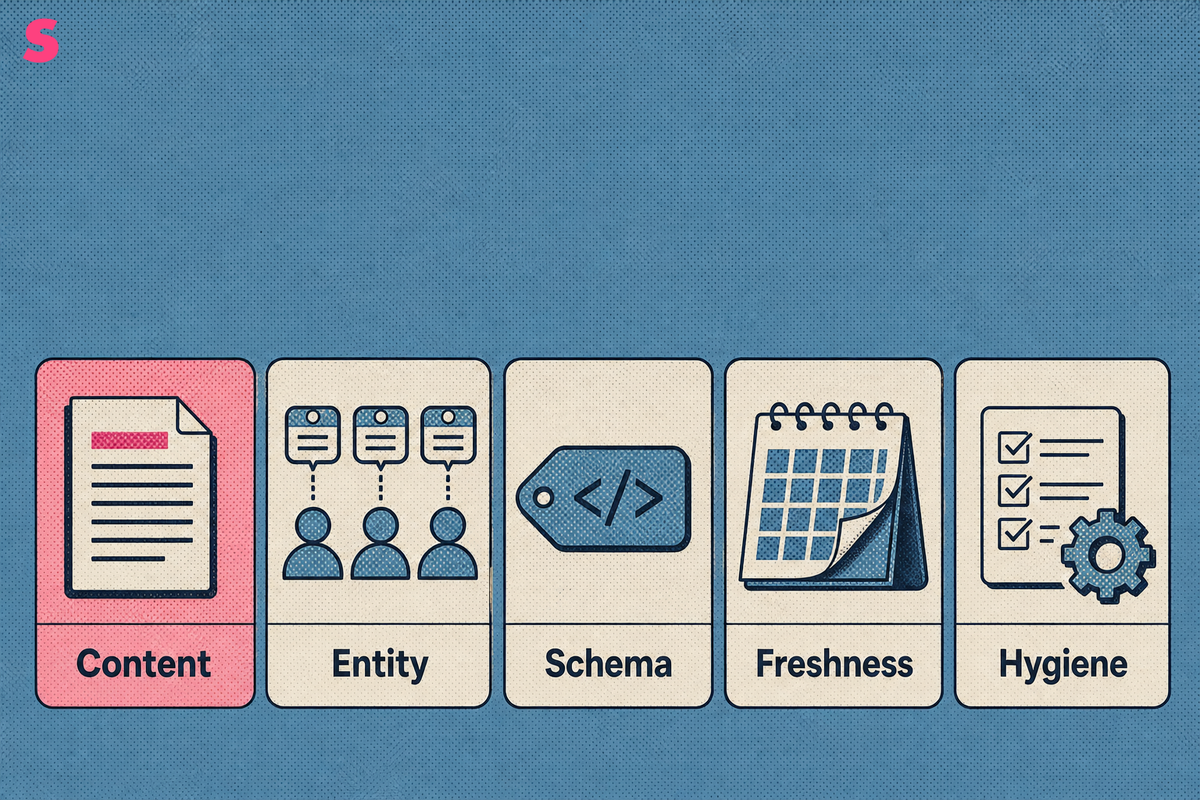
Pages that state the answer first, name the brand and its category consistently, carry valid Schema.org markup including FAQPage JSON-LD, and show a recent update are easiest for an engine to parse and quote. Each signal lowers the effort of extracting a correct answer.
- Content: lead each section with the direct answer, include definitions, and attach every figure to a named source and date.
- Entity: use the same brand name, category label and product names on every page and profile, so an engine resolves them to one entity.
- Schema: cover and validate Schema.org markup. FAQPage JSON-LD lets an engine extract question and answer pairs directly.
- Freshness: update pages on moving topics. A crawlable, well-marked-up page can still lose a citation when it has gone stale.
- Hygiene: metadata, semantic headings, alt text, explicit image width and height, and security response headers.
The Free AI Readiness Checker audits a page across crawlability, performance, security, content structure, content quality and accessibility. It returns a score with a letter grade. The score shows whether engines can technically crawl and parse a page; it does not show whether the brand appears in answers. Treat it as a dated snapshot, and rerun the audit to confirm fixes landed.
How should a B2B SaaS company build an LLM SEO workflow?
Build it as a loop: choose intent-based prompts, baseline competitors on them, find the sources that cite rivals but not you, ship the fixes, then rerun the same prompts daily. Each step produces the list the next step consumes.
- Write the prompt set. Turn commercial keywords into buyer questions. Tag each with intent and buying stage so decision-stage prompts outrank awareness-stage ones.
- Baseline competitors. Run the set across engines and record who is mentioned, in what position, and with which sources.
- Run a citation-gap analysis. List the sources cited for competitors on prompts where you are absent.
- Ship the fixes. Publish a page, correct a source, or pursue an inclusion.
- Rerun daily. Review the benchmark quarterly.
Take an attribution vendor whose prompt "best attribution software for B2B" cites an analyst roundup and a comparison post, naming two rivals but not the vendor. The gap list has two entries: get included in the roundup, and publish a page that answers the prompt directly. Both are work items.
A single visibility score for the brand is not a work item; a prompt-level view is. Sona AI Visibility shows, page by page, the prompts a site should appear in but does not, with intent and buying stage on each tracked prompt row.
Which metrics show whether LLM SEO is working?
Track visibility rate, share of voice, cited sources and AI crawler visits as leading metrics, and AI-referred visits, branded search, assisted conversions and pipeline as outcomes. A visibility score is a dated snapshot; a comparable series over time shows the trend.
- Visibility: the share of answers on a fixed prompt set that mention the brand, and its position.
- Share of voice: the brand's mentions against competitors on the same prompts.
- Sources: which domains engines cite, and how often.
- Outcomes: AI-referred visits, branded search, assisted conversions, pipeline and self-reported attribution.
Volatility is the first objection. Answers vary by model, location and prompt wording, so one run proves nothing. Daily runs of a fixed prompt set separate noise from movement: a change that holds across repeated daily observations is a trend, and a one-day spike is not.
Collection method matters too. Some offerings capture the end-user experience directly, scraping the prompt response the way a person would see it, ads and formatting included. Others pull data from the vendor's official API, which returns a structured response that may not match what an end user sees on screen. The two methods can capture different answers. Sona aims to mirror the end-user experience as closely as possible, and uses both methods to do it.
The second objection is that AI referrals look small. Buyers often research in an engine and convert later as direct traffic. Self-reported attribution on demo and signup forms credits that research, and Sona AI Visibility reconciles it against click data on one account timeline.
How do you compare tools that monitor AI visibility?
Compare monitoring tools on three things: how many answer engines they track, how many prompts the entry plan runs daily, and the price per prompt on a shared denominator. Starting with Sona, the table below uses prices read from each vendor's own pricing page in September and October 2026: PromptWatch's figures were verified in September 2026, and every other row in October 2026.
| Tool | Starting price | Agency Plans? (Yes/No) | # of Answer Engines Tracked | Answer Engines | # of Daily Tracked Prompts (entry plan) | Cost per Daily Tracked Prompt | Differentiation |
|---|---|---|---|---|---|---|---|
| Sona AI Visibility | Brands from $75/month (Starter) and $249 (Growth), agencies from $199/month, all billed annually. 14-day free trial, no credit card. Unlimited seats and API/MCP access on every plan | Yes | 11 | ChatGPT, Gemini, Google AI Mode, Google AI Overviews and Perplexity on standard, plus Claude, DeepSeek, Grok, Copilot, Qwen and Mistral on premium | 5,000 credits/month on Starter 5K, which is about 166 prompts tracked daily on one model, or 56 across three. 1 credit = 1 AI answer | $0.45 per daily tracked prompt | Connects AI citations and prompts to pipeline and revenue on one account timeline; tracks AI crawler activity with no JavaScript tag |
| Peec AI | From $95/month (Starter), $245 (Pro), $495 (Advanced) billed monthly, 15% off annually; Enterprise custom. Free trial. Unlimited users on every plan; 50, 150 and 350 prompts by tier; extra models are a paid add-on | Yes | 3 of 6, plus add-ons | ChatGPT, Google AI Mode, Google AI Overviews, Microsoft Copilot, Gemini, Naver AI | 50 prompts on Starter, 150 on Pro, 350 on Advanced, tracked daily on every plan | $0.63 per daily tracked prompt | Unlimited users on every plan; extra models are a paid add-on |
| Profound | Quote-only, no public pricing. 7-day free trial: 50 prompts, run daily. No self-serve price is published: a 7-day trial and custom Enterprise pricing only | Not published | 3 | ChatGPT, Gemini and Google AI Overviews | 50 prompts run daily on the 7-day trial; Enterprise allowances are custom | No refresh cadence published | Custom Enterprise pricing and a trial with daily runs |
| Otterly.ai | From $29/month (Lite), $189 (Standard), $489 (Premium) billed monthly, or $25, $160 and $422 a month billed annually; Enterprise custom. Free trial, no commitment. 15% off annual; unlimited team members on every plan; Enterprise starts from 1,000 prompts | Not published | 4 | ChatGPT, Google AI Overviews, Perplexity and Microsoft Copilot | 15 prompts on Lite, 100 on Standard, 400 on Premium, checked daily on every plan | $0.48 per daily tracked prompt | Unlimited team members on every plan; Enterprise starts from 1,000 prompts |
| Scrunch AI | From $250/month (Core); Enterprise custom. 7-day free trial of Core. Core: 125 prompts, 5,000 responses/month, 5 user licenses, 1 brand workspace | Not published | 4 | ChatGPT, Perplexity, Google AI Overviews and Copilot | 125 unique prompts and 5,000 responses/month on Core | $1.51 per daily tracked prompt | Splits custom prompts from industry prompts |
| AthenaHQ | From $295/month (Starter) billed monthly, 17% off annually; Enterprise custom. Free Essential tier with 300 credits. 17% off annual; 1 credit = 1 AI response; API access and extra credits are paid add-ons | Not published | 11 | ChatGPT, Perplexity, Google AI Overviews, Google AI Mode, Gemini, Claude, Copilot, Grok, DeepSeek, Meta AI and Mistral | 3,600 credits on Starter, where 1 credit is 1 AI response. 300 credits on the free Essential tier | $2.46 per daily tracked prompt | Credit-based plans with a free Essential tier of 300 credits |
| PromptWatch | Essential $95/month, Professional $245, Business $579. 7-day free trial on Essential and Professional | Yes | 4 of 11 | Not published | 50 prompts and 6,000 responses/month on Essential | $0.48 per daily tracked prompt | Published agency plan alongside brand plans |
The cost column uses one denominator: one prompt, on one model, once a day. Vendors count differently. Some sell credits, and some sell prompt slots that already span several engines, so dividing a price by a vendor's own headline count misleads. Where a vendor publishes no refresh cadence, the cell says so instead of estimating. The column states a unit price and is not a ranking.
What is LLM SEO not, and is it just a way of gaming language models?
LLM SEO is not a way of gaming language models, and it is not a new name for SEO. It is the work of making accurate, well-sourced content easy for an engine to retrieve and quote, then measuring whether that happened.
It is commonly confused with four things:
- Prompt injection or hidden text: instructions buried in a page to steer a model are manipulation, and the buyer reading the answer still lands on the real page.
- Guaranteed rankings: an engine's answer is never fixed, so no one can promise a position. The honest claim is better data and ranked fixes.
- A replacement for SEO: crawlability, relevance and authority carry over unchanged.
- Mention monitoring alone: counting mentions is the baseline. The value lies in tracing which prompts and sources produced them, and what followed.
The rebrand objection is partly right, since the foundations are the same as SEO. The new parts are the outcomes (mentions, citations, recommendations), the surfaces (many engines instead of one results page) and the measurement.
The manipulation objection fails on method. Tactics that mislead a model also mislead the buyer, and engines expose their sources. Clear structure, accurate claims and dated figures help the reader and the retrieval system alike.
Frequently Asked Questions
Is LLM SEO the same as GEO?
The two terms overlap heavily, and many teams use them interchangeably. Both aim to get a brand retrieved and accurately represented in AI answers. Vendors draw the line differently, so check how a source defines each term before comparing advice.
Does LLM SEO replace traditional SEO?
No. Crawlability, relevance and authority still underpin it. LLM SEO adds new outcomes to measure: mentions, citations and recommendations inside generated answers.
Does a site need an llms.txt file to appear in AI answers?
Treat it as an optional aid, not a guarantee. Crawler access, clean rendering and clear page structure matter more. Sona's audit lists llms.txt as one crawlability check beside robots.txt, canonical tags and indexability, and the Sona llms.txt Generator exists for sites that want one. Fix blocked bots first.
How often should AI visibility be measured?
Run a fixed prompt set daily across engines. Answers vary by model, location and prompt wording, so repeated snapshots separate real movement from noise. Review positioning and competitor benchmarks monthly or quarterly, on their own slower clock.
Can AI mentions be tied to revenue?
Yes. Connect mentions and citations to branded search, assisted conversions, pipeline and sales feedback rather than reporting visibility alone. Self-reported attribution on demo and signup forms fills the zero-click gap, and AI-referred visits resolved to accounts show which prompts preceded a deal.
How long does LLM SEO take to show results?
No fixed timeline applies, because none can be sourced. Results follow crawl and retrieval cycles, which differ by engine, so judge progress by the trend across repeated snapshots of the same prompt set rather than any single run.
Summarize this article with AI: ChatGPT · Claude · Perplexity · Google AI Mode
Last updated: October 2026