An LLMrefs review concludes that $79 monthly provides a capable, affordable tracker for SMBs and early testers, rather than an execution layer. The listed plan includes 500 tracked prompts, while published engine totals vary from eight to 11, so verify coverage before purchasing. An independent reddit.com review rated it 2/5 for data accuracy and 2/5 for data freshness. Most trackers only measure mention counts; Sona AI Visibility links prompts and citations with pipeline and revenue.
Is a $79-per-month AI visibility tracker worth the money?
Verdict: LLMrefs suits SMBs and early AI-search testers that need broad monitoring across several answer engines for $79 per month. This llmrefs review finds a credible price-to-coverage proposition, but the product is better suited to observing brand visibility than operationalising findings across revenue, audiences, or workflows.
The reported All in One plan includes 500 tracked prompts at a single price point, with published reviews reporting coverage across eight to 11 engines. That structure is easier to assess than credit-heavy products with engine add-ons. The key question is whether 500 prompts covers the brands, categories, competitors, countries, and languages your team must monitor.
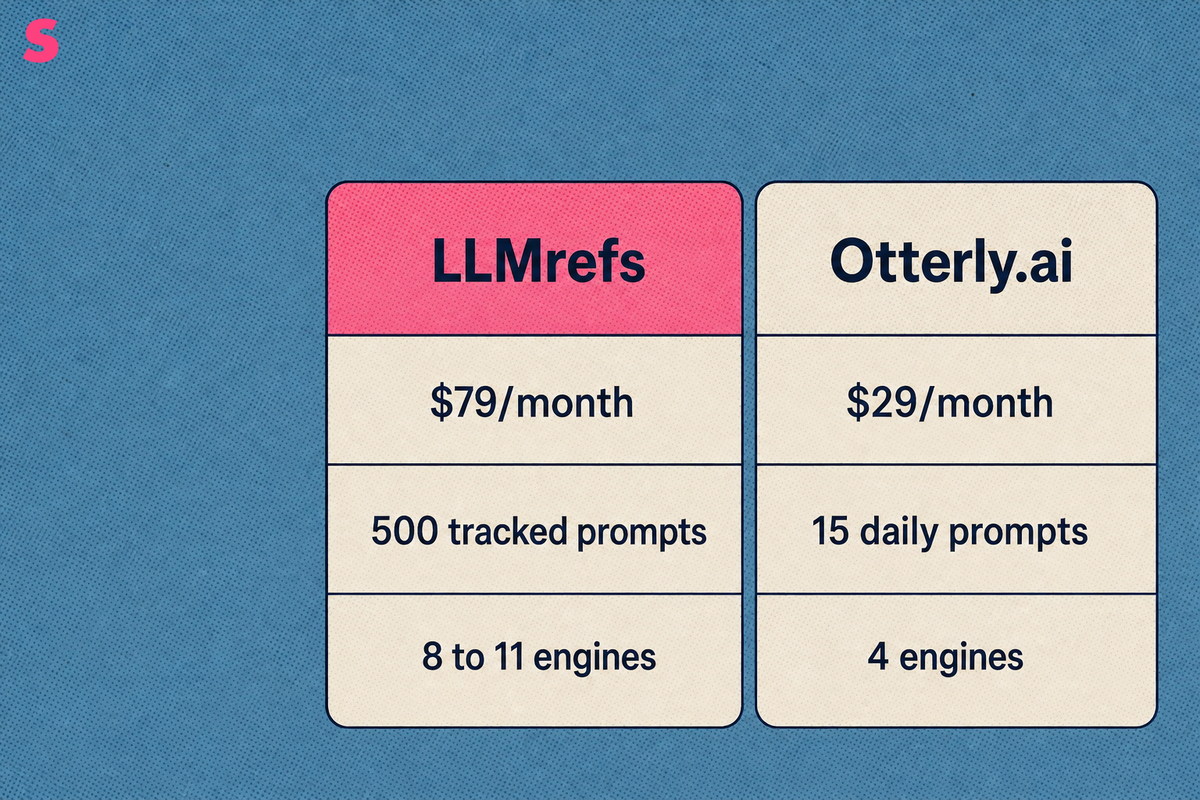
$79 is not the lowest entry price in this market. Otterly.ai starts at $29 per month as of October 2026, although its Lite tier covers 15 daily prompts across four engines. LLMrefs makes more sense for teams that value broader monitoring and unlimited projects over the lowest starting bill.
Independent reviews describe a clear trade-off: strong price-to-coverage with a more limited execution layer. Most trackers report where a brand appears. Sona AI Visibility connects citations to pipeline and revenue on one account timeline, while tracking the AI crawlers reaching pages, which makes the measurement useful beyond mention counts.
What does the $79 plan actually include?
LLMrefs has one paid plan, All in One, at $79 per month, marked as limited-time pricing in the October 2026 listing. The listing also describes a 7-day trial and cancel-anytime terms. Confirm the live price before procurement because limited-time labels indicate that commercial terms may change.
The reported plan includes 500 tracked prompts, unlimited team members, unlimited projects, and geo-targeting across 50+ countries, per the October 2026 listing. It also supports 20+ languages, according to techniver.com, October 2026. Those terms let small teams separate brands, markets, or clients without seat-based billing constraints.
Unlimited projects does not create unlimited monitoring volume. The 500-prompt allowance is the operating boundary because every project and country configuration draws from the same tracked-prompt pool. Teams with several regions should map required prompts before assuming one plan covers every market.
- Commercial model: one reported All in One plan at $79 per month.
- Trial: 7 days, with cancel-anytime terms reported in October 2026.
- Practical limit: 500 tracked prompts, regardless of the number of projects or users.
Which AI search engines does it track, and why do reviews disagree on the count?
LLMrefs engine counts vary between eight, ten, and 11, so buyers should confirm the active engine list during the trial. One October 2026 plan summary lists ChatGPT, Google AI Overviews, Google AI Mode, Gemini, Perplexity, Claude, Copilot, and Meta AI.
Another October 2026 summary describes ten engines, while a July 2026 review describes 11, adding Grok, DeepSeek, and ChatGPT Search. The difference is partly definitional. ChatGPT Search can be counted separately from ChatGPT, and Google AI Mode can be counted separately from Google AI Overviews.
Engine relevance matters more than the headline count. A B2B software team should confirm ChatGPT, Google AI Overviews, Google AI Mode, Gemini, Claude, Perplexity, and Copilot. Consumer-facing or international teams should also verify Meta AI, Grok, DeepSeek, language support, and country-level availability.
Sona’s own AI visibility data, September 2026, covers eight answer surfaces: ChatGPT, Google AI Overviews, Perplexity, Google AI Mode, Gemini, Mistral, Qwen and Claude. The useful operating question is which answer surfaces match the places where buyers research vendors.
How does keyword-based tracking turn one keyword into tracked prompts?
LLMrefs reportedly expands seed keywords into prompts, with one July 2026 product review describing 25 prompts per keyword. Another October 2026 review describes the 500-prompt allowance as roughly 50 keywords. Those figures do not map cleanly, so buyers should ask how generated prompts consume the plan allowance.
A keyword is a short demand signal. A prompt is the fuller question a buyer asks an answer engine. If 25 prompts are generated for every keyword, 50 keywords would imply 1,250 prompts, which exceeds the reported 500-prompt allowance. The discrepancy could reflect filtering, partial tracking, shared prompt groups, or different definitions of a tracked prompt, but published material does not establish the explanation.
Ask for a live walkthrough of three items: how many prompts one seed keyword generates, whether every generated prompt counts against the cap, and whether each country or language version creates a separate tracked prompt. Those answers determine the real capacity of the $79 plan more than the headline keyword estimate.
- Enter a branded keyword set.
- Add category and competitor terms.
- Inspect the generated prompt list before saving it.
- Confirm the exact prompt count deducted from the 500-prompt allowance.
What metrics does it report, and can you reproduce them?
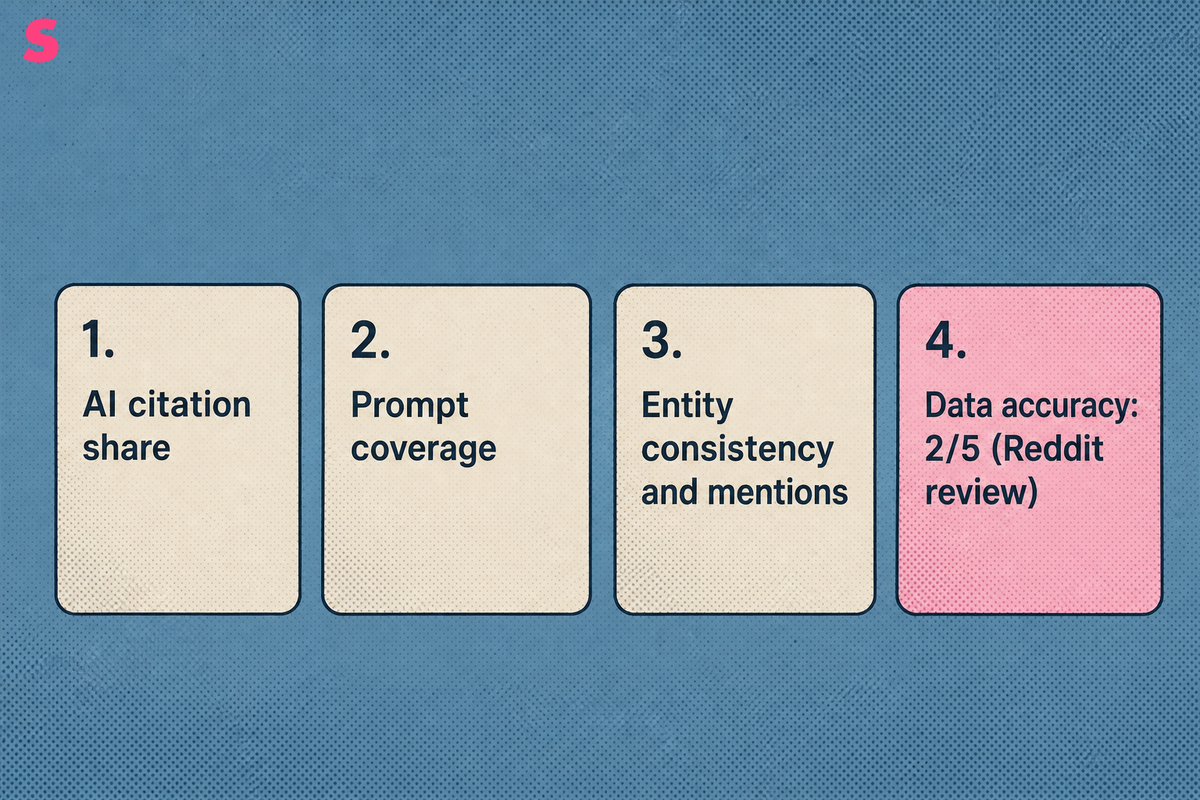
LLMrefs reports AI citation share, prompt coverage, entity consistency, mentions, citations, and ranking in AI answers. These metrics answer a useful monitoring question: where does a brand appear, and how consistently does it appear across tracked prompts and answer engines?
Reproducibility is the harder test. AI answers are non-deterministic, so buyers should ask whether LLMrefs runs each prompt multiple times, what sample size supports aggregate metrics, how variance is handled, whether raw responses are retained, and whether citations are captured exactly as users see them.
One independent review on reddit.com gave data accuracy a 2/5 score. That is one reviewer’s view, not a verified benchmark or universal product score. It still justifies validating a representative prompt set before using citation share or rankings for budget allocation.
A brand-level visibility score is not a work item. A prompt-level view that identifies the answer source and the page associated with a citation gives a team a concrete investigation path. Sona AI Visibility uses AI Search Insights to show prompts buyers ask and the sources AI cites, while connecting those observations to the pages competing for visibility.
Is daily or weekly data fresh enough for tracking AI search?
Daily prompt collection is more useful for tracking AI search, but buyers need to separate collection frequency from the reporting cadence visible in the interface. LLMrefs’ reported plan includes 500 prompts, refreshed weekly, as of October 2026. Buyers who require daily collection should verify whether results are collected daily and when they appear in the interface.
An answer can change after a retrieval-index update, a model update, or a competitor’s publication. A team that runs the same prompt list daily can identify patterns that a weekly snapshot may average away. A change that holds for four days is a trend. A one-day spike is not.
One independent review on reddit.com gave data freshness a 2/5 score. Treat that score as a reviewer’s experience rather than a product-wide benchmark, then test the live workflow. Ask whether results are collected daily, when they appear in the interface, whether raw answer history is retained, and whether exports preserve date-level observations.
Sona AI Visibility tracks prompts daily. Prompt monitoring needs daily resolution, while broader technical review or competitive benchmarking can run monthly or quarterly.
Where does this tracker stop short?
LLMrefs stops short when a team needs an execution layer tied to commercial outcomes rather than monitoring alone. Independent reviews characterise the product as a trade-off between strong price-to-coverage and a more limited execution layer, which fits its position as a basic, low-cost tracker for SMBs and early testers.
The 500-prompt cap is the practical constraint. Unlimited projects and team members help with organisation, but they do not increase the prompts available for countries, categories, competitors, and language variants. The reported 2/5 data-accuracy and 2/5 freshness scores in one independent review on reddit.com add a second reason to validate coverage during the trial.
LLMrefs focuses on monitoring where a brand is mentioned, cited, and ranked in AI answers. That supports visibility reporting. Sona AI Visibility connects prompts and citations to pipeline and revenue, then tracks AI crawler and agent activity from server logs or a lightweight edge worker without a JavaScript tag.
The choice depends on the decision your team must make. Use a low-cost tracker when the immediate need is broad monitoring. Use a measurement system when leadership needs to know which AI-referred accounts entered pipeline, what they did next, and whether the channel produced revenue.
What should an honest hands-on tracker review disclose, and what did this one not test?
This llmrefs review did not include hands-on testing. The assessment relies on documented product behaviour and published independent reviews, with pricing read in October 2026. No product score, visibility result, accuracy test, or response-time claim in this review comes from a private trial.
A full 7-day trial can test a defined prompt portfolio across the available collection and reporting views. A two-week validation requires continued paid access or another explicitly available access arrangement. Preserve exports to compare dated observations, but exports do not extend the collection period.
- Build a branded set: brand name, product names, and comparison prompts.
- Build a category set: commercial questions that describe the problem your product solves.
- Build a competitor set: vendor-comparison prompts relevant to active deals.
- Measure variance: record citation share, prompt coverage, cited sources, and run-to-run differences.
- Set a minimum sample: require repeated observations for each priority prompt before treating a movement as meaningful.
The output should be a log rather than a single score. A score is a dated snapshot. A series of dated prompt observations shows whether visibility changed, while the underlying responses show which citations and sources created that movement.
How does it compare with other AI visibility tools on price and focus?
LLMrefs sits between entry-level monitoring products and measurement-led AI visibility platforms. As of October 2026, its $79 monthly plan offers 500 prompts and reported coverage of eight named answer engines, while Otterly.ai starts at $29 per month with 15 daily prompts on its Lite plan.
The table separates published commercial terms from product focus. Sona AI Visibility appears first because it connects AI citations and prompts to pipeline and revenue on one account timeline, and resolves anonymous accounts behind AI-referred visits without cookies. LLMrefs and Otterly.ai focus on citation and mention tracking across AI engines.
| Tool | Starting price | Agency Plans? | # of Answer Engines Tracked | Answer Engines | # of Daily Tracked Prompts (entry plan) | Cost per Daily Tracked Prompt | Differentiation |
|---|---|---|---|---|---|---|---|
| Sona AI Visibility | From $75/month, billed annually, as of October 2026 | Yes | 11 | ChatGPT, Gemini, Google AI Mode, Google AI Overviews, Perplexity, Claude, DeepSeek, Grok, Copilot, Qwen, Mistral | 5,000 credits/month, about 56 prompts tracked daily across three engines | $0.45 per daily tracked prompt | Connects AI citations and prompts to pipeline and revenue, and resolves anonymous AI-referred accounts without cookies |
| Otterly.ai | From $29/month, as of October 2026 | Yes | 4 | ChatGPT, Google AI Overviews, Perplexity, Microsoft Copilot | 15 prompts daily | $0.48 per daily tracked prompt | Focus: tracking citations, mentions, and visibility across AI answer engines |
Price alone does not resolve the buying decision. Compare prompt volume, engine coverage, refresh cadence, evidence behind reported metrics, and whether the output can be tied to commercial outcomes. Confirm each point in a live trial because AI visibility product plans change quickly.
What are the frequently asked questions about this tracker?
How much does a tracker like this cost per month?
LLMrefs has one plan at $79 per month, with a 7-day trial and cancel-anytime terms in the October 2026 listing. The plan is described as limited-time pricing, so confirm the current price before buying or entering procurement.
How many AI engines does it cover?
Published reviews report eight, ten, or 11 engines, depending on when the review was written and whether ChatGPT Search and Google AI Mode are counted separately. Confirm the active engine list during the trial, especially when buyers use specific answer engines.
How many prompts and keywords does the paid plan allow?
The reported plan includes 500 tracked prompts and is described elsewhere as covering roughly 50 keywords, with unlimited projects and team members. The prompt cap is the real constraint. Ask how many generated prompts each keyword creates and how those prompts consume the allowance.
Is the data accurate enough to base decisions on?
One independent review on reddit.com scored data accuracy and freshness at 2/5 each. AI answers also vary between runs, so test sample sizes, raw-response access, citation capture, and run-to-run variance during the trial before using results for high-stakes decisions.
Who is a low-cost AI visibility tracker best suited to?
A low-cost tracker suits SMBs and early testers that want broad monitoring of brand mentions and citations across AI answers. Teams that need citations tied to pipeline and revenue, anonymous account resolution, or automated follow-up need a broader measurement workflow.
What should you check during the 7-day trial?
Track a branded, category, and competitor keyword set. Confirm which engines run, inspect how keywords convert into prompts, and verify whether results are collected daily and what reporting history is available in the interface. Preserve exports so results remain comparable after the trial ends.
Summarize this article with AI: ChatGPT · Claude · Perplexity · Google AI Mode
Last updated: October 2026