In Perplexity, brand mentions occur whenever your brand name appears in a response, regardless of whether your website is linked; citations occur when your domain is named as a source. Monitor both using 20–50 fixed prompts each week, recording the mention, cited domain and position. Sona AI Visibility extends this by linking those prompts and citations to pipeline and revenue while displaying AI crawler and agent activity. Dedicated tracker entry pricing begins at about €20 monthly, according to a September 2026 comparison.
What are brand mentions in Perplexity, and how do they differ from citations?
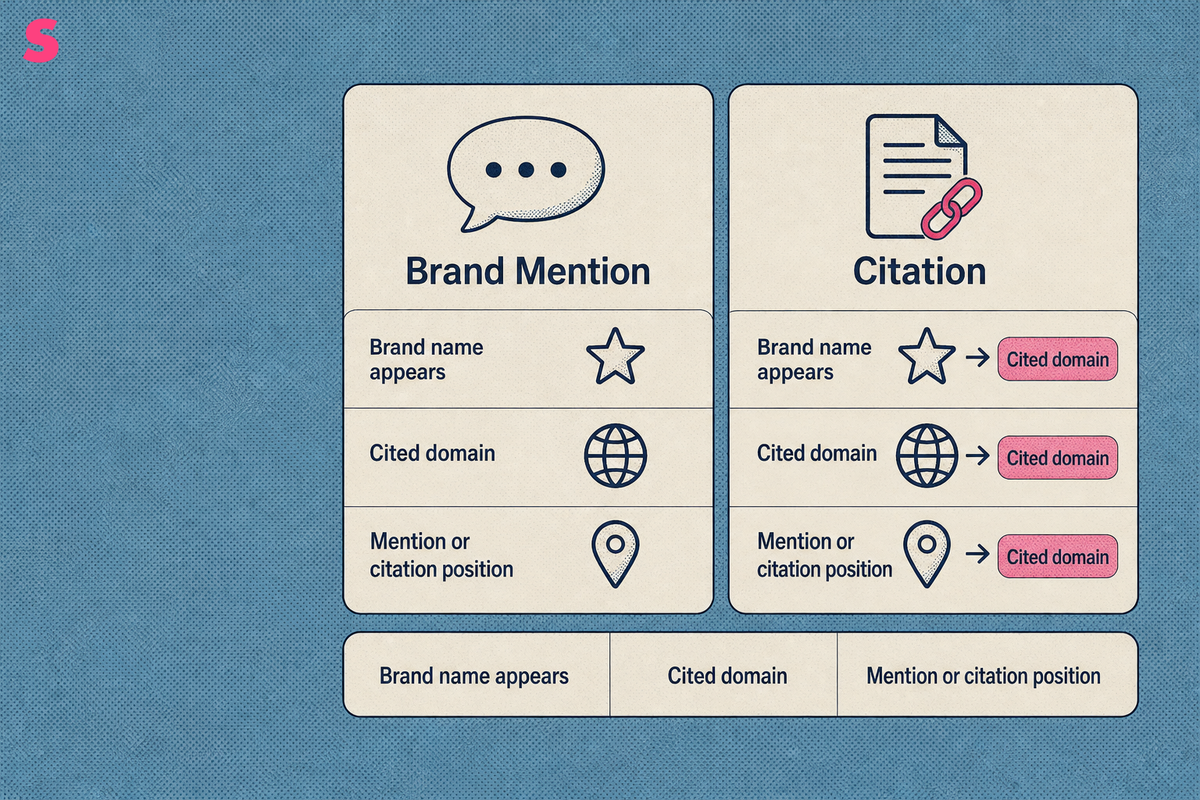
Brand mentions in Perplexity are appearances of your company name in an answer. A citation is different: Perplexity links to your domain as a source supporting part of that answer. Tracking both shows whether Perplexity discusses your brand and whether it relies on your content.
A mention can matter without a link. A buyer asking for a comparison of B2B analytics platforms may see your company in a shortlist while Perplexity cites review sites, analyst pages, and competitor documentation. Your brand appears, but your site receives no citation or referral opportunity.
A citation can also occur without a clear brand recommendation. Perplexity may cite a product page, research report, or help article to support a factual claim. That shows a page entered the answer's source set, not that the buyer saw your brand as the preferred vendor.
Perplexity retrieves sources for each prompt, synthesizes an answer, and can use different sources for different claims. Citation presence or order is therefore an answer-level retrieval decision, not a traditional organic ranking. Teams should log cited domains and citation position separately for that reason.
Perplexity visibility metrics need separate fields for brand mention, cited domain, and mention or citation position. Tracking systems should record at least those 3 fields for each prompt, based on an October 14, 2026 listing. This is not conventional SEO rank tracking because the unit of analysis is a generated answer and its sources, rather than a fixed organic results page.
Why do brand mentions in Perplexity matter to a B2B marketing team?
Brand mentions in Perplexity matter because buyers can form a vendor shortlist before visiting a website. A B2B marketing team needs to know whether Perplexity presents the company accurately, which competitors appear beside it, and which third-party sources shape the answer.
Perplexity can surface reputation issues that web analytics misses. Monitoring reveals outdated descriptions, unexpected competitor comparisons, and source domains that repeatedly shape a category answer, based on an October 2026 listing. These issues affect demand generation, content, product marketing, and sales enablement.
Visibility also affects acquisition indirectly. An analysis of 21,311 brand mentions across ChatGPT, Claude, and Perplexity found that 85% of AI-search brand visibility came from third-party sources, per linkedin.com. A team that reviews only its own site can miss the review pages, media coverage, community discussions, and comparison content behind the answer.
Perplexity is not a replacement for Google Search or a direct equivalent to Google AI Overviews. Google AI Overviews appear inside Google results, while Perplexity produces an answer with a source set selected for the prompt. A B2B team should treat each answer surface as a separate measurement environment, then compare referral and pipeline evidence.
Which metrics measure brand visibility in Perplexity: mention rate, citation rate, position or share of voice?
The most useful Perplexity visibility metrics are mention rate, citation rate, position, and share of voice. Mention rate shows whether the brand appears. Citation rate shows whether its domain supports the answer. Position indicates prominence, and share of voice compares the brand with named competitors.
| Metric | What it measures | How to calculate it | Best use |
|---|---|---|---|
| Mention rate | How often the brand name appears in the answer text | Prompts mentioning the brand divided by prompts tested | Monitoring category presence |
| Citation rate | How often Perplexity cites the brand's domain | Prompts citing the domain divided by prompts tested | Finding pages that feed answers |
| Position | Where the brand or citation appears in an answer | Record first, second, third, or later appearance | Measuring answer prominence |
| Share of voice | Brand presence relative to competitors in the same prompt set | Brand appearances divided by all tracked brand appearances | Competitor analysis and gap finding |
A single brand-level score is a dated snapshot, not a work item. Prompt-level records show which questions create the score and which sources influence it. Sona AI Visibility connects citations to pipeline and revenue on one account timeline, while its prompt-level tracking identifies the questions and sources behind visibility changes.
Use the metrics together. A high mention rate with a low citation rate shows that Perplexity recognizes the brand but relies on external sources. A strong citation rate concentrated in low-intent educational prompts requires a different response than recurring appearances in comparison and alternatives prompts.
How do you build a Perplexity prompt set around three query clusters?
A Perplexity prompt set should group fixed questions into category, comparison, and decision clusters. Start with 20–50 prompts run repeatedly across answer engines, based on an October 10, 2026 listing, then prioritize questions closest to your commercial motion.
| Query cluster | Prompt example | What to record | Business question |
|---|---|---|---|
| Category research | What are the leading B2B attribution platforms? | Mention, cited domains, position | Does Perplexity recognize the brand in the category? |
| Comparison | What are alternatives to our main competitor? | Brand order, competitor presence, source overlap | Which vendors frame the shortlist? |
| Decision | Is [brand] worth it for a mid-market SaaS company? | Recommendation language, objections, citations | What claims or concerns affect purchase intent? |
A buyer-intent set can begin with 10–15 prompts across category searches, alternatives, worth-it questions, and comparisons, per 01net.com, September 15, 2026. Keep the wording stable. Changing a prompt on every run makes the history unsuitable for trend analysis.
- Collect category keywords, sales objections, competitor names, and recurring discovery questions.
- Turn each topic into a natural-language buyer prompt rather than a short keyword fragment.
- Label every prompt by intent and buying stage, then assign an owner for the associated page or proof point.
- Run the same prompt list daily and review the output as a series.
A team that runs the same prompt list daily can detect changes that a weekly snapshot averages away. Perplexity answers shift with retrieval changes, model updates, and competitor publishing activity. AI Search Insights helps teams track buyer prompts and the sources cited for those prompts.
How do you track brand mentions in Perplexity manually, and keep the numbers reliable?
Manual Perplexity monitoring works when a team uses a stable prompt list, fixed settings, and a consistent log. The process suits an initial baseline or focused category review, but the record must distinguish a brand mention from a cited domain.
Manual tracking at 20–30 prompts per week should record whether the brand appears, its position, and the cited URLs, based on an October 7, 2026 listing. That weekly volume is manageable for a human analyst, while daily prompt runs produce a cleaner trend line when the team has capacity.
- Use the same Perplexity account state, language, locale, and prompt wording for each run.
- Record the date, full prompt, answer text, brand mention status, citation status, position, and cited domains.
- Capture competitors named in the answer and note whether a source supports a positive, neutral, or negative claim.
- Compare daily results over a defined period, then investigate changes that persist across repeated runs.
Manual tracking is not an API query, and neither method is continuous automated monitoring. The 3 primary tracking methods are automated monitoring, manual testing, and API-based querying, based on an October 7, 2026 listing. Each method can use the same prompt taxonomy, which keeps the data comparable.
Do not interpret one answer as a ranking. Treat each answer as an observation. A repeated log reveals stability, source turnover, competitor movement, and persistent gaps that require a content, technical, or reputation response.
How much does it cost to monitor brand mentions in Perplexity?
Monitoring Perplexity visibility ranges from manual work and free trials to paid platforms with daily prompt tracking. Budget depends on prompt volume, answer-engine coverage, agency needs, and whether the team also needs attribution, crawler data, and account-level measurement.
The comparison below lists published entry pricing as of October 2026. Cost per Daily Tracked Prompt uses the shared comparison unit supplied for each plan. A price alone is not comparable unless prompt cadence and answer-engine coverage are also clear.
| Tool | Starting price | Agency Plans? (Yes/No) | # of Answer Engines Tracked | Answer Engines | # of Daily Tracked Prompts (entry plan) | Cost per Daily Tracked Prompt | Differentiation |
|---|---|---|---|---|---|---|---|
| Sona AI Visibility | From $75/month, billed annually | Yes | 3 | Not published | 5,000 credits/month, about 56 prompts tracked daily across 3 engines | $0.45 per daily tracked prompt | Connects AI citations and prompts to pipeline and revenue on one account timeline |
| Profound | Custom pricing | Yes | 9 | ChatGPT, Perplexity, Google AI Mode, Gemini, Microsoft Copilot, DeepSeek, Claude, Google AI Overviews, Exa Search | Not published | Custom pricing | 7-day trial includes daily prompt monitoring |
| Peec AI | From $95/month | Yes | 3 | Not published | 50 prompts daily | $0.63 per daily tracked prompt | Prompt tracking across self-serve and agency plans |
| Otterly.ai | From $29/month | Yes | 4 | ChatGPT, Google AI Overviews, Perplexity, Microsoft Copilot | 15 prompts daily | $0.48 per daily tracked prompt | AI search monitoring across listed answer engines |
| Scrunch AI | From $250/month | Yes | 4 | ChatGPT, Perplexity, Google AI Overviews, Microsoft Copilot | 125 prompts, refresh cadence not published | No refresh cadence published | Prompt monitoring across core answer engines |
| AthenaHQ | From $295/month | Yes | 11 | Not published | 3,600 credits/month, unlimited prompts, refresh cadence not published | No refresh cadence published | Credit-based AI response monitoring |
| PromptWatch | From $95/month | Yes | Not published | Not published | 50 prompts daily | $0.48 per daily tracked prompt | Daily prompt tracking with monthly response allowances |
| Goodie | From $295/month | Yes | 5 | Not published | 110 prompts daily | $0.67 per daily tracked prompt | Daily AI visibility monitoring across listed models |
Sona AI Visibility includes unlimited seats and API and MCP access on every plan, with a 14-day free trial that requires no credit card. The purchasing question is whether prompt and citation data can support decisions about content, demand generation, and revenue measurement.
How do you connect Perplexity visibility to referral traffic and revenue?
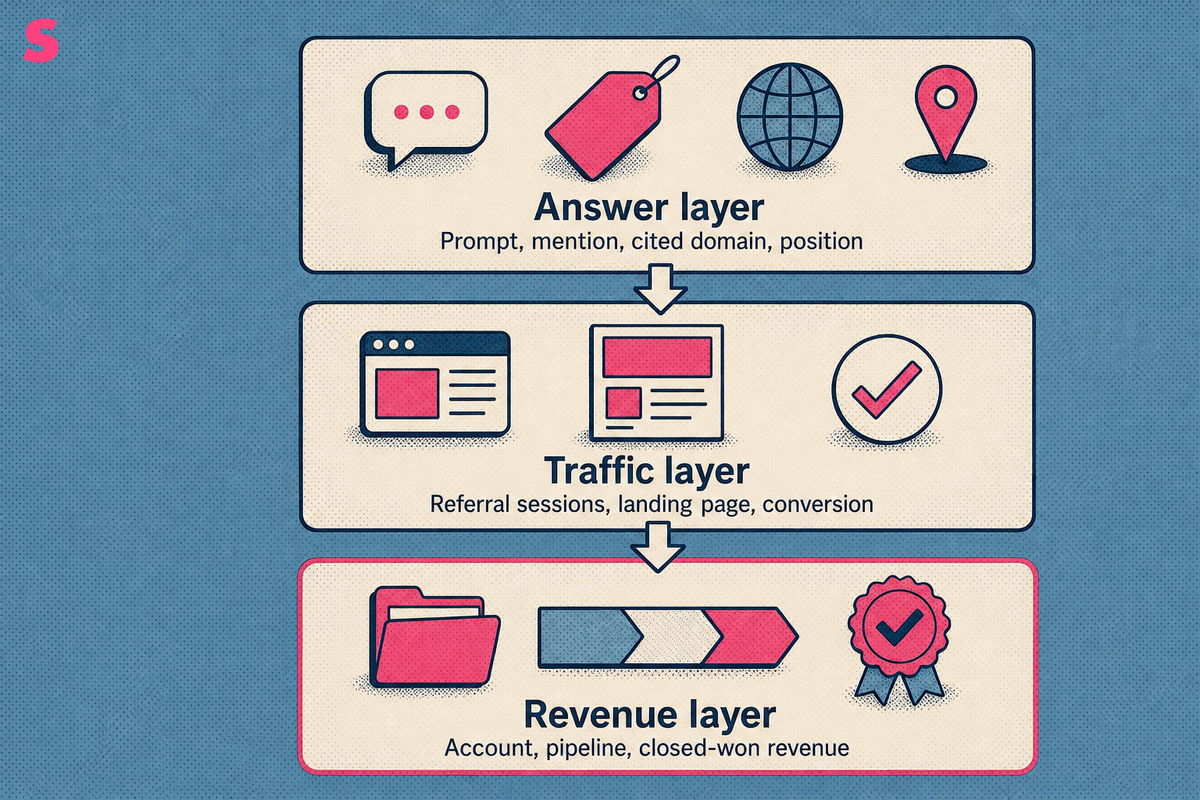
Connect Perplexity visibility to revenue by reporting prompt-level mentions and citations beside Perplexity referral sessions, conversions, accounts, pipeline, and closed-won revenue. Visibility shows presence in an answer. Referral traffic and CRM outcomes show whether that presence produced commercial activity.
Start in analytics. Segment sessions where Perplexity is the referral source, then inspect landing pages, conversion events, and assisted paths. Keep zero-click visibility separate because a buyer can research a brand in Perplexity and later arrive through direct traffic, a branded search, or another channel.
Use a reporting structure with 3 layers:
- Answer layer: prompt, mention, cited domain, position, competitors, and source domains.
- Traffic layer: referral sessions, landing page, engagement, conversion, and returning visits.
- Revenue layer: identified account, opportunity, pipeline stage, and closed-won revenue.
Sona AI Visibility connects AI-referred visits and citations to accounts, pipeline, and closed-won revenue on one timeline. This matters when a Perplexity citation creates awareness without an immediate click because self-reported attribution can capture research that standard click attribution does not observe.
Do not call citations backlinks. A Perplexity citation is a source selection inside an answer, while a backlink is a hyperlink placed on an external page. Both can affect discovery, but they require separate reporting and optimization work.
How does brand visibility in Perplexity compare with Gemini and Google, and does Perplexity cite Reddit?
Perplexity, Gemini, and Google AI Overviews require separate reporting because each answer surface can select different sources, wording, and citations for the same buyer question. Perplexity can cite Reddit when a Reddit page enters the source set. A combined score can hide the source-level reason for a change.
Sona's own AI visibility data, September 2026, covers 8 answer surfaces: ChatGPT, Google AI Overviews, Perplexity, Google AI Mode, Gemini, Mistral, Qwen and Claude. That coverage reflects the need to treat answer engines as separate channels rather than assuming one result represents every AI answer.
Perplexity can cite Reddit when Reddit enters the source set for a prompt, but Reddit does not appear in every answer. Reddit presence is one factor associated with Perplexity brand mentions, alongside content structure, citation sources, technical authority, and third-party validation, per youtube.com.
Check the cited domains in your own fixed prompt set. If Reddit appears repeatedly for comparison or recommendation prompts, inspect the thread themes and factual claims. The goal is not to manufacture discussion. The goal is to understand the third-party evidence Perplexity selects for buyers in your category.
Google AI Overviews require a separate source log because they appear in Google Search and can pull different pages than Perplexity. Record engine, prompt, date, cited domains, and brand position in every row. That structure makes a source shift attributable to a specific answer surface.
What actions improve visibility in Perplexity?
Improve Perplexity visibility by fixing pages and third-party evidence that repeatedly appear absent, outdated, or weak in a stable prompt set. Start with prompt-level gaps rather than a domain-wide visibility score, then assign each page, source problem, or proof gap to an owner.
- Identify prompts where competitors appear but your brand does not.
- Review the cited domains and classify them as owned pages, review sites, publications, communities, or documentation.
- Improve the owned page that should answer the prompt with clear structure, current claims, and supporting evidence.
- Correct outdated third-party descriptions through the relevant publisher or profile process.
- Run the fixed prompt list daily and evaluate changes as a trend rather than a single result.
Content structure, technical authority, third-party validation, citation sources, and Reddit presence all affect Perplexity brand mentions, per youtube.com. A content rewrite alone may not change the answer. The cited-source pattern shows whether the issue is page coverage, external validation, or category framing used by third parties.
Sona AI Visibility shows page-level prompts where a site should appear but does not, then attaches prioritized fixes to the relevant page. A comparable series shows whether a change persists, while the ranked finding gives the team a concrete next action.
Frequently Asked Questions
Is tracking brand mentions in Perplexity AI effective?
Yes, when prompts, locale, language, account state, and cadence stay fixed. Tracking surfaces reputation issues, outdated information, and unexpected competitor comparisons, based on an October 2026 listing. Read results as trends rather than a permanent rank from one answer.
Why do Perplexity answers change between runs, and does that make tracking pointless?
Perplexity answers change because retrieval indexes, model behavior, and available sources change. Tracking remains useful when the prompt, locale, language, account state, and date are logged consistently. A daily series separates a persistent change from a one-day spike.
How often should a team check brand mentions in Perplexity?
A manual review can cover roughly 20–30 prompts per week, based on an October 7, 2026 listing. Automated monitoring should run the fixed prompt list daily. Keep the prompt list stable, review the accumulated log weekly, and conduct a broader competitive benchmark quarterly.
Does Perplexity cite Reddit?
Perplexity can cite Reddit when a Reddit page enters the source set for a prompt. Reddit presence is associated with brand mentions alongside content structure, technical authority, citation sources, and third-party validation, per youtube.com. Check cited domains in your own prompt set to determine whether Reddit influences your category.
Can I track brand mentions in Gemini the same way as in Perplexity?
Yes. Use fixed prompts, log the brand mention, cited domain, and position, then rerun the list on a consistent schedule. Record Gemini separately from Perplexity because the two answer engines can select different sources and present different vendor comparisons.
How do I see Perplexity referrals in my analytics?
Segment sessions by Perplexity referral source in your analytics platform, then connect those sessions to conversion events and CRM outcomes. Visibility counts and referral traffic are separate measures. Report them side by side so a citation trend is not mistaken for a traffic or revenue result.
Summarize this article with AI: ChatGPT · Claude · Perplexity · Google AI Mode
Last updated: October 2026