Generative engine optimization brand integration capabilities link an AI visibility platform with a brand's CMS, analytics, CRM, SEO tools and reporting, determining whether visibility data reaches the teams that use it. Engine coverage, prompt limits, refresh cadence and export options vary by vendor and plan, so evaluate them like-for-like before buying. Sona AI Visibility connects prompts and citations to pipeline and revenue, while tracking AI crawler and agent activity at the front of that same path.
What are generative engine optimization brands integration capabilities?
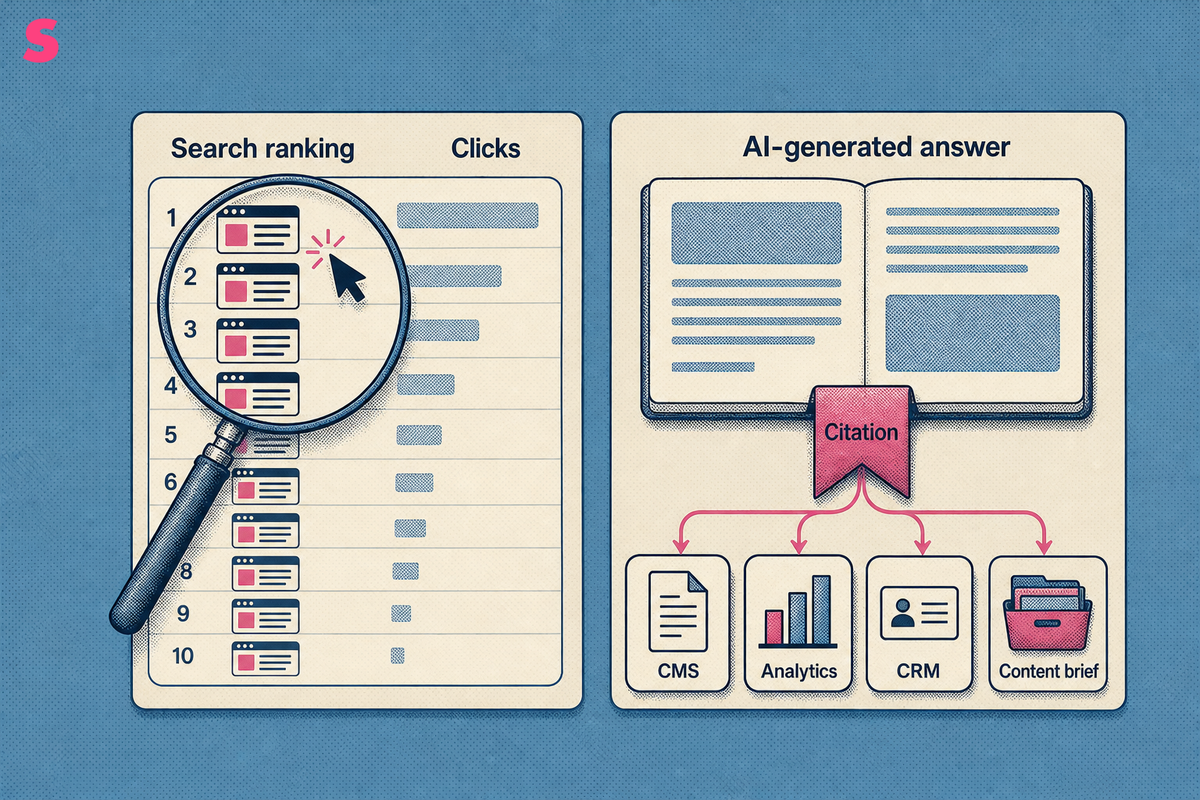
Generative engine optimization brand integration capabilities move AI visibility data into the systems a brand already uses to create content, identify buyers, measure performance, and manage revenue. GEO aims to earn citations, summaries, and mentions in AI-generated answers.
Traditional SEO measures whether a page ranks in a results list and earns clicks. GEO measures a different outcome: generative engines synthesize web sources into answers, so a brand needs representation within the answer through a citation, recommendation, comparison, or summary.
An integration capability moves a visibility signal into a CMS workflow, analytics report, CRM record, CDP audience, or content brief where a team can act. A mention-tracking dashboard only shows whether a brand appeared for a prompt.
GEO shares technical foundations with SEO, including crawlability, canonical tags, structured content, performance, and authoritative source material. The measurement target differs. SEO measures visibility in search results, while GEO measures whether an answer engine can understand, retrieve, and cite a page.
Why do integration capabilities matter more than another AI visibility dashboard?
Marketing teams cannot justify GEO work with mention counts alone. GEO metrics should measure how often a brand appears in AI-generated summaries and how often its site is cited, because an answer may satisfy research before a buyer visits the site.
A visibility dashboard supports observation. Integration makes the signal operational. Content teams can turn missing citations into page revisions, demand teams can compare AI-referred visits with pipeline, and marketing operations teams can reconcile those visits with account and opportunity data.
Most AI visibility tools report whether a brand appeared. Sona AI Visibility connects citations to pipeline and revenue on one account timeline and tracks which AI crawlers reach pages, turning a mention into a measurable marketing signal.
Mention tracking is not revenue attribution. A brand may receive frequent citations for informational prompts without creating qualified pipeline. The useful question is whether AI-referred research later appears in account activity, a demo request, an opportunity, or closed-won revenue.
Which AI engines should a GEO platform integration cover?
A GEO platform should cover the answer engines that matter to a brand’s buyers and provide enough prompt volume, geography, language, and refresh controls for consistent measurement. As of October 2026, platforms commonly monitor ChatGPT, Perplexity, Gemini, Google AI Overviews, Claude, Copilot, and other answer engines, although vendor coverage varies materially.
Engine count is a weak buying signal. Most tools track 5–10 AI platforms, per October 2026 listings, but an eleven-engine plan with a small prompt allowance may produce less useful evidence than a narrower engine set with strong coverage of priority countries, languages, and commercial prompts.
Google AI Overviews requires separate consideration because it is a Google search feature. ChatGPT, Perplexity, Gemini, Claude, and other answer engines use different retrieval and generation paths. Sona's own AI visibility data, September 2026, covers eight answer surfaces: ChatGPT, Google AI Overviews, Perplexity, Google AI Mode, Gemini, Mistral, Qwen and Claude.
Teams should run the same prompt list daily because retrieval indexes, model updates, and new competitor content can change an answer. A daily history reveals patterns that a weekly snapshot can obscure. Teams should distinguish sustained movement from a one-day spike.
How does a GEO platform connect to a CMS, CDP, analytics and CRM?
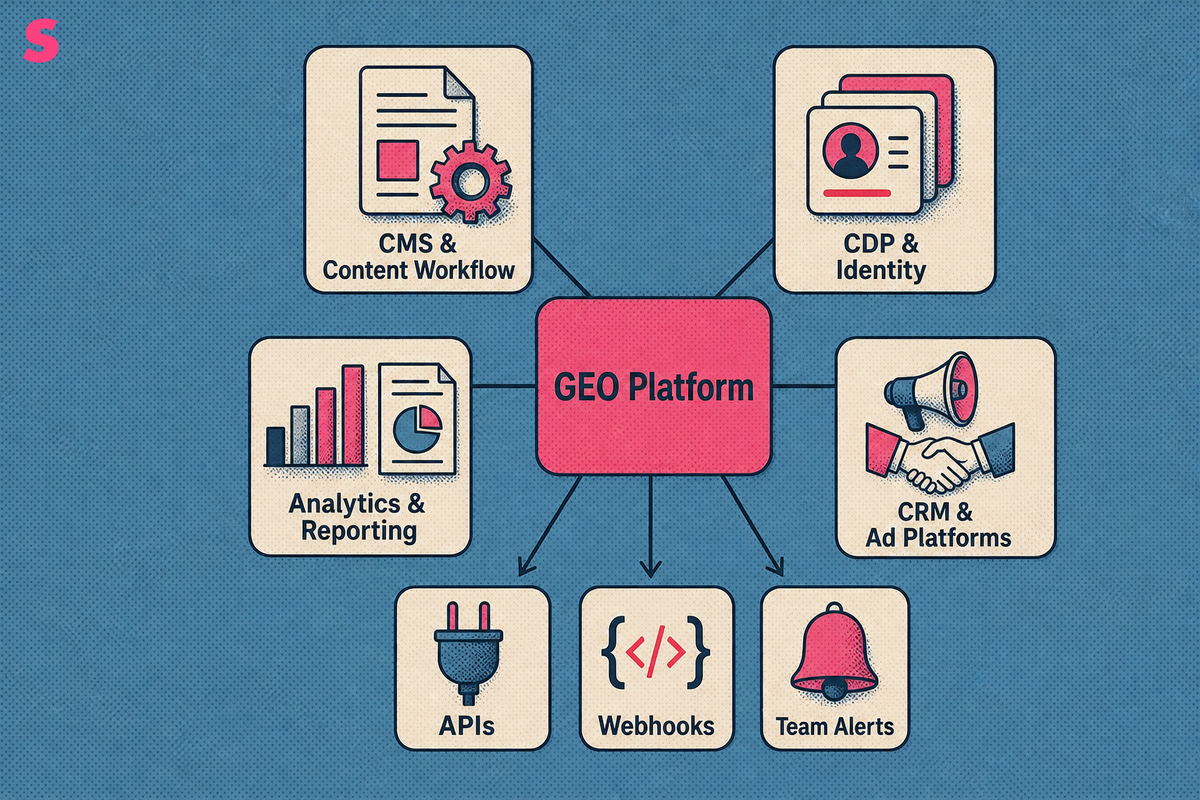
A GEO platform passes visibility, crawl, visitor, and intent signals into the systems where teams publish content and manage buyers. Core integrations include CMS and content workflows, CDP and identity systems, analytics and reporting, CRM and ad platforms, plus APIs, exports, webhooks, and team alerts.
- CMS and content workflow: content teams use prompt, citation, and page findings to update source material, schema markup, metadata, comparison pages, and product documentation.
- CDP and identity: anonymous AI-referred activity is matched to an account where identity resolution supports that workflow, allowing AI research to join other account signals.
- Analytics and reporting: marketing teams combine AI-referred visits, cited pages, conversion events, and channel performance in executive reporting.
- CRM and ad platforms: high-intent accounts can enter CRM workflows and live audience activation, while sales teams receive alerts tied to account activity.
Consider a buyer who asks an AI assistant for enterprise software options, receives an answer citing a comparison page, and then visits that page. Sona AI Visibility can infer the likely prompt behind the AI-referred visit, attach a buying stage and account intent score, resolve eligible company-level activity, and connect the account to pipeline and revenue. Sona Marketing Measurement provides the attribution and identity-resolution foundation across channels.
Most checkers stop at mention counts; Sona AI Visibility connects citations to pipeline and revenue, then supports Slack alerts, CRM sync, and live ad audiences for accounts whose AI-referred activity meets a defined intent threshold. Exports, APIs, and webhooks prevent a GEO dashboard from becoming the system of record for content, demand generation, or sales.
How should marketing, content and product teams share one GEO workflow?
A shared GEO workflow should follow an ordered implementation sequence from baseline measurement through remediation, activation, and validation.
- Define engines and prompts: select the answer engines, buyer questions, geographies, languages, and commercial topics that matter to the brand.
- Establish a baseline: measure mentions, citations, cited pages, and AI-referred visits before changing content or technical conditions.
- Audit technical readiness: identify crawl, rendering, structure, accessibility, and content-quality issues that prevent answer engines from accessing or reusing pages.
- Map findings into CMS work items: turn missing citations and page findings into owned revisions for source material, schema markup, documentation, and comparison pages.
- Send signals into analytics, CDP, and CRM: connect AI-referred visits, account activity, conversion events, and intent signals to existing reporting and buyer workflows.
- Assign team owners: give marketing ownership of measurement, content ownership of accuracy and structure, and product or web teams ownership of technical access.
- Publish fixes: release approved content, technical, and documentation changes through the existing CMS and development workflow.
- Re-run measurement and connect changes to pipeline: compare the same prompt set over time and evaluate whether cited pages create account engagement, opportunities, pipeline, and revenue.
| Workflow | Inputs | Owners | Systems touched | Outputs |
|---|---|---|---|---|
| Traditional SEO | Keywords, rankings, crawl data | SEO and content | CMS, search analytics, technical monitoring | Updated pages and organic search priorities |
| Content strategy | Buyer questions, product expertise, source evidence | Content marketing and subject-matter experts | CMS, editorial calendar, knowledge base | Accurate, structured content briefs and published pages |
| Product data | Technical documentation, pricing, integrations, release details | Product marketing, product, engineering | Documentation system, CMS, product database | Current claims, data definitions, and reference pages |
| GEO | Prompts, citations, AI-referred visits, account signals | Marketing operations, demand generation, content | AI visibility platform, analytics, CRM, CDP, ad platforms | Prioritized fixes, account actions, and pipeline reporting |
Content teams own clarity, structure, and factual accuracy. GEO content should answer conversational questions directly, use authoritative data, and preserve evidence behind product claims. Experience, expertise, authoritativeness, and trust signals help answer engines retrieve and summarize material without ambiguity.
Product and engineering teams own the conditions that keep content accessible: server-rendered HTML, stable URLs, canonical tags, structured data, current documentation, and crawler access. Marketing owns the reporting loop, including whether cited pages create qualified visits, account engagement, and pipeline.
What does a technical-readiness audit check before AI engines can cite a page?
A technical-readiness audit checks whether an AI crawler can reach, render, understand, trust, and reuse a page. The audit should evaluate six dimensions: crawlability, performance, security, content structure, content quality, and accessibility.
Answer engines need access to and parseable versions of a page, then must match a passage to the user’s question, verify clear and current claims against authoritative evidence, and reuse a self-contained passage in a synthesized answer. These citation-selection signals differ from traditional position-based ranking and do not imply a universal proprietary ranking formula.
Crawlability covers robots.txt, llms.txt, canonical tags, indexability, and answer-engine access. Performance covers rendered experience, Core Web Vitals, server-rendered HTML, and JavaScript dependency. Server logs and crawler activity let technical teams verify that AI bots reach the site rather than assume access.
Security examines transport and header hygiene, including Strict-Transport-Security, Content-Security-Policy, and X-Content-Type-Options. Content structure covers metadata, semantic HTML, Schema.org markup, and FAQPage JSON-LD. Content quality tests whether material is clear, current, accurate, and substantial enough to earn a citation.
Accessibility covers alt text, ARIA attributes, contrast, and explicit image dimensions. These checks make pages easier to parse and verify, while accurate structured content gives answer engines clearer evidence for citations.
A visibility score reports an outcome, but a technical audit identifies the page-level issues blocking progress. Sona AI Visibility uses Site Pages to score a page out of 100 across six categories, rank findings as critical or medium with the fix attached, and re-run the audit on an ongoing basis so teams can verify whether the fix landed.
How do GEO platforms compare on pricing, prompt limits and integrations?
GEO platforms differ in pricing units, prompt allowances, answer-engine coverage, reporting focus, and how far data travels into marketing workflows. The table uses October 2026 pricing and product listings. Costs are not like-for-like because plans may be sold by domain, workspace, credits, prompt slots, seats, or custom enterprise scope.
| Tool | Starting price | Agency Plans? (Yes/No) | # of Answer Engines Tracked | Answer Engines | # of Daily Tracked Prompts (entry plan) | Cost per Daily Tracked Prompt | Differentiation |
|---|---|---|---|---|---|---|---|
| Sona AI Visibility | From $75/month, billed annually | Yes | 11 | Not published | 5,000 credits/month, about 56 daily tracked prompts across three engines | About $0.45 per daily tracked prompt | Connects AI citations and prompts to pipeline and revenue on one account timeline, with AI crawler activity read from server logs or a lightweight edge worker. |
| Peec AI | From $95/month | Yes | 3 | Not published | 50 prompts daily | $0.63 per daily tracked prompt | Prompt-level monitoring across listed answer engines. |
| Profound | Custom pricing | Yes | 3 | ChatGPT, Gemini, Google AI Overviews | 50 prompts daily during the seven-day trial | Cannot calculate from custom pricing | AI visibility tracking and agent-supported optimization. |
| Scrunch AI | From $250/month | Yes | 4 | ChatGPT, Perplexity, Google AI Overviews, Copilot | 125 prompts, refresh cadence not published | No refresh cadence published | AI crawler control and answer-surface visibility. |
Sona AI Visibility treats AI search as a measurable channel, connecting citations, accounts, pipeline, revenue, and crawler activity in the same measurement path. Semrush extends established SEO workflows into AI visibility, while Ahrefs Brand Radar focuses on brand monitoring, citations, and backlink context.
Listings range from $20 per month for credit-based GEO tools to several thousand dollars per month for enterprise platforms, per October 2026 listings. DIY software and agency services are separate purchases: software supplies data and workflows, while agency services add people, production capacity, strategy, and reporting.
Can AI visibility measurements be trusted, and what should vendors disclose?
AI visibility measurements are trustworthy when a vendor discloses the prompt set, sample size, scoring rules, refresh cadence, geography, language, and test repeatability. A single answer reading is unreliable because answers vary by model, location, time, personalization, and retrieval context.
A score is a dated snapshot. The useful output is a comparable series showing how the same prompt set changes over time, with page-level, severity-ranked fixes attached to affected pages. That evidence distinguishes a persistent shift from temporary response variation.
Buyers should examine the evidence behind comparison articles. Vendor comparisons can mix editorial rankings, affiliate relationships, and vendor-supplied pricing. A credible evaluation separates observed product facts from opinion, dates volatile pricing, and states what was measured rather than implying universal performance.
Pipeline is the final check on visibility metrics. Citation frequency can rise without generating qualified demand. Connecting AI citations and AI-referred visits to accounts, opportunities, pipeline, and revenue shows whether the movement represents commercial value.
What should a brand ask a GEO vendor about integrations before buying?
A brand should choose a GEO platform based on the systems its data must reach, not the engine count on a sales page. The buying process should test integration depth, measurement design, operational fit, and whether recommendations reach the people who can change content or act on demand.
- Which answer engines are covered, and which engines are available on the selected plan?
- What prompt, credit, response, and workspace limits apply to the required monitoring scope?
- Does the platform refresh prompt lists daily, and what geographic and language controls are available?
- Can teams export data, use an API, receive webhooks, and configure team alerts?
- How does the platform connect with the CMS, analytics platform, CDP, CRM, and advertising audiences?
- Does the platform provide recommendations and attached fixes, or measurement only?
- How are prompt sets, sample sizes, scoring rules, and repeatability documented?
Ask the vendor to demonstrate one complete workflow: a missing citation, the affected page, the recommended fix, the downstream reporting destination, and the relevant account or pipeline record. That demonstration shows whether the product supports an operating process or produces an isolated report.
What are the frequently asked questions?
What does GEO integration mean for a marketing team?
GEO integration moves mention, citation, crawler, and AI-referred visitor data into the CMS, analytics platform, CRM, CDP, and reporting tools the marketing team already uses. The data informs content planning, account scoring, campaign reporting, and revenue measurement rather than remaining in a separate dashboard.
Which AI engines do GEO platforms usually monitor?
GEO platforms commonly monitor ChatGPT, Perplexity, Gemini, Google AI Overviews, Claude, Copilot, and other answer engines, as of October 2026 listings. Most tools track 5–10 platforms, per October 2026 listings. Check the prompt volume, refresh cadence, geographic controls, and language controls behind every engine claim.
How much do generative engine optimization tools cost?
GEO software ranges from about $20 per month for credit-based tools to several thousand dollars per month for enterprise platforms, per October 2026 listings. Agency services cost more because they include execution and reporting. Compare like-for-like units, including domains, workspaces, credits, prompts, monitored engines, seats, and custom services.
Can GEO tools connect AI visibility to pipeline and revenue?
Some GEO tools connect AI visibility to pipeline and revenue. Mention and citation tracking alone does not show commercial impact, so buyers should ask whether the product resolves AI-referred visits to accounts and passes relevant activity into the CRM. Sona AI Visibility is built to connect citations and AI-referred visits to pipeline and revenue.
Is GEO the same as SEO?
No. Traditional SEO aims to rank pages in a search-results list, while GEO aims to get a brand cited, summarized, or mentioned in synthesized AI answers. GEO and SEO share technical foundations, including crawlability, structured content, performance, authoritative data, and accurate pages.
How reliable are AI answer measurements?
AI answer measurements vary by model, location, time, personalization, and retrieval context, so one prompt proves little. Look for vendors that disclose prompt sets, sample sizes, scoring rules, refresh cadence, and repeatability. A daily prompt history provides stronger evidence than an isolated snapshot.
Summarize this article with AI: ChatGPT · Claude · Perplexity · Google AI Mode
Last updated: October 2026