For stronger brand visibility in Perplexity, ensure pages can be crawled, address every target question clearly, and secure third-party mentions, then assess performance using a fixed prompt panel. Perplexity responses differ across runs, so monitor citation rate, share of voice, and recommendation rank instead of a ranking position. Sona AI Visibility ties those prompts and citations to pipeline and revenue, making the effort visible as deals rather than mention totals. Re-run the panel each week and measure every result against your baseline.
What do you need in place before you try to improve brand presence in Perplexity?
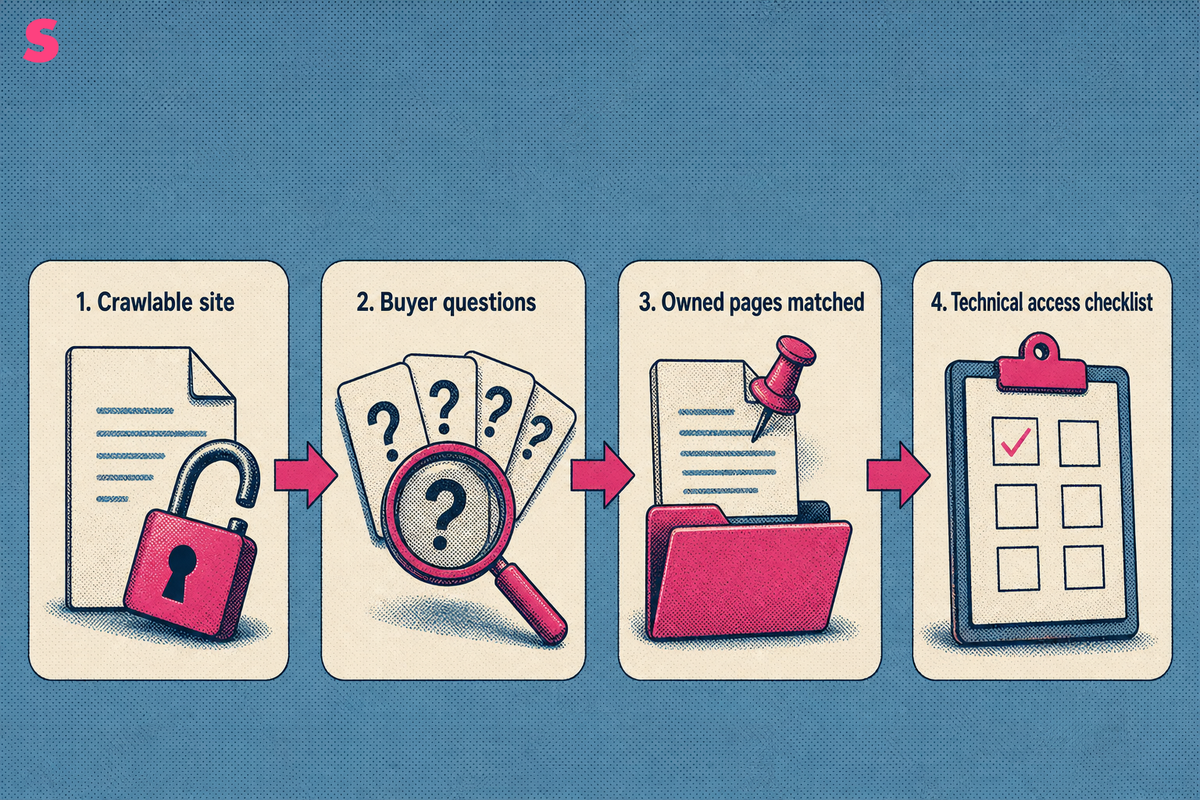
To improve brand presence in Perplexity, start with a crawlable site, a defined audience, and a fixed set of buyer questions. Perplexity interprets a prompt, retrieves candidate web sources, selects passages for relevance and support, synthesizes an answer, and attaches citations to supporting sources. Visibility therefore depends on mentions, citations, recommendations, third-party authority, and your own pages.
Establish a measurement baseline before changing content. Define the products, categories, competitors, and use cases that matter to revenue. Without a baseline, a new citation can appear valuable even when it displaced a more relevant page or surfaced for an irrelevant prompt.
- Define the commercial scope. List the product categories, audience segments, industries, and buying stages that matter to revenue.
- Identify owned pages. Match every important subject to the page that should answer it, such as a product page, comparison page, documentation page, or research article.
- Confirm technical access. Check robots.txt, canonical tags, server-rendered HTML, page performance, and structured content before publishing new material.
A practical Perplexity optimization checklist should assign owners for content, technical fixes, and reporting. Review whether AI engines can crawl and parse priority pages, then document blocked pages, rendering issues, canonical conflicts, and missing structured content.
Do not treat technical readiness as the outcome. Crawlability is only one stage in the retrieval path. Identify the prompts, sources, passages, and pages that explain the result.
How do you build a prompt panel and baseline your Perplexity visibility first?
Build a prompt panel of 30–50 questions before optimizing pages, then record which brands, domains, and URLs Perplexity cites. A visibility-tracking methodology dated May 18, 2026 recommends a minimum baseline of 30–50 prompts for a useful signal.
Use prompts that reflect buyer research, not only keywords your site already ranks for. Perplexity questions are often longer, comparative, and conditional. A prompt panel should cover branded research, category education, vendor comparison, use cases, objections, and purchase-stage questions.
- Write branded prompts. Include questions about your company, products, alternatives, pricing, and customer fit.
- Write category prompts. Include problems buyers need solved before they know your brand.
- Write competitor prompts. Include comparisons where your brand should be considered, without forcing your brand into every query.
- Log the output. Capture the answer, cited domains, cited URLs, citation order, brand mentions, recommendation position, and date.
Track the same panel daily. Daily runs reveal patterns that weekly snapshots can average away. Perplexity answers shift when retrieval indexes change, models update, or competitors publish new material. Treat isolated changes as observations until repeated prompt runs establish a pattern.
Sona AI Visibility supports this work through AI Search Insights, which maps buyer prompts to brand visibility, cited sources, and page performance. Sona’s own AI visibility data, September 2026, covers eight answer surfaces: ChatGPT, Google AI Overviews, Perplexity, Google AI Mode, Gemini, Mistral, Qwen and Claude.
How do you make your site crawlable and readable for Perplexity?
Make Perplexity visibility possible by ensuring retrieval systems can reach, render, and interpret the pages you want cited. Fix crawlability before rewriting copy. A strong article cannot become a reliable source if a crawler cannot load its content or determine its canonical version.
Start with robots.txt and verify that important pages are not blocked by a web application firewall, rate limit, authentication wall, or JavaScript dependency. Then check canonical tags, indexability, internal links, and server-rendered HTML. Perplexity needs accessible source material, not only a polished browser experience.
- Crawlability: allow relevant retrieval bots to fetch key pages and resolve blocking rules.
- Rendering: expose substantive content in server-rendered HTML rather than requiring a client-side application.
- Canonicalization: assign one canonical URL to each source page and avoid near-duplicate variants.
- Structure: use descriptive headings, semantic HTML, schema markup where relevant, and stable page sections.
- Freshness: revise facts, examples, and supporting evidence when the underlying subject changes.
Implement structured data by selecting a schema type that accurately matches the visible page, then add JSON-LD that reflects the same entities, claims, and canonical URL shown on the page. Validate the markup before deployment, recheck it after deployment, and update it whenever the visible content changes. Structured data can clarify page meaning, but it does not guarantee a Perplexity citation.
Run a full technical re-audit monthly or quarterly, not daily. Prompt tracking needs daily resolution. Technical remediation needs a separate operating clock because crawlability, rendering, and security fixes take time to deploy and validate.
How do you restructure an article so Perplexity can quote it?
Restructure each article around direct, self-contained answers that Perplexity can cite without reconstructing your argument. Lead with the answer, then explain scope, evidence, conditions, and next steps.
Make each section useful when extracted from the page. A paragraph that depends on a previous heading or vague pronoun is difficult to cite cleanly. Name the subject, provide the answer, and use headings that match the question a buyer would ask.
| Content element | Weak format | Quotable format | Why it supports citation |
|---|---|---|---|
| Opening paragraph | Broad introduction with no conclusion | Direct answer in the first two sentences | Gives Perplexity a complete claim to synthesize |
| Headings | Topic labels such as “Features” | Specific buyer questions | Matches conversational prompt language |
| Evidence | Unattributed claims and generic examples | Dated facts with clear scope and source | Lets readers evaluate the claim behind a citation |
| Comparisons | Dense prose with mixed criteria | Tables with one criterion per column | Makes distinctions easier to extract accurately |
Use short definitions where a category term could be misunderstood. Define the metric, state the method, and distinguish it from adjacent terms. For example, citation rate measures how often Perplexity cites your domain within a fixed prompt panel. It differs from referral traffic and recommendation rank.
Update publication dates only after meaningful revisions. A new date without new evidence, clearer structure, or changed guidance creates no useful experiment. Log the change, preserve the prior version internally, and compare citation movement against the prompt baseline.
How do you earn the third-party mentions Perplexity draws on?
Earn third-party authority by becoming a useful source in the places Perplexity already treats as evidence for your category. Your own site establishes expertise, but Perplexity brand presence also depends on independent mentions, citations, reviews, comparisons, and expert commentary.
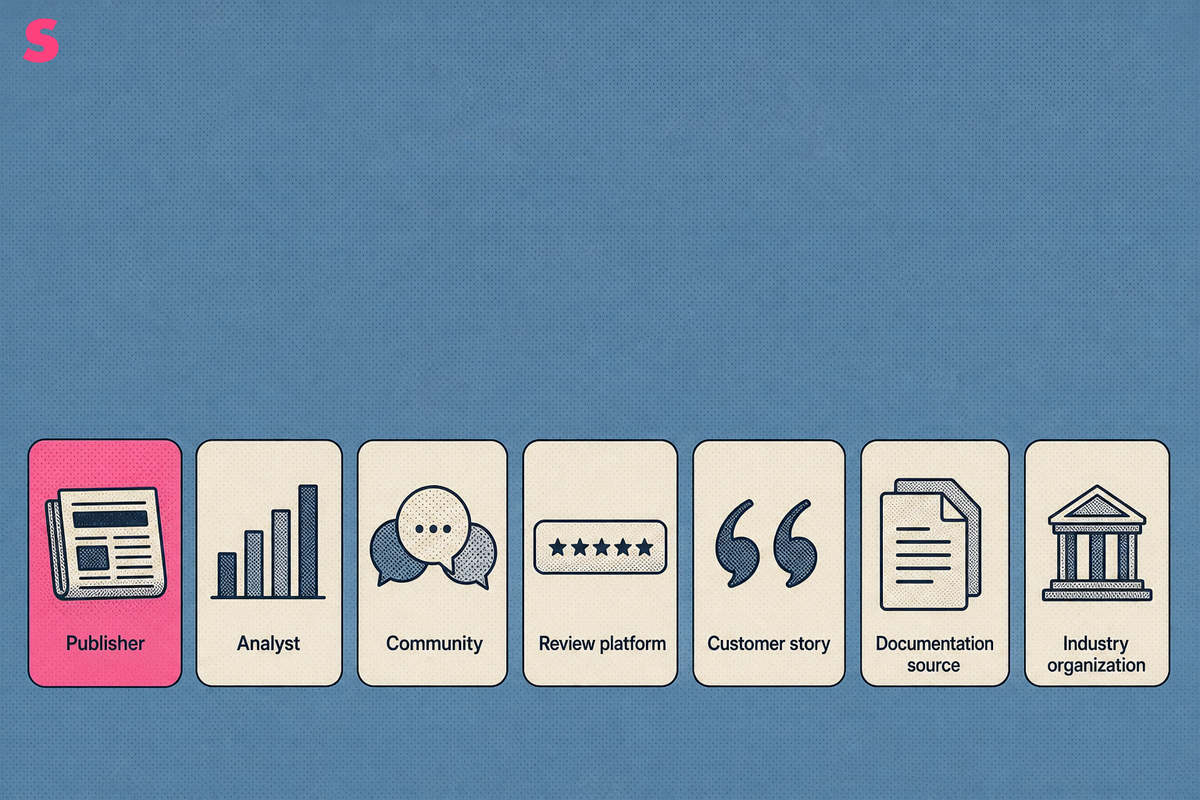
Inspect the domains Perplexity cites for your prompt panel. Classify each source by role: publisher, analyst, community, review platform, customer story, documentation source, or industry organization. This creates a target list based on retrieval behavior rather than a generic outreach list.
- Find citation gaps. Identify prompts where competitors appear through third-party sources and your brand does not.
- Contribute evidence. Publish original research, practical benchmarks, documented use cases, and expert explanations worth referencing.
- Improve discoverability. Make external profiles, product descriptions, case studies, and public documentation consistent with your positioning.
- Monitor source changes. Record new cited domains and lost citations in the same prompt log.
Do not confuse volume with authority. Ten shallow mentions do not carry the same strategic value as a respected source that repeatedly appears in commercial prompts. Prioritize sources connected to buyer questions that lead to evaluation, comparison, and purchase.
Third-party work should reinforce the claim on your owned page. If an external article describes your category inaccurately, repair the underlying evidence first, then offer a clearer primary source that publishers and analysts can reference.
How do you measure Perplexity citation success with a repeatable framework?
Measure Perplexity citation success with citation rate, mention share, citation share, recommendation rank, cited URL diversity, brand mentions, and AI referral traffic. A visibility framework dated May 18, 2026 separates citation rate, share of voice, and recommendation rank because each captures a different result.
| Metric | Question answered | Calculation | Action triggered |
|---|---|---|---|
| Citation rate | How often does Perplexity cite our domain? | Prompt-runs with at least one citation to an owned domain divided by all prompt-runs | Improve pages that should answer uncited prompts |
| Mention share | How often does our brand appear against named competitors? | Answers that mention your brand divided by answers that mention any brand in the comparison set | Investigate competitor sources and content patterns |
| Citation share | What share of cited domains belongs to us? | Citations to owned domains divided by all citations to domains in the comparison set | Investigate source gaps and page coverage |
| Recommendation rank | Where does the brand appear in a vendor recommendation? | Average brand order across eligible answers, assigning an absent brand a rank one place below the last named brand | Strengthen comparison, proof, and category positioning |
| Cited URL diversity | Are multiple pages earning citations? | Count of unique owned URLs cited during the measurement period | Expand coverage beyond one successful page |
| Brand mentions | How often does Perplexity name the brand? | Count of answer text instances that name the brand during the measurement period | Review prompt intent and brand positioning |
| AI referral traffic | How much site traffic arrives from Perplexity? | Sessions attributed to Perplexity referrals during the measurement period | Review landing-page relevance and conversion paths |
Use a fixed prompt panel and treat each completed prompt execution as one prompt-run. Preserve the raw answer, cited sources, date, market, settings, and comparison set for every run. Hold those variables constant, identify the page or variable changed, then compare baseline and post-change observations. Record absent brands as absent under the metric rules rather than removing those runs from the denominator.
This framework is a repeatable measurement protocol, not a claim of tested citation outcomes. A valid result requires recorded baseline and post-change observations, a documented change, and the same calculation rules for every prompt-run. Sona AI Visibility connects that prompt and citation data to pipeline and revenue, rather than leaving the team with a brand total alone.
Use a baseline date and preserve the raw answers. docs.perplexity.ai, October 19, 2026, states that the search_results field exposes source titles, URLs, and publication dates, while the older citations field was deprecated and removed.
Review the metrics in two layers. Read the daily series for prompt movement, then hold a monthly or quarterly business review for page priorities, source strategy, and revenue outcomes. This separates answer volatility from durable performance decisions.
How do you track Perplexity traffic and rankings when every answer varies?
Track Perplexity traffic through referral-source segments, landing-page analysis, prompt-level citations, assisted conversions, and branded search movement. Do not look for a traditional keyword ranking position. Perplexity produces a cited answer, so source inclusion and citation position are more useful measures.
Identical Perplexity queries can show 40–60% month-over-month URL drift, according to a tracking analysis dated May 18, 2026. That volatility makes a fixed prompt panel essential. Compare each run against the original baseline and a rolling daily series, not only against yesterday’s answer.
- Segment referral traffic. Create a Perplexity referral-source segment in your analytics platform.
- Map landing pages. Compare referral landing pages with the URLs your prompt panel records as cited.
- Connect conversions. Track form submissions, product signups, demo requests, and assisted conversions from those sessions.
- Investigate changes. Review answer text, cited URLs, competitor sources, page updates, and referral shifts together.
Sona AI Visibility uses AI Attribution to connect AI-referred visits, accounts, pipeline, and closed-won revenue on one timeline. That attribution matters when a buyer researches in Perplexity, reaches the site later through another channel, and converts after several sessions.
Perplexity’s standard web-search API costs $0.0025 per invocation, or $2.50 per 1,000 invocations, per docs.perplexity.ai, October 21, 2026. Its Fast Search API costs $1 per 1,000 requests, per docs.perplexity.ai, October 19, 2026. API collection can support a structured log, but the measurement design determines whether the data answers a commercial question.
Do you need a tool to run the panel and tie citations to revenue?
You need a tool when manual prompt checks no longer preserve answer history, citation details, traffic context, and ownership of follow-up work. A spreadsheet is sufficient for a small baseline. A platform becomes useful when multiple markets, competitors, pages, and stakeholders need a shared operating record.
The comparison below covers tools that can support AI visibility measurement. Prices, prompt allowances, engine coverage, and agency-plan status are stated as of October 2026. Perplexity Pro is listed at $20 per month or $200 annually, while Enterprise Pro is listed at $40 per user per month and Enterprise Max at $325 per user per month, per a July 7, 2026 pricing listing.
| Tool | Starting price | Agency Plans? (Yes/No) | # of Answer Engines Tracked | Answer Engines | # of Daily Tracked Prompts (entry plan) | Cost per Daily Tracked Prompt | Differentiation |
|---|---|---|---|---|---|---|---|
| Sona AI Visibility | From $75/month, billed annually | Yes | 11 | Not published | 5,000 credits/month, about 166 daily tracked prompts on one model or 56 across three | $0.45 per daily tracked prompt | Connects AI citations and prompts to pipeline and revenue on one account timeline |
| Peec AI | From $95/month | Yes | 3 | Not published | 50 prompts daily | $0.63 per daily tracked prompt | AI visibility tracking across self-serve and agency plans |
| Otterly.ai | From $29/month | Yes | 4 | ChatGPT, Google AI Overviews, Perplexity, Microsoft Copilot | 15 prompts daily | $0.48 per daily tracked prompt | Prompt monitoring across listed answer engines |
| PromptWatch | From $95/month | Yes | Not published | Not published | 50 prompts daily | $0.48 per daily tracked prompt | Prompt and response monitoring with agency tiers |
| Goodie | From $295/month | Yes | 5 | Not published | 110 prompts daily | $0.67 per daily tracked prompt | AI search visibility monitoring across model tiers |
Most trackers report mention counts, citation trends, and competitor visibility. Sona AI Visibility also follows AI-driven visits through account identification and revenue attribution, which changes the decision from whether a citation occurred to whether the citation influenced pipeline.
How do you know the optimization worked, and what do you do when it has not?
You know Perplexity optimization worked when the same prompt panel produces sustained gains in relevant citations, recommendation placement, cited URL diversity, qualified referral traffic, and commercial outcomes. One favorable answer is not success. A repeated pattern across the right prompts is success.
Set success criteria before deploying changes. For a category article, success could mean the intended page begins appearing as a citation for related category prompts. For a comparison page, success could mean your brand appears in relevant recommendations with accurate positioning.
- If citations rise but traffic does not: inspect the cited page, answer framing, call to action, and audience fit.
- If traffic rises but conversions do not: review landing-page intent, form friction, product relevance, and sales follow-up.
- If citations disappear: compare the new answer with the prior answer, then review competitor sources, technical access, content freshness, and page relevance.
- If no page appears: return to crawlability, direct-answer structure, and third-party authority before publishing more pages.
Recovery requires a documented change log. Record the page revised, the technical change, the date, the prompts affected, and the source pattern observed. Perplexity ranking tracker tools can document citation losses and rival content patterns, but the useful response is still a concrete page, source, or technical action.
Keep the operating rhythm disciplined: run the prompt panel daily, inspect material movements weekly, and review the strategic content and authority plan quarterly. The output is a record a team can use over time, not a score reported once.
What are the frequently asked questions about how to improve brand presence in perplexity?
Does Perplexity have a keyword ranking position I can track?
No. Perplexity synthesizes a cited answer rather than presenting a ten-result page. Track source inclusion, citation share, citation position, and recommendation rank across a fixed prompt panel. Those measures show whether Perplexity cited your brand, which URL it used, and how the brand appeared within the answer.
How many prompts do I need to measure Perplexity visibility?
Use 30–50 prompts as a minimum baseline, split across branded, category, and competitor prompts. A visibility-tracking methodology dated May 18, 2026 recommends that range for a useful signal. Add prompts only when they map to a genuine buyer question, page, or commercial use case.
How often should I re-run my Perplexity prompt panel?
Run the same prompt panel daily and use weekly reviews for competitive categories. A tracking analysis dated May 18, 2026 found 40–60% month-over-month URL drift for identical Perplexity queries. Compare each run with the baseline and daily history rather than treating one answer as definitive.
How do I find Perplexity referral traffic in my analytics?
Segment sessions by Perplexity as a referral source, then map landing pages to the URLs your prompt panel shows as cited. Pair that view with assisted conversions and branded search lift. Referral traffic alone cannot show every research interaction because some buyers return through another channel.
Does traditional SEO still matter for Perplexity?
Yes. Crawlable, well-structured pages remain the foundation for Perplexity citations. Perplexity presence also requires direct answers, third-party mentions, cited sources, and authority beyond traditional SEO rankings. Treat technical SEO as the access layer, then build content and external evidence on top.
Is changing the publication date enough to refresh a page for Perplexity?
No. Change the publication date only after meaningful updates to facts, evidence, structure, examples, or recommendations. Log the revision date and compare later citation movement against the prompt baseline. A date change without substantive work does not create a useful optimization test.
Summarize this article with AI: ChatGPT · Claude · Perplexity · Google AI Mode
Last updated: October 2026