Build an AI search engine by ingesting and chunking sources, embedding them, using hybrid keyword and vector retrieval, reranking results, and having a model respond only from retrieved passages with citations. Begin with a single source set and improve retrieval first, since a larger context window cannot fix weak retrieval. Before launch, test your top 500 real queries and evaluate citation accuracy independently of answer quality.
What do you need in place before you build an AI search engine?
To create an AI search engine, define a narrow corpus, retrieval target, authorization model, and evaluation set before writing the generation prompt. An AI search engine analyzes query context, intent, and semantics to deliver results, per ibm.com. It requires more than attaching an LLM to a search box.
| Traditional search | AI search |
|---|---|
| Ranks documents primarily through lexical matching and returns result links. | Combines semantic retrieval, retrieval-augmented generation (RAG), and synthesized answers with citations. |
| Leaves source comparison and answer construction to the user. | Retrieves evidence, explains the answer, and should identify the supporting passages. |
Start with one source set with clear ownership, such as product documentation, support articles, contracts, or selected public websites. Define what a successful answer includes: a direct response, supporting passages, source citations, and a refusal when evidence is missing.
- Corpus: the documents or web pages the engine can search.
- Identity and permissions: rules that prevent one user from retrieving another team’s private content.
- Retrieval index: keyword, vector, or hybrid indexes that return candidate passages.
- Answer contract: a structured response containing answer text, citations, confidence signals, and errors.
- Evaluation set: representative questions with expected evidence and known failure modes.
Define the evaluation set before deployment. A useful first benchmark is the company’s top 500 queries, audited by query type and failure mode, per the October 2026 listing.
Should an AI search engine search the web, your private documents, or both?
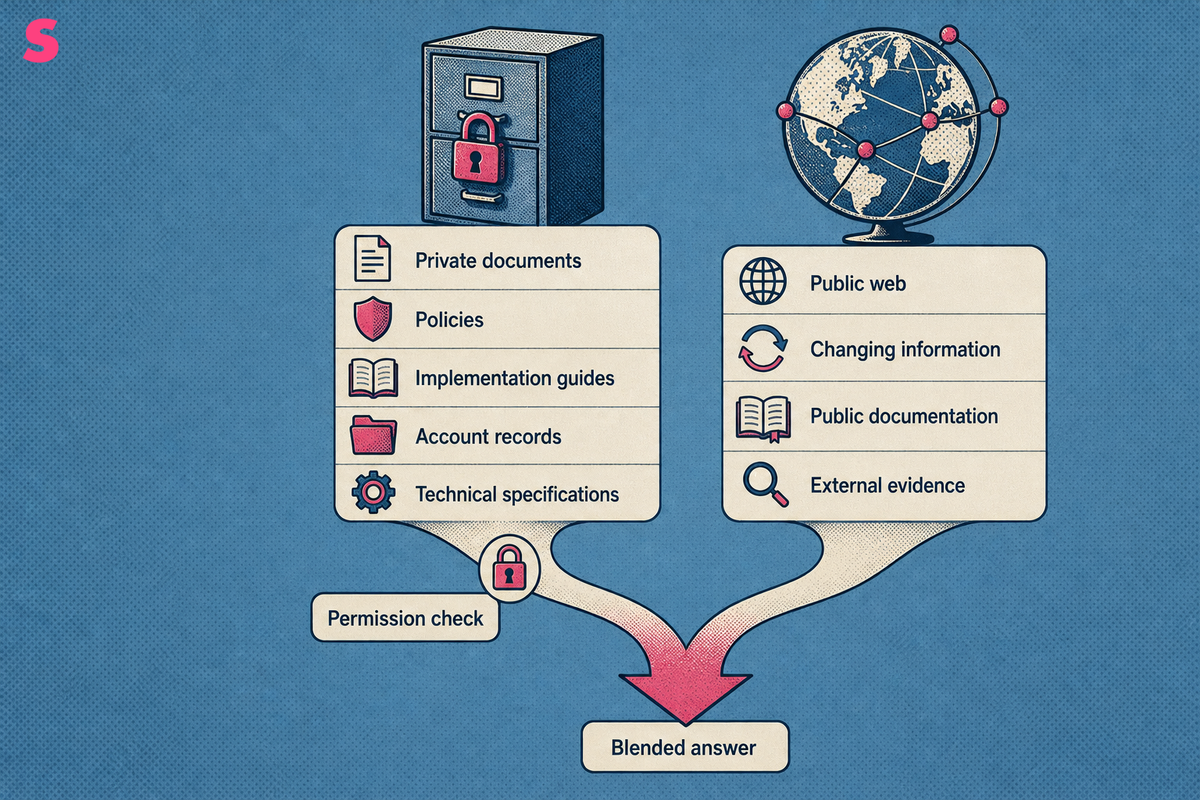
An AI search engine should begin with the source class that creates business value. Use private documents for permissioned internal knowledge, public web search for current external information, and both only when an answer needs internal context plus public evidence.
Private-document search works best for policies, implementation guides, account records, technical specifications, and internal research. The retrieval layer must filter by document-level permissions before ranking passages. Do not retrieve first and apply authorization later, because unauthorized passages can enter model context.
Web search works best for changing information, public documentation, and content outside a controlled corpus. A web pipeline needs query generation, search, URL extraction, content cleaning, deduplication, and citation metadata. Creating a custom AI search engine requires scaffolding, related queries, web search, and content extraction from URLs, per the October 2026 listing.
Common deployed use cases include employee-policy search in financial services, clinical-procedure search in healthcare, parts and specification search in manufacturing, case-law research in legal teams, and product-support search in software. Private-document search is appropriate when source access determines the answer. Public-web search is appropriate when freshness and external evidence determine the answer.
- Choose the initial source boundary, such as one documentation domain or one internal repository.
- Assign every document a source ID, canonical URL or file path, owner, timestamp, and access policy.
- Run retrieval against that boundary before adding a second source class.
- Add blended ranking only after separate internal and web retrieval results are measurable.
A blended engine should label each citation by source class. Users need to know whether an answer came from an approved internal policy, a public page, or both.
What architecture does an AI search engine need from ingestion to streamed answer?
An AI search engine needs an ingestion pipeline, hybrid retrieval, reranking, grounded generation, citation assembly, and an evaluation loop. Each layer should produce inspectable records so an engineer can identify whether a failed answer began with bad extraction, weak retrieval, or unsupported generation.
The ingestion pipeline fetches content, extracts clean text, preserves headings and metadata, chunks passages, creates embeddings, and indexes lexical fields and vectors. Keep raw content separate from normalized text. When a parser changes, reprocessing should create a new index version rather than silently replacing evidence.
- Receive the query: authenticate the user, apply permissions, and classify the request.
- Retrieve candidates: run keyword and vector search in parallel, then merge the results.
- Rerank evidence: score candidates against the complete question, not only embedding similarity.
- Generate from evidence: instruct the model to answer only from retrieved passages.
- Stream the answer: send answer tokens while preserving passage IDs for inline citations.
- Log the trace: retain the query, retrieved passages, ranking scores, citations, latency, and user feedback.
A successful streamed response contains three visible parts: an answer, citations that resolve to source passages, and a traceable failure state when no evidence clears the relevance threshold. That is a search system, not a chat interface with a search-shaped prompt.
Which build path fits your team: open-source framework, edge platform, or managed search API?
The right build path depends on who must operate retrieval quality, security controls, and infrastructure. Open-source frameworks suit teams that need full orchestration control. Edge platforms suit teams that want low-latency deployment near their application. Managed search APIs suit teams that prioritize a supported service boundary.
An open-source implementation commonly separates tool wrappers, agent logic, and the interface. A framework-and-interface implementation has four main stages: setting up dependencies, creating tool wrappers, building the interface, and implementing core agent logic, per medium.com. Open-source tools can also provide web-scale search capabilities, per youtube.com.
Use an edge platform when ingestion and retrieval must sit close to application traffic. Use a managed API when the organization accepts platform constraints in exchange for less operational work. Google’s Agent Search charges $4.00 per 1,000 queries for Search Enterprise Edition with Core Generative Answers, per cloud.google.com, October 2026.
| Build path | Orchestration control | Infrastructure ownership | Latency | Security boundaries | Vendor constraints | Operating burden |
|---|---|---|---|---|---|---|
| Open-source framework | High | Team-owned | Depends on deployment | Defined by the application team | Low platform dependency | High |
| Edge platform | Moderate | Shared with the platform | Low near application traffic | Defined across application and platform | Platform runtime and storage choices | Moderate |
| Managed search API | Lower | Provider-operated | Depends on provider routing | Provider service boundary | API, pricing, and feature constraints | Lower |
Real-world implementation examples include Cloudflare AI Search’s simple search pattern and a framework-and-interface build using tool wrappers and agent logic. Choose the path that preserves the permissions, observability, and retrieval controls required by the production workflow.
How do you build a web-search AI engine step by step, with working code?
Build a web-search AI engine by implementing one synchronous query path first: search, fetch, extract, chunk, retrieve, generate, and cite. Keep each adapter replaceable. A working prototype should search one approved domain before attempting broad web coverage.
- Create a query endpoint that accepts a user question and authenticated user context.
- Generate a small set of related queries only when the original query is ambiguous.
- Send the query to a web-search adapter and collect result URLs.
- Fetch allowed pages, extract main content, preserve canonical URLs, and reject duplicate text.
- Chunk and index the extracted passages with lexical and vector fields.
- Retrieve, rerank, generate a grounded answer, and return passage-level citations.
Install Express, then configure SEARCH_API_URL, SEARCH_API_KEY, LLM_API_URL, LLM_API_KEY, LLM_MODEL, and ALLOWED_HOST in the application environment. The search endpoint must return { results: [{ title, url }] }, and the LLM endpoint must accept an OpenAI-compatible chat-completions request.
import express from "express";const app = express();
app.use(express.json());
const env = process.env;
for (const key of ["SEARCH_API_URL", "SEARCH_API_KEY", "LLM_API_URL",
  "LLM_API_KEY", "LLM_MODEL", "ALLOWED_HOST"]) {
  if (!env[key]) throw new Error(Missing ${key});
}
const words = text => new Set(text.toLowerCase().match(/\w+/g) || []);
async function searchWeb(query) {
  const response = await fetch(${env.SEARCH_API_URL}?q=${encodeURIComponent(query)}, {
    headers: { Authorization: Bearer ${env.SEARCH_API_KEY} }
  });
  const body = await response.json();
  return body.results.filter(result =>
    new URL(result.url).host.endsWith(env.ALLOWED_HOST));
}
async function fetchAndExtract(result) {
  const html = await (await fetch(result.url)).text();
  const text = html.replace(/<script[\s\S]?</script>/gi, "")
    .replace(/<style[\s\S]?</style>/gi, "")
    .replace(/<[^>]+>/g, " ").replace(/\s+/g, " ").trim();
  return { ...result, text };
}
function chunk(page) {
  return page.text.match(/.{1,1200}(?:\s|$)/g)?.map((text, index) => ({
    id: ${page.url}#${index}, title: page.title, url: page.url, text
  })) || [];
}
function retrieve(query, passages) {
  const queryWords = words(query);
  return passages.map(passage => ({
    ...passage, score: [...queryWords].filter(word => words(passage.text).has(word)).length
  })).filter(passage => passage.score > 0).sort((a, b) => b.score - a.score).slice(0, 6);
}
async function generate(query, evidence) {
  const sources = evidence.map(p => [${p.id}] ${p.text}).join("\n");
  const response = await fetch(env.LLM_API_URL, {
    method: "POST",
    headers: { "Content-Type": "application/json", Authorization: Bearer ${env.LLM_API_KEY} },
    body: JSON.stringify({ model: env.LLM_MODEL, messages: [
      { role: "system", content: "Answer only from evidence. Cite passage IDs after factual claims. Say insufficient evidence when needed." },
      { role: "user", content: Question: ${query}\nEvidence:\n${sources} }
    ]})
  });
  const body = await response.json();
  return body.choices[0].message.content;
}
app.post("/search", async (req, res) => {
  const results = await searchWeb(req.body.query);
  const pages = await Promise.all(results.map(fetchAndExtract));
  const evidence = retrieve(req.body.query, pages.flatMap(chunk));
  if (!evidence.length) return res.json({ answer: "Insufficient evidence.", citations: [] });
  const answer = await generate(req.body.query, evidence);
  res.json({ answer, citations: evidence.map(({ id, title, url }) => ({ id, title, url })) });
});
app.listen(3000);
A sample request is POST /search with { "query": "What does this product support?" }. The response contains an answer string and a citations array of passage IDs, titles, and source locations. The search adapter, page fetcher, chunker, lexical retriever, generation call, and citation assembly are separate functions, so each component can be tested independently.
Cloudflare’s simple AI Search pattern describes 256 tokens as a sufficient chunk size for its example and recommends disabling query rewriting when matching the original query directly, per developers.cloudflare.com, August 2026 and updated October 2026. Use that setting for exact navigational or identifier-heavy queries.
How should you chunk, embed and retrieve passages so answers stay accurate?
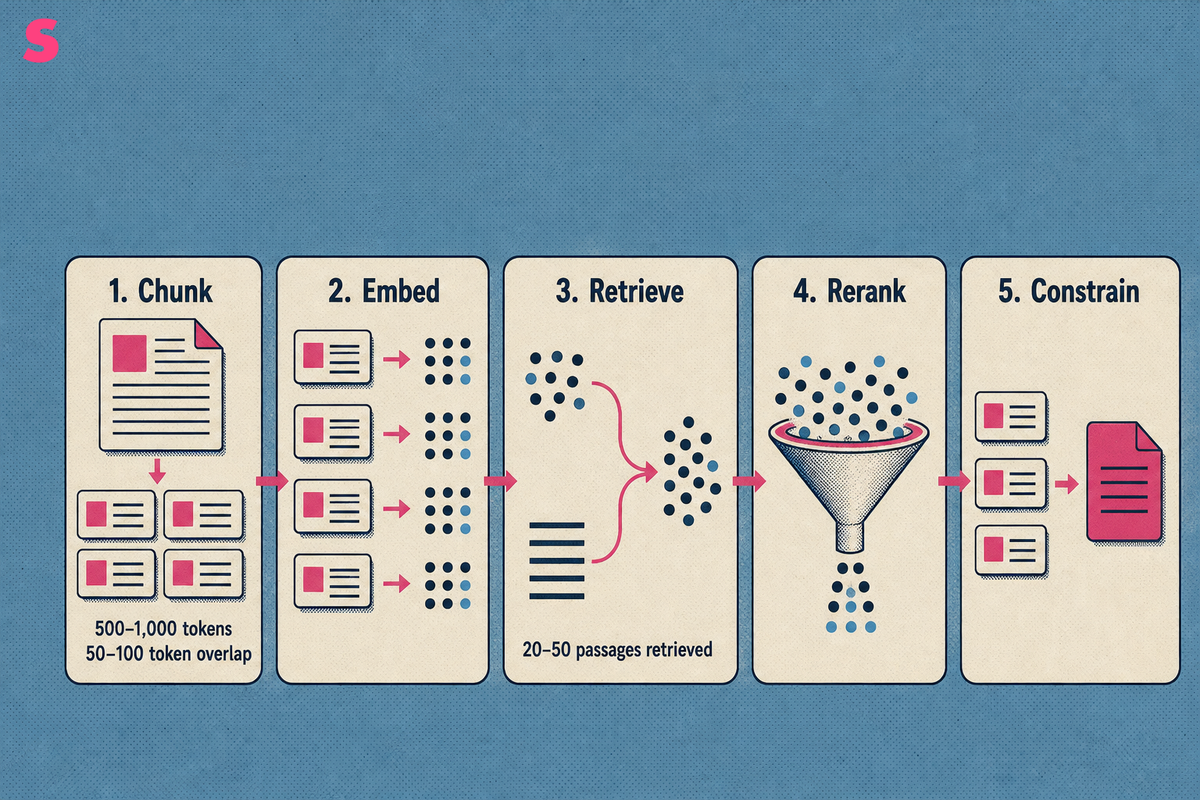
Accurate AI search depends on semantically complete chunks, hybrid retrieval, and reranking. Start with document sections rather than arbitrary character counts, retain heading context in every chunk, and use keyword retrieval alongside vectors for product names, error codes, clause numbers, and exact identifiers.
Tencent Cloud recommends 500–1,000-token document chunks with 50–100 tokens of overlap for its example architecture, per tencentcloud.com, August 2026 and updated October 2026. That range is a starting point, not a universal setting. A pricing table, API reference, and long policy document need different chunk boundaries.
- Chunk: split at headings, lists, and semantic boundaries while retaining parent-title metadata.
- Embed: store vectors for semantic similarity and preserve document, section, timestamp, and permissions metadata.
- Retrieve: combine lexical and vector results, then deduplicate overlapping passages.
- Rerank: score the top candidates against the full user question and requested answer format.
- Constrain: generate only from passages that clear a relevance threshold.
Retrieve broadly before generation. A practical RAG implementation can retrieve 20–50 passages before sending evidence to the generation model, per tencentcloud.com, August 2026 and updated October 2026. Reranking then narrows the candidate set to the passages the model receives.
How do you make an AI search engine cite sources and avoid hallucinations?
An AI search engine should treat citations as required output fields, not decorative links added after generation. Every factual claim needs a passage ID, source title, canonical location, and an evidence span the user can inspect.
Build the answer prompt around an evidence contract: use only supplied passages, cite each factual claim, state when evidence is insufficient, and never infer a missing detail from general model knowledge. The generation service should receive compact passage objects containing text, source metadata, retrieval score, and stable identifiers.
- Assign every chunk a stable passage ID and preserve its source location.
- Require the model to return claim-to-passage mappings in structured output.
- Validate that cited IDs exist in the retrieved evidence set.
- Reject or flag any sentence containing a factual claim without evidence.
- Display citations next to the relevant sentence, not only in a references block.
The common failure is citation laundering: the model attaches a real source to a nearby sentence that the source does not support. Test citation correctness separately from answer fluency. An answer can sound precise while relying on stale, partial, or irrelevant evidence.
Use abstention as a product feature. If retrieval returns no adequate evidence, return a concise explanation of the missing source coverage and offer a narrower query. Unsupported confidence is worse than a visible retrieval failure.
How do you know your AI search engine works, and how do you recover when it fails?
An AI search engine works when it retrieves authorized evidence, cites the correct passage, answers the question directly, and fails visibly when evidence is absent. Measure those outcomes with a fixed query set, production traces, and a failure taxonomy rather than a single satisfaction score.
Create test cases for navigational questions, factual lookups, multi-document synthesis, ambiguous queries, permission boundaries, stale content, and adversarial prompts. For each query, record expected sources, acceptable answer elements, prohibited claims, and whether abstention is correct.
- Bad extraction: the relevant page exists but text cleaning removed the needed section. Reprocess the document and compare extraction output.
- Bad retrieval: the passage exists but falls outside the candidate set. Improve metadata, hybrid search weights, or reranking.
- Bad citation: the cited passage does not support the claim. Tighten structured-output validation.
- Bad generation: evidence is correct but the answer overstates it. Reduce prompt latitude and require claim-level grounding.
Run the same prompt list daily once the engine supports public or changing content. Daily evaluation separates persistent changes from one-day noise. Run a full retrieval-quality review monthly or quarterly.
The Free AI Readiness Checker provides a separate technical check for whether AI can crawl and parse a site, returning a score and letter grade. The score is a dated snapshot; engine logs and repeated evaluations reveal the operating trend.
What does it cost to build an AI search engine compared with buying one?
Building an AI search engine costs engineering time, search infrastructure, model usage, content processing, security work, and ongoing evaluation. Buying enterprise search converts more of that work into subscription cost, but implementation, integrations, permissions, and data quality still require internal ownership.
Enterprise search is estimated at $20–$75 per user per month in 2026, per the October 2026 listing. For a 200-person company, that equals an estimated annual range of $48,000–$180,000 before implementation and overages, per the October 2026 listing. A separate 200-user, three-year comparison lists $144,000 for GoSearch Pro and $216,000 for Gemini Enterprise Standard, per the October 2026 listing.
Build when proprietary workflow, permissions, source control, or answer behavior are core requirements. Use a managed product when standard enterprise search solves the problem and the organization values deployment speed over custom retrieval architecture. Price the operational owner as carefully as the software bill.
What are the frequently asked questions about creating an AI search engine?
Is vector search enough to create an AI search engine?
No. Pure semantic retrieval can miss exact product names, identifiers, error codes, and contract language. Hybrid keyword-plus-vector retrieval is the safer default because lexical matching catches exact terms while embeddings capture semantic similarity. Add reranking after the first candidate set is assembled.
Why build an AI search engine when a general-purpose LLM already answers questions?
A general-purpose LLM does not inherently respect your permissions, cite internal sources, remain current with your content, or expose retrieval failures. A custom AI search engine is justified when those requirements matter to the workflow, particularly for internal knowledge, regulated processes, and technical support.
Does a larger context window remove the need for retrieval?
No. Sending more passages raises token cost and can dilute relevant evidence. Chunk design, reranking, and retrieval quality still determine answer quality. A practical pipeline retrieves 20–50 passages before generation, per tencentcloud.com, August 2026 and updated October 2026.
Do citations guarantee the answer is trustworthy?
No. A citation can point to a stale, partial, or irrelevant passage. Evaluate citation correctness and evidence sufficiency separately from readability. The citation must support the exact claim beside it, and the evidence set must be adequate for the user’s full question.
How long does it take to build a first working AI search engine?
There is no reliable fixed build time because corpus size, permissions, integrations, and evaluation requirements determine the work. Start with one narrow source set and one query path, then add permissions, hybrid retrieval, reranking, streaming, and evaluation. A narrow prototype exposes content and retrieval problems before platform complexity expands.
How do I get my own content cited by public AI search engines?
Keep pages crawlable and server-rendered, then measure what AI crawlers and referred visits actually do. Sona's own AI visibility data, September 2026, counts 8 answer surfaces: ChatGPT, Google AI Overviews, Perplexity, Google AI Mode, Gemini, Mistral, Qwen and Claude. Sona AI Visibility connects AI citations and prompts to pipeline and revenue, and tracks AI crawler activity from server logs or a lightweight edge worker without a JavaScript tag.
Summarize this article with AI: ChatGPT · Claude · Perplexity · Google AI Mode
Last updated: October 2026