An SEO MCP server connects an AI assistant like Claude or ChatGPT to SEO tools and data sources through plain-language requests, using the open Model Context Protocol rather than a custom integration. It provides actual ranking and keyword data instead of model estimates, but does not validate the model’s conclusions. Listed October 2026 starting prices run from $3 to $117.33 per month, while some servers bill by API credit or require a minimum payment. Begin with read-only access.
What is an SEO MCP server, and how does it connect an AI assistant to SEO data?
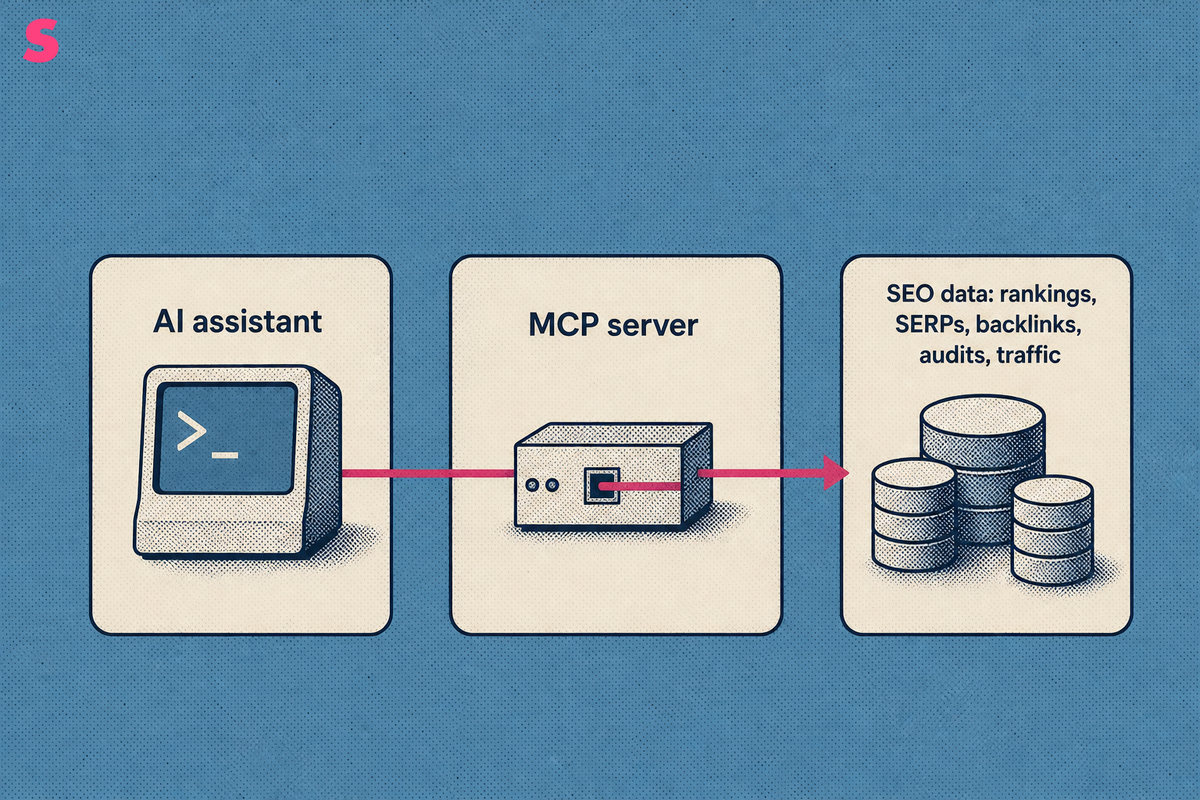
An SEO MCP server connects an AI assistant to SEO-tool APIs through plain-language requests. Model Context Protocol, or MCP, is an open standard that connects AI agents with external data sources, tools, and services through a standardized interface.
For SEO professionals, the practical value is access to current keyword metrics, SERP results, domain analytics, backlinks, site audits, and traffic analytics. The assistant retrieves underlying data rather than relying on training data.
As the Marketing91 editorial team wrote in September 2026, “An MCP server for SEO (or MCP for SEO) is a connector that lets an AI assistant call an SEO tool’s API in plain language, reading data and, for some servers, taking actions inside a project.”
An SEO MCP server does not replace an SEO platform, crawler, or analytics property. It is the connection layer between an AI client and those systems. The underlying tool retains control of data, permissions, usage limits, and actions.
How does a request travel from an AI assistant to an SEO tool and back?
An SEO MCP server translates an assistant’s request into a structured tool call, sends it to an SEO data source, and returns the result for interpretation. The assistant plans the question. The server controls available actions.
A simple mechanism looks like this:
- A marketer asks an AI assistant to identify pages losing rankings for a priority keyword cluster.
- The AI assistant selects an available SEO tool exposed through the MCP server.
- The MCP server sends a structured request using the connected account’s credentials.
- The SEO platform returns ranking, URL, keyword, or audit data.
- The assistant summarizes the result, identifies exceptions, and proposes a next action.
The distinction matters because the assistant does not receive unrestricted account access. It can call only the tools that the server exposes. A read-only server retrieves data. A write-capable server can create or modify objects when the connected platform supports those actions.
For example, an assistant can compare ranking data with audit output and identify pages that combine declining visibility with technical issues. That analysis starts with current account data rather than generic recommendations.
Is an SEO MCP server just an API wrapper, and what is it commonly confused with?
An SEO MCP server uses APIs, but it does more than a basic API wrapper. An API defines how software exchanges data. MCP gives an AI assistant a standardized way to discover tools, provide inputs, and use responses during a task.
The most common confusion is with traditional SEO work. Traditional SEO improves pages for crawlers and search results. An MCP connection exposes data directly to AI agents so they can analyze rankings, audits, backlinks, and keyword metrics during a conversation or workflow.
- It is not an SEO strategy. The server does not decide which commercial topics deserve investment.
- It is not an AI visibility tracker. Ranking and audit data do not show whether answer engines cite a brand.
- It is not autonomous execution. The assistant can take only actions that the server exposes and the account permits.
- It is not a replacement for data governance. OAuth scopes, API keys, and user permissions still determine access.
One 2026 comparison tested and ranked 9 SEO MCP servers, published September 7, 2026 and updated October 2, 2026. That count indicates a growing implementation market, not a shared feature standard.
Which SEO tasks can an SEO MCP server handle?
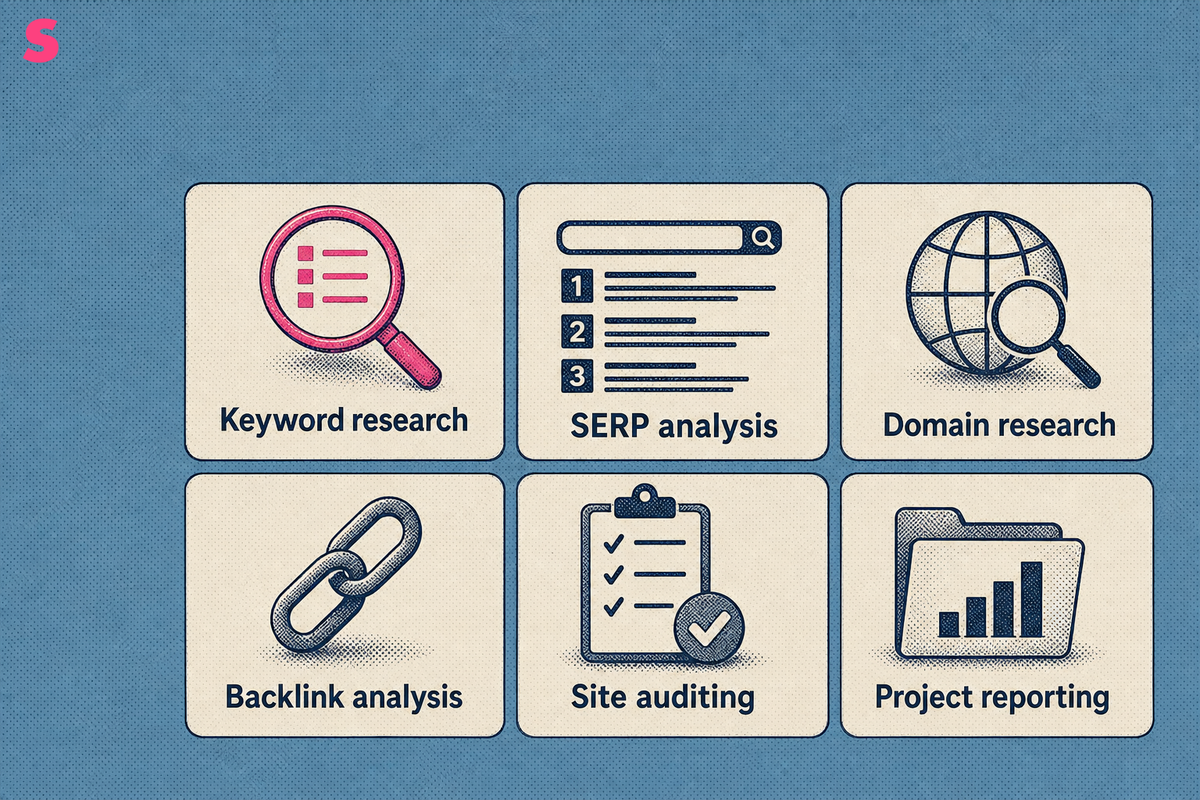
An SEO MCP server can support retrieval and analysis across keyword research, SERP analysis, domain research, backlink analysis, site auditing, and project reporting. The connected server determines the available task set.
A B2B team can ask an assistant to group declining pages by topic, find ranking opportunities around commercial terms, summarize backlink changes, or turn an audit into a prioritized worklist. This reduces manual navigation across dashboards, spreadsheets, and exports.
One MCP implementation lists 37 research tools for SEO, LLM visibility, keyword rankings, backlink profiles, site audits, and traffic analytics, per reddit.com. Another October 2026 listing describes 160+ tools across keyword research, backlinks, domain analysis, audits, AI search visibility, SERP analysis, and project management.
Sona AI Visibility supports a related measurement workflow by connecting citations to pipeline and revenue on one account timeline, while AI Search Insights shows prompts buyers ask and the pages that perform in AI answers. That work differs from using an MCP server to retrieve conventional SEO data.
Use the server for evidence gathering and structured analysis. Keep editorial judgment with the SEO team, especially when prioritizing topics, technical fixes, and content changes.
What are the types of SEO MCP server: hosted, local, community-built and vendor-built?
SEO MCP servers fall into four practical types: hosted services, local servers, community-built implementations, and vendor-built integrations. The right type depends on credential management, data location, and whether the team needs read-only analysis or write-capable workflows.
- Hosted servers run as a managed service. They reduce setup work but require review of account access, data handling, and billing.
- Local servers run on a user’s machine or controlled infrastructure. They give a team closer control of credentials and environment configuration.
- Community-built servers are open implementations maintained by developers. Free servers exist, including implementations based on Ahrefs data, per github.com.
- Vendor-built servers connect directly to an SEO platform’s existing data model and account permissions.
The hosting model alone does not establish safety. A local installation with broad credentials can expose sensitive data, while a hosted implementation with narrowly scoped read-only access can support a controlled analysis workflow.
Start with a narrow use case, such as rank analysis or Search Console reporting. Expanding to write actions before the team understands the tool inventory creates avoidable operational risk.
What does an SEO MCP server cost?
An SEO MCP server can cost nothing for a self-hosted implementation, a small monthly fee for API access, or a larger platform subscription for broad data coverage. Total cost includes the MCP connection, underlying data source, API credits, and internal setup time.
Published pricing spans several models. One SEO MCP offering starts at $39 per month for 500 API credits, $69 per month for 2,500 credits, and $299 per month for a team plan, per an October 2026 listing. Another pay-as-you-go MCP service requires a $50 minimum payment, per an October 2026 listing.
The following comparison provides AI visibility and MCP-access context. Pricing, engine coverage, prompt allowances, and agency-plan details are current as of October 2026. Sona pricing and product details are from Sona product documentation, October 2026.
| Tool | Starting price | Agency Plans? (Yes/No) | # of Answer Engines Tracked | Answer Engines | # of Daily Tracked Prompts (entry plan) | Cost per Daily Tracked Prompt | Differentiation |
|---|---|---|---|---|---|---|---|
| Sona AI Visibility | From $75/month billed annually | Yes | 11 | ChatGPT, Gemini, Google AI Mode, Google AI Overviews, Perplexity, Claude, DeepSeek, Grok, Copilot, Qwen, Mistral | 5,000 credits/month, about 56 daily tracked prompts on 3 engines | $0.45 per daily tracked prompt | Connects AI citations and prompts to pipeline and revenue on one account timeline |
| Peec AI | From $95/month | Yes | 3 | Not published | 50 prompts daily | $0.63 per daily tracked prompt | AI visibility tracking across self-serve and enterprise plans |
| Profound | Custom pricing | Yes | 9 | ChatGPT, Perplexity, Google AI Mode, Gemini, Microsoft Copilot, DeepSeek, Claude, Google AI Overviews, Exa Search | Not published | No per-prompt cost published | Daily prompt tracking under custom enterprise plans |
| Otterly.ai | From $29/month | Yes | 4 | ChatGPT, Google AI Overviews, Perplexity, Microsoft Copilot | 15 prompts daily | $0.48 per daily tracked prompt | AI visibility tracking with engine add-ons |
| PromptWatch | From $95/month | Yes | Not published | Not published | 50 prompts daily | $0.48 per daily tracked prompt | Prompt and response monitoring across supported models |
| Goodie | From $295/month | Yes | 5 | Not published | 110 prompts daily | $0.67 per daily tracked prompt | AI search visibility tracking across model tiers |
Price alone does not establish fit. SEO teams should separate assistant-access costs from the cost of trustworthy data, data-refresh cadence, credential management, and workflow review.
What are the security and accuracy risks of giving an AI assistant access to SEO data?
The main risks are over-broad permissions, exposed credentials, inaccurate interpretation, and unreviewed write actions. An SEO MCP server gives an assistant access to live systems, so the security model requires deliberate design before analysis begins.
Search Console properties, OAuth tokens, API keys, backlink data, competitor research, and internal URLs can reveal sensitive business information. Use a separate service account or narrowly scoped credentials where the connected system supports that control. Read-only access is the right starting point for most teams.
Accuracy needs a second control. The AI assistant can summarize returned data incorrectly, select the wrong date range, misunderstand a metric, or turn a correlation into a recommendation. The analyst should verify source rows, filters, geography, device context, and sampling before acting.
Write-capable tools require stronger review. One October 2026 listing reported 55 tools in one content platform’s MCP documentation, including 22 tools that create or modify content. Another listing reported 26 read-only tools in a separate platform’s MCP documentation. Read-only and write-capable access are materially different operating models.
What should a B2B SEO team check before and after deploying an SEO MCP server?
A B2B SEO team should define a narrow first workflow, restrict credentials, test data quality, and compare outputs against the source platform before using an SEO MCP server in recurring operations. Deployment is a governance task, not only an installation task.
| Deployment stage | What to check | Evidence to retain | Owner | Review cadence |
|---|---|---|---|---|
| Before connection | Tool inventory, available actions, API limits, data classifications | Approved tool list and permission map | SEO lead and RevOps | Before deployment |
| Credential setup | Read-only scope, token storage, account separation, expiry process | Credential owner and revocation procedure | Systems administrator | Before deployment |
| Initial validation | Rankings, URLs, date ranges, and filters against source records | Sample query and source-data comparison | SEO analyst | Initial deployment |
| Workflow review | Prompt templates, approval steps, and any write-capable actions | Documented operating procedure | SEO lead | Monthly |
| Performance review | Whether the server reduces manual work without reducing analytical rigor | Task log and exception record | SEO and marketing operations | Quarterly |
Use daily tracking for a recurring prompt list. A team that runs the same prompt list daily can identify patterns that a weekly snapshot averages away. A change that holds for four days is a trend. A one-day spike is not.
Technical re-audits and positioning reviews run on a different schedule. Review technical findings monthly or quarterly, then prioritize severity-ranked fixes attached to the affected page. A score is a dated snapshot; the attached fix creates an operational work item.
Sona AI Visibility also tracks AI crawler activity from server logs or a lightweight edge worker, without a JavaScript tag, helping a B2B team distinguish AI crawler access from ordinary site traffic during measurement review.
Does an SEO MCP server show whether AI assistants cite your brand?
An SEO MCP server can retrieve AI visibility data only when the connected tool exposes that data. It does not, by itself, show whether ChatGPT, Perplexity, Gemini, Claude, and other answer engines mention or cite a brand.
AI citation tracking is a separate measurement problem. Sona’s own AI visibility data, September 2026, covers 8 answer surfaces: ChatGPT, Google AI Overviews, Perplexity, Google AI Mode, Gemini, Mistral, Qwen and Claude. Coverage matters because a brand can appear differently across answer surfaces.
Monitoring which AI answers mention a brand is only half the job. Sona AI Visibility connects citations and AI-referred visits to accounts, pipeline, and revenue on one account timeline.
An SEO MCP server can support surrounding work by retrieving page data, audit findings, keywords, and ranking evidence behind a citation strategy. Teams should treat citation measurement, technical analysis, and revenue attribution as distinct but connected workflows.
What are the frequently asked questions about SEO MCP servers?
What does MCP stand for in SEO?
MCP stands for Model Context Protocol. It is an open standard that lets AI agents connect to external data sources, tools, and services in a standardized way. In SEO, MCP is the layer that lets an assistant query ranking, keyword, backlink, and audit data through approved tools.
Which AI assistants work with an SEO MCP server?
Large language model assistants such as Claude and ChatGPT can connect to SEO tools through an SEO MCP server. Support depends on both the AI client and the server implementation, so teams should confirm supported clients, authentication methods, and tool permissions before deployment.
Are there free SEO MCP servers?
Yes. Free community implementations exist, including some based on Ahrefs data, per github.com. Free access often requires self-hosted setup, external API costs, or strict usage limits. One technical crawler option is listed as free with a 500-URL cap, per an October 2026 listing.
Can an SEO MCP server change my website or my SEO tool settings?
Only if the installed server exposes write-capable tools. Some servers are read-only and return data for analysis. Others can create or modify content inside the connected platform. Check the documented tool list, required permissions, and approval flow before allowing write actions.
Is it safe to connect Google Search Console to an AI assistant?
It can be safe with narrowly scoped, read-only credentials and a documented revocation process. Search Console properties, OAuth tokens, and API keys can expose sensitive business data when permissions are broad. Test access with a limited property before connecting production accounts.
Is an SEO MCP server the same as optimizing content for AI search?
No. An SEO MCP server gives an AI assistant access to SEO data and tools. Optimizing for AI search concerns whether answer engines mention and cite a brand, which requires separate visibility tracking, page analysis, and attribution measurement.
Summarize this article with AI: ChatGPT · Claude · Perplexity · Google AI Mode
Last updated: October 2026