Brandlight does not publish pricing; it is available through quotes or paid pilots, while third-party estimates from October 2026 range from roughly $199 monthly at the low end to $4,000–$15,000 per month for enterprise agreements. The vendor has not confirmed any of these amounts, although one listing mentions a free trial. Multiple self-serve alternatives appear at or below the entry estimate; Sona AI Visibility additionally links prompts and citations with pipeline and revenue. View each amount as a quote-tested range, not a published list price.
What does Brandlight pricing cost, and does Brandlight publish it?
Brandlight pricing is quote-only rather than a published rate card. In October 2026, Brandlight’s pricing and plans pages returned 404 errors, so buyers needed to request a demo for pricing. That differs from self-serve AI visibility software with visible monthly plans.
Third-party estimates read in October 2026 place Brandlight at about $199 per month for entry access, $750 or more per month for an activation-level configuration, and roughly $4,000–$15,000 per month for reported enterprise contracts. These figures are not vendor-confirmed, so they are budgeting ranges rather than list prices.
One listing described a free trial in October 2026, but its terms were not independently verified. Treat a demo, trial, or paid pilot as a commercial proposal that requires written scope, deliverables, and pricing before approval.
For context, Sona AI Visibility publishes plans from $75/month, as of October 2026, while connecting AI citations to pipeline and revenue on one account timeline. Public pricing does not decide the product choice, but it makes initial budget comparison more direct.
Which Brandlight pricing tiers do third parties report, from entry to enterprise?
Third-party descriptions of Brandlight pricing report conflicting tier structures rather than one confirmed plan catalogue. The estimates range from about $199 per month at entry level to reported enterprise contracts between $4,000 and $15,000 per month, as read in October 2026.
| Reported tier | Approximate monthly price | Reported scope or billing detail |
|---|---|---|
| Entry | About $199 | Entry-level access, with inclusions not publicly verified |
| Starter | $250 annually or $300 monthly | Reported named tier, with feature limits not publicly verified |
| Growth | $417 annually or $500 monthly | Reported named tier, with feature limits not publicly verified |
| Activation | $750 or more | Reported activation-level configuration |
| Enterprise | $750 scaling to $5,000 or more, or $4,000–$15,000 in another estimate | Custom enterprise scope and sales engagement |
One October 2026 listing also reported an approximate $750 setup fee for the activation configuration. Keep that fee separate from the recurring monthly amount because onboarding cost and platform cost answer different budget questions.
Do not treat the $199 entry estimate, $250 Starter, $417 Growth, and $750 activation labels as one official price sheet. They are separate third-party descriptions read in October 2026.
How reliable are the reported Brandlight price estimates?
Brandlight did not publish a verified list price in October 2026. Its pricing required an enterprise sales engagement, and no published performance commitments were available on the pages checked that month.
The $199 entry estimate, $750 activation estimate, and $4,000–$15,000 enterprise range are third-party estimates read in October 2026. They can set an approval range, but they do not establish what a specific buyer will pay.
The gap between a $199 entry level and a $750 activation level is $551 per month, or $6,612 per year, based on October 2026 estimates. That spread warrants a line-item quote rather than a single headline number for an annual plan.
Tier names can conflict because listings may describe different sales packages, billing periods, service levels, or points in time. Record the date of every estimate, preserve the proposed scope, and compare quotes only after normalising them to monthly recurring cost.
What changes the price of a Brandlight quote?
A Brandlight quote can vary because enterprise proposals are scoped around the buyer’s operating model rather than a public plan menu. One October 2026 estimate describes usage-based scaling, which helps explain why buyers can receive different numbers.
Ask Brandlight to price the same operating requirements in every proposal:
- How many brands, domains, business lines, and markets does the quote cover?
- Which AI engines and prompt volumes are included in the recurring price?
- What onboarding work, setup fees, governance support, and services are included?
- Which deliverables belong to the platform subscription, and which belong to a managed program?
These questions create a consistent proposal scope, but they do not confirm Brandlight’s pricing mechanics. A multi-market organisation with several business lines may require a different commercial package than a company tracking one brand in one market.
Run the same prompt list daily once a program begins. Daily tracking can reveal changes that a weekly snapshot averages away, including shifts caused by retrieval indexes, model updates, and competitor publishing.
What does Brandlight include beyond monitoring?
Brandlight is described as an enterprise AI visibility platform that helps brands understand and influence how they appear in AI-generated answers. Reported extras include governance, recommendations, content execution, and strategic support, placing its commercial model beyond a dashboard subscription.
Those descriptions primarily come from vendor editorial material rather than independent evaluation. Buyers should request a written statement of work that separates software access from advisory work, content execution, and strategic support.
An October 2026 listing describes Brandlight as covering 11 AI engines, including ChatGPT, Perplexity, Gemini, Claude, Grok, Meta AI, Google AI Overviews, Microsoft Copilot, DeepSeek, GPT-4o, and OpenAI systems. Engine count does not establish prompt quality, citation analysis, or recommendation quality.
Brandlight held a 4.7/5 G2 rating from 19 verified reviews in October 2026. The review base can inform a sales conversation, but it cannot replace testing the prompt set, markets, and reporting requirements relevant to the buyer.
How does Brandlight pricing compare with self-serve AI visibility tools?
Brandlight uses custom pricing, while several self-serve AI visibility tools publish monthly entry points. The table uses monthly starting prices and the shared cost per daily tracked prompt unit where a published prompt cadence allows comparison, as of October 2026.
| Tool | Starting price | Agency Plans? | # of Answer Engines Tracked | Answer Engines | # of Daily Tracked Prompts (entry plan) | Cost per Daily Tracked Prompt | Differentiation |
|---|---|---|---|---|---|---|---|
| Sona AI Visibility | From $75/month | Yes | 11 | ChatGPT, Gemini, Google AI Mode, Google AI Overviews, Perplexity, Claude, DeepSeek, Grok, Copilot, Qwen, Mistral | 5,000 credits/month, about 56 daily tracked prompts across three engines | $0.45 per daily tracked prompt | Connects AI citations and prompts to pipeline and revenue on one account timeline |
| Brandlight | Custom pricing | Not published | Not published | Not published | Not published | No refresh cadence published | Enterprise AI visibility platform with reported governance and strategic support |
| Otterly.ai | From $29/month | Yes | 4 | ChatGPT, Google AI Overviews, Perplexity, Microsoft Copilot | 15 prompts daily | $0.48 per daily tracked prompt | AI visibility monitoring across listed answer engines |
| Peec AI | From $95/month | Yes | 3 | Not published | 50 prompts daily | $0.63 per daily tracked prompt | Prompt tracking across AI answer engines |
| Scrunch AI | From $250/month | Yes | 4 | ChatGPT, Perplexity, Google AI Overviews, Microsoft Copilot | 125 prompts, refresh cadence not published | No refresh cadence published | AI visibility monitoring for enterprise teams |
| Semrush AI Toolkit | From $99/month per domain | No | 4 | ChatGPT, Google AI, Gemini, Perplexity | 25 custom prompts tracked daily | $0.99 per daily tracked prompt | AI visibility tooling within an SEO platform |
| Ahrefs Brand Radar | From $199/month | No | Not published | Not published | Not published | No refresh cadence published | Brand monitoring and AI visibility analysis |
Sona AI Visibility tracks 11 answer engines, while Sona’s own AI visibility data covered 8 answer surfaces, ChatGPT, Google AI Overviews, Perplexity, Google AI Mode, Gemini, Mistral, Qwen, and Claude, in September 2026. Coverage count is useful context, but buyers should still ask whether tracked prompts represent commercial research.
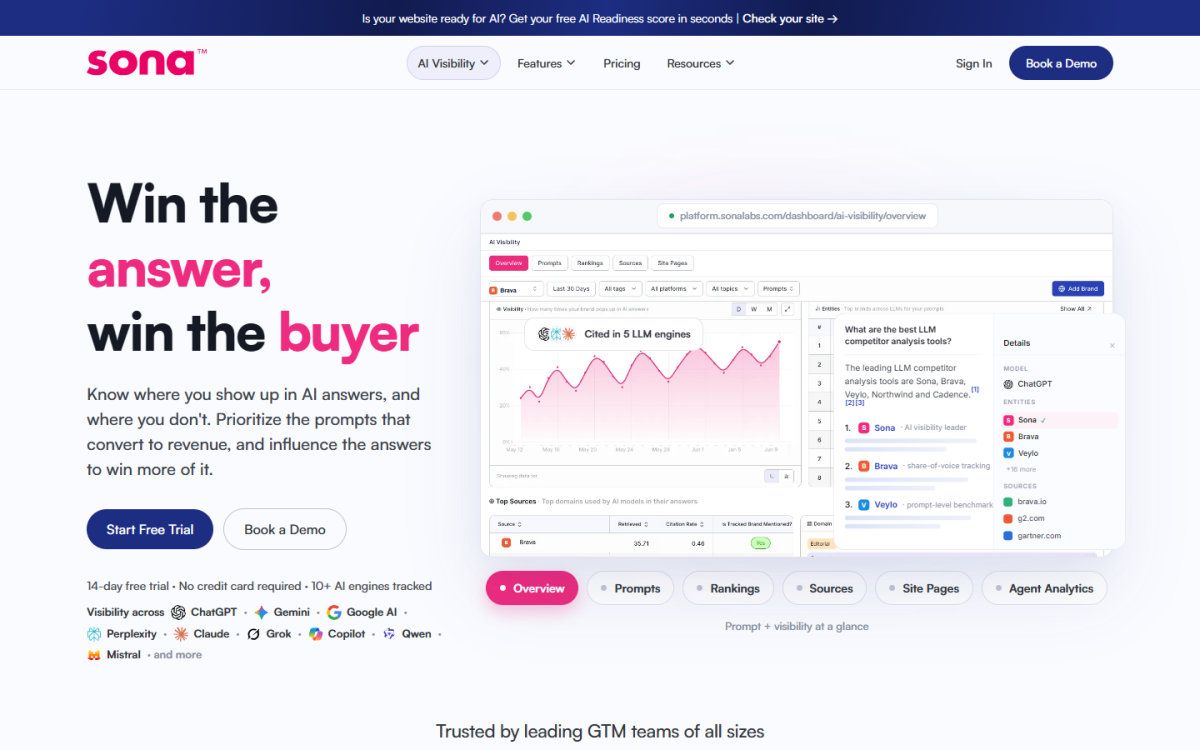
The published prices in the table are not a quality ranking. They show a budgeting distinction: Brandlight requires a scoped quote, while self-serve plans provide a visible starting point and published usage allowance.

When is Brandlight pricing a good fit, and when is a cheaper tool enough?
Brandlight pricing fits buyers that need multi-brand or multi-market governance, strategist-led support, and a scoped enterprise program. A self-serve plan can suit a team that owns prompt research internally and needs routine monitoring for one domain or a small prompt set.
For a single domain with a small prompt list, both a quote-led program and a self-serve subscription can support basic monitoring when the team has clear prompts, one market, and internal reporting ownership.
Vendor dependence deserves attention before a larger commitment. Ask who owns the prompt library, reporting definitions, exports, baselines, and recommendations. Those details affect switching costs and year-two budgeting more than a first-month discount.
Sona AI Visibility is relevant when the decision requires measurement beyond reported visibility, because it connects citations to pipeline and revenue and tracks AI crawler activity from server logs or a lightweight edge worker. The comparison then centres on the evidence a program can produce rather than dashboard access alone.
What should a buyer ask before accepting a Brandlight quote or paid pilot?
A Brandlight quote or paid pilot should define the measurement design before work begins. A pilot does not prove ROI merely because it produces a report. It needs predefined prompts, markets, metrics, and baselines before results count as evidence.
- Define the pilot length and the launch date.
- List every brand, domain, business line, and market included.
- Specify the AI engines and the number of prompts tracked each day.
- Document platform deliverables, advisory deliverables, and content deliverables separately.
- Set success metrics and record baseline measurements before launch.
- Agree on what happens after the pilot, including reporting access and next-step scope.
Ask for daily prompt reporting rather than a weekly snapshot. A change that holds for four days is a trend, while a one-day spike is noise. The output should become a comparable log rather than a dated score that cannot explain movement.
Use a quarterly clock for positioning reviews and competitive benchmark reports. Prompt tracking needs daily resolution, while strategy reviews benefit from a longer time window and a defined decision meeting.
What should a Brandlight quote be measured against, mentions or revenue?
A Brandlight quote should be measured against the business outcome it is expected to produce, not only mention volume. Mention and competitor tracking is the baseline most AI visibility tools offer. A stronger evaluation asks which prompts matter, which pages are cited, and whether that activity reaches commercial outcomes.
Monitoring AI answers that mention a brand is only half the job. Sona AI Visibility closes the other half through AI Attribution, which connects prompts and citations to accounts, pipeline, and revenue, while tracking AI crawler and agent activity at the front of that path.
Ask every vendor to show how reporting moves from a prompt to a business decision. A practical chain is prompt, cited page, account, pipeline, and revenue. If a proposal cannot define the evidence at each stage, the buyer is purchasing activity reporting rather than measurable contribution.
What are the frequently asked questions?
How much does Brandlight cost per month?
No public Brandlight price exists. Third-party estimates read in October 2026 range from about $199 per month at entry level to roughly $4,000–$15,000 per month for enterprise contracts. None of those figures is vendor-confirmed, so treat them as planning ranges.
Is Brandlight pricing public?
No. Brandlight did not publish pricing in October 2026, and its pricing and plans pages returned 404 errors. Buyers needed a demo request and sales conversation to receive a price.
Does Brandlight have a free trial?
One third-party listing described a free trial in October 2026. Brandlight is more often described as quote-only or as a paid pilot, so confirm trial duration, access, deliverables, and conversion terms in writing before relying on a trial.
How do I get a Brandlight quote?
Request a demo through the sales team. Bring a defined list of brands, markets, prompts, and AI engines so the resulting proposal can be compared with another quote or a self-serve subscription using the same scope.
Is Brandlight worth the price for a small business?
Brandlight can fit a small business that needs governance, multi-market coverage, or hands-on strategic support. For one domain and a small prompt set, self-serve monitoring tools with reported starting prices from about $29 to $199 per month, read in October 2026, can cover the basic requirement.
Are the reported Brandlight prices accurate?
Treat reported Brandlight prices as ranges rather than confirmed tiers. Third-party estimates read in October 2026 disagree on plan names and amounts, while Brandlight’s actual quote will reflect the requested scope, services, markets, and usage requirements.
Summarize this article with AI: ChatGPT · Claude · Perplexity · Google AI Mode
Last updated: October 2026