Yes, generative engine optimization carries risks: inaccurate or manipulated AI responses, harm to brand and reputation, technical and security exposure, and strategic risk due to unstable, difficult-to-measure outcomes. GEO is not equally appropriate for every site. Approach GEO as a measurement and governance challenge, assessing it by pipeline instead of mention counts; Sona AI Visibility links prompts and citations with pipeline and revenue. Presence in AI answers is never assured.
What are the main risks of generative engine optimization?
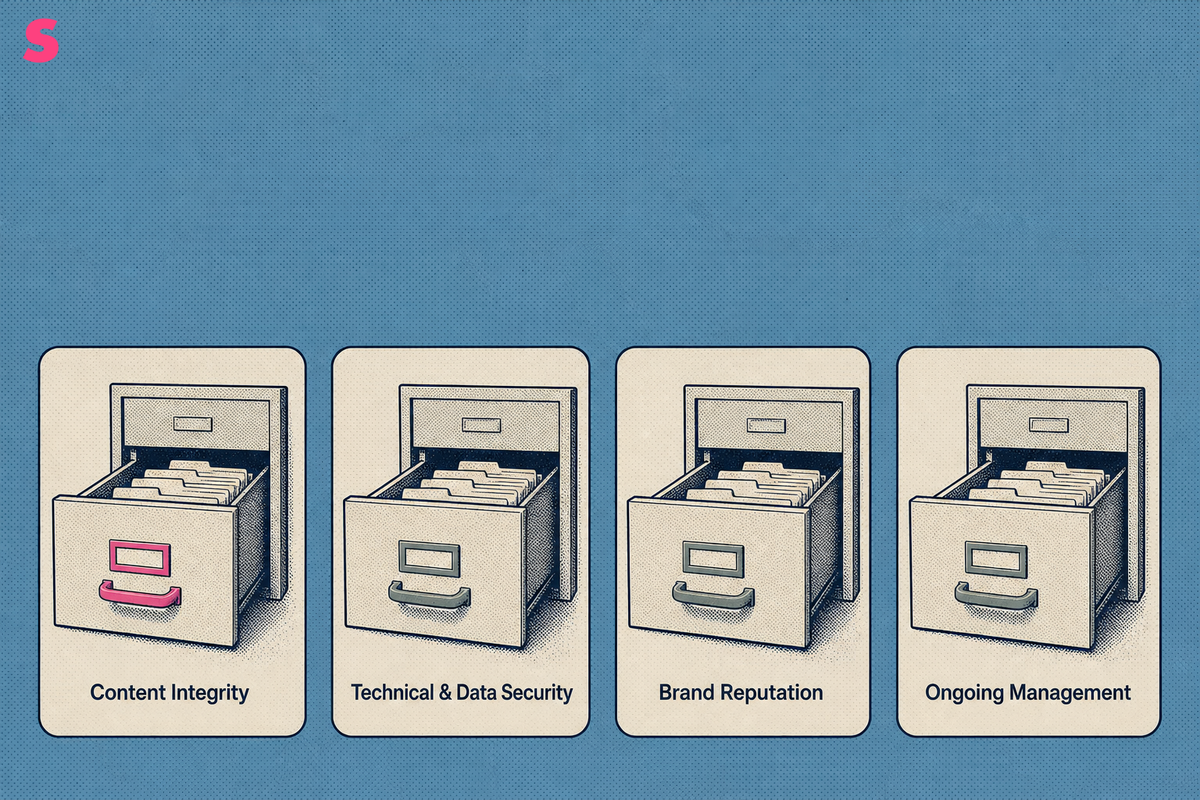
Yes, generative engine optimization carries risks. Generative engine optimization, or GEO, improves content and technical accessibility so AI answer engines can retrieve, cite, and summarize a website in responses.
The main GEO risks are content integrity, technical and data security, brand reputation, and ongoing management. Specific concerns include no guaranteed inclusion in AI responses, inaccurate summaries, over-optimization, weak evidence, and neglect of traditional SEO.
For marketing leaders, the operational risk is spending budget on visibility signals that do not produce qualified visits, pipeline, or revenue. An AI answer can cite a page without naming the brand, summarize it incorrectly, or rely on a third-party source. A citation shows retrieval, not commercial impact.
- Content risk: AI-generated or heavily optimized copy can become repetitive, thin, or poorly evidenced.
- Measurement risk: Answer placement changes between engines and over time, making a single snapshot unreliable.
- Reputation risk: A misleading summary can circulate under a brand’s name even when the source material is accurate.
- Security risk: GEO creates another advertising and security surface for LLM-based search, per techrxiv.org.
Manage GEO as a monitored marketing channel with editorial controls, technical governance, and an attribution plan.
Is generative engine optimization just SEO with a new label?
No. Generative engine optimization overlaps with SEO, but GEO addresses how AI systems retrieve, synthesize, cite, and present information in answers. SEO remains foundational because crawlability, authority, structured content, and useful pages affect whether source material can be discovered.
Both disciplines improve content discoverability, but they solve different problems. Traditional SEO concentrates on rankings and clicks in search results. GEO also covers citation selection, answer framing, source attribution, model volatility, and AI-referred traffic that can arrive without a visible search-result click.
A B2B software company can rank a comparison page in traditional search while an AI assistant cites an analyst article, review site, or directory instead. SEO still supports discoverability, but GEO requires teams to evaluate which third-party sources shape the answer.
Owned content alone is insufficient for many brands. “AI engines pull 90 percent or more of citations from third-party sources,” said PBJ Marketing, source author not individually named, May 15, 2026. Editorial outreach, accurate directories, credible references, and source consistency therefore matter.
The mistake is replacing SEO with GEO. SEO provides the technical and content foundation, while GEO adds a measurement and distribution problem.
Can AI engines misrepresent or misattribute content that is accurate?
Yes. AI engines can misrepresent accurate content through compression, faulty synthesis, stale retrieval, or incorrect attribution. Generative engine optimization can improve source accessibility, but it cannot control the final wording an answer engine produces.
Misattribution is especially damaging when an engine cites a repost, aggregator, or third-party summary instead of the original publisher. Jakob Nielsen’s research notes that unscrupulous actors can repost other people’s content, and an AI system can cite the repost when the original is less accessible.
Consider a company that publishes a technically accurate security guide. A reseller copies the guide, removes qualifying language, and earns a citation because its page is easier for an AI system to retrieve. The answer can then attribute a simplified or distorted claim to the reseller rather than the original expert source.
Generative engines also assess credibility through citations. Outdated or inconsistent directory information can weaken trust, particularly when a company’s name, location, category, services, or product details differ across sources.
- Maintain a canonical source page for material claims.
- Check third-party listings for inconsistent descriptions and outdated information.
- Use evidence, dates, and clear definitions in high-stakes pages.
- Review AI answers for attribution errors, not only whether the brand appears.
Sona AI Visibility connects citations and AI-referred visits to pipeline and revenue on one account timeline, helping teams distinguish visible citations from citations associated with commercial outcomes.
How can generative engine optimization damage a brand's reputation?
Generative engine optimization can damage a brand when it produces low-quality content, exaggerated claims, inconsistent third-party information, or attempts to manipulate answer engines. The reputational problem is not optimization itself. It is publishing material that cannot withstand citation, scrutiny, or repetition.
Poor GEO implementation can produce large volumes of near-duplicate pages built around prompt variations rather than useful, verified material for real readers.
Over-optimization creates a separate credibility problem. Pages overloaded with synthetic FAQs, unsupported comparisons, or unnatural product claims can become difficult for customers and partners to trust. The content may be technically crawlable yet commercially harmful.
Brand reputation also depends on source consistency. A prospect who receives one description from an AI answer, another from a directory, and a third from the company website has no clear basis for confidence. That is especially consequential for B2B companies with long buying cycles and multiple stakeholders.
- Require subject-matter review for claims about product capability, pricing, security, and outcomes.
- Keep product pages, support content, directories, and partner profiles aligned.
- Do not publish unverified AI-generated claims to fill perceived content gaps.
- Escalate repeated answer-engine inaccuracies as a communications and product-marketing issue.
GEO requires the same approval standards as any other public marketing channel. A citation is not a substitute for evidence.
What technical and security risks come with optimizing for AI engines?

Generative engine optimization introduces technical and security risks because AI crawlers, retrieval systems, and AI-referred visitors interact with websites differently from conventional search traffic. GEO turns LLM-based search into a new advertising and security surface, per techrxiv.org.
A company must decide which crawlers can access specific content while avoiding accidental blocks from robots.txt rules, web application firewalls, rate limits, rendering failures, or inconsistent canonical tags. A page that loads in a human browser but does not return useful server-rendered HTML can be harder for an AI system to parse.
Security teams also need to assess public content carefully. A page designed to answer detailed buyer questions can expose outdated pricing, unsupported implementation guidance, or operational detail that should remain private. GEO does not require publishing everything. It requires deliberate choices about authoritative public material.
The environmental cost also warrants consideration. Use of generative AI in simple internet searches is far more energy intensive than the text-based extractive searches that were previously the norm, per reddit.com. That does not make GEO inappropriate, but it supports focused content governance rather than indiscriminate content production.
Sona AI Visibility tracks AI crawler activity from server logs or a lightweight edge worker, without a JavaScript tag, so teams can inspect which AI crawlers reach pages without relying on browser-side tracking.
What do researchers say about the risks of generative engine optimization?
Research on generative engine optimization identifies risks beyond content mechanics. A position paper on arxiv.org, dated May 18, 2026 and updated September 19, 2026, identifies concentrated influence, undisclosed commercial influence, and academic-industry blind spots as three underexamined GEO risks.
Concentrated influence means a small number of answer engines can shape which sources, brands, and viewpoints receive attention. A company can improve its own site and still depend on opaque retrieval, ranking, and synthesis systems operated elsewhere.
Undisclosed commercial influence is a separate concern. If commercial incentives affect which sources are surfaced, promoted, or preferred, users may not know why a particular company appears in an answer. GEO teams should not treat answer placement as neutral proof of quality.
Academic-industry blind spots matter because organizations often test visible signals such as mentions or citations while missing downstream effects on trust, buying behavior, competition, and information quality. LinkedIn.com reported that 74% of marketers were already using GenAI in SEO workflows, while over half said they did not know how to measure its impact, in 2026.
GEO needs governance. Teams should document claims, retain source evidence, distinguish visibility from endorsement, and evaluate commercial outcomes separately from answer-engine appearances.
Why is generative engine optimization hard to measure, and what do monitoring tools cost?
Generative engine optimization is hard to measure because answers vary by engine, prompt wording, retrieval state, and time. Monitoring costs range from $10 to $1,000+ per month for DIY tools and $1,500 to $50,000+ per month for agency services, per an October 2026 listing.
A brand-level visibility score is a dated snapshot, not a work plan. Teams need to know which prompts triggered the result, which sources were cited, and which pages should own the answer. Sona AI Visibility provides that prompt-level view through AI Search Insights, which shows buyer prompts and the sources AI engines cite.
Most chatbot engines refresh only monthly on a rolling 90-day window, per an October 2026 listing. A content change can therefore take time to influence persistent answer behavior. A short delay does not prove that a page failed.
For tracked prompts, use a daily operating rhythm. A team that runs the same prompt list daily can identify patterns that a weekly snapshot averages away. Compare repeated observations with isolated fluctuations, and define trend thresholds from the team’s own baseline and monitoring cadence.
Sona's own AI visibility data, September 2026, covers 8 answer surfaces: ChatGPT, Google AI Overviews, Perplexity, Google AI Mode, Gemini, Mistral, Qwen, and Claude. A useful measurement program compares like-for-like prompts and records cited sources, answer language, page destination, and commercial result.
| Tool | Starting price | Agency Plans? | # of Answer Engines Tracked | Answer Engines | # of Daily Tracked Prompts (entry plan) | Cost per Daily Tracked Prompt | Differentiation |
|---|---|---|---|---|---|---|---|
| Sona AI Visibility | From $75/month, billed annually, as of October 2026 | Yes | 11 | ChatGPT, Gemini, Google AI Mode, Google AI Overviews, Perplexity, Claude, DeepSeek, Grok, Copilot, Qwen, Mistral | 5,000 credits/month, about 56 prompts tracked daily across three engines | $0.45 per daily tracked prompt | Connects AI citations and prompts to pipeline and revenue on one account timeline |
| Peec AI | From $95/month, as of October 2026 | Yes | 3 | Not published | 50 prompts daily | $0.63 per daily tracked prompt | AI visibility tracking for self-serve and agency plans |
| Otterly.ai | From $29/month, as of October 2026 | Yes | 4 | ChatGPT, Google AI Overviews, Perplexity, Microsoft Copilot | 15 prompts daily | $0.48 per daily tracked prompt | Prompt tracking across its Lite-tier answer engines |
| Scrunch AI | From $250/month, as of October 2026 | Yes | 4 | ChatGPT, Perplexity, Google AI Overviews, Microsoft Copilot | 125 prompts, frequency not stated | No refresh cadence published | AI search monitoring across Core and Enterprise plans |
| PromptWatch | From $95/month, as of October 2026 | Yes | Not published | Not published | 50 prompts daily | $0.48 per daily tracked prompt | Daily prompt tracking with response allowances |
Does generative engine optimization work for all types of websites?
No. Generative engine optimization does not work equally well for every website because results depend on crawlability, third-party coverage, content quality, buyer intent, and the questions answer engines receive. Transactional B2B sites and established publishers have different GEO opportunities from local, highly regulated, or thin-content websites.
Websites with clear product documentation, independently cited expertise, and strong technical accessibility provide more material for answer engines to retrieve and validate. A local business can still benefit, but results often depend more heavily on accurate directories, reviews, and location-specific third-party sources.
Tool selection does not resolve the fit question. A website needs a realistic prompt set, enough source material to cite, and a way to determine whether citations relate to commercially valuable research behavior.
Which generative engine optimization mistakes are most worth avoiding?
The GEO mistakes most worth avoiding are abandoning SEO, optimizing for mentions alone, publishing weak AI-generated content, treating one score as a strategy, and failing to audit source accuracy. Each creates activity without a defensible measurement or editorial process.
Start with a limited prompt set tied to real buyer questions. Record the answer, cited sources, brand mention, page cited, and commercial intent. A broad list of generic prompts creates noise. A focused list reveals which questions matter to the business.
- Do not treat guaranteed inclusion as an achievable target.
- Do not create pages solely to repeat prompt wording.
- Do not ignore traditional SEO, technical accessibility, or third-party source quality.
- Do not publish claims without evidence and an accountable reviewer.
- Do not use a quarterly audit as a substitute for daily prompt monitoring.
A GEO implementation guide dated May 15, 2026 and updated October 17, 2026 recommends a quarterly audit cadence because models and ranking behavior change over time. Use quarterly reviews for strategy, technical assessment, and source consistency. Use daily tracking for the fixed prompt list.
Sona AI Visibility can help teams connect citations to pipeline and revenue, but management discipline remains essential: verify claims, maintain accurate sources, document changes, and prioritize prompts with commercial relevance rather than visibility alone.
Frequently Asked Questions
Can generative engine optimization guarantee my brand appears in AI answers?
No. GEO cannot guarantee inclusion because answers vary between runs and answer engines. Owned content alone also cannot secure a mention, because a GEO implementation guide stated that AI engines obtain 90% or more of citations from third-party sources, dated May 15, 2026 and updated October 17, 2026.
Does generative engine optimization replace SEO?
No. Traditional SEO remains the foundation for crawlability, discoverability, page quality, and technical access. GEO adds retrieval behavior, citation generation, answer synthesis, and answer volatility. Ignoring SEO is a documented GEO risk.
Can bad actors manipulate what AI engines say about my brand?
Yes, in principle. Reposted content can be cited instead of the original when the original is less accessible to an AI system, according to research from jakobnielsenphd.substack.com. Researchers have also described prompt injection and adversarial manipulation as risks around AI-driven recommendations.
How often should I review my GEO results?
Run the same prompt list daily so the team can distinguish a sustained change from an isolated fluctuation. For strategy and technical governance, a GEO implementation guide dated May 15, 2026 and updated October 17, 2026 recommends quarterly audits because models and ranking behavior change over time. Chatbot refresh cycles can also be slow.
Is generative engine optimization worth it for a small or local business?
It depends on third-party coverage, crawlability, and how transactional buyer intent is. Local businesses often need accurate directory information and credible third-party references. Regulated organizations need additional editorial review because unsupported summaries or stale information can create greater reputational exposure.
How much does generative engine optimization cost?
GEO costs range from $10 to $1,000+ per month for DIY tools and from $1,500 to $50,000+ per month for agency services, per an October 2026 listing. Prompt caps, answer-engine coverage, refresh cadence, agency support, and reporting scope vary by tool and service level.
Summarize this article with AI: ChatGPT · Claude · Perplexity · Google AI Mode
Last updated: October 2026