AI visibility checkers are tools that measure whether ChatGPT, Gemini, Perplexity, Google AI Overviews and Claude mention, cite or recommend a brand, and prices for paid tools cluster between $29 and roughly $295 a month. Sona goes further by connecting those citations and AI-referred visits to pipeline and revenue rather than stopping at mention counts. This article explains how these checkers work, what they cost, and what to look for before choosing one.
What is an AI visibility checker?
An AI visibility checker is a tool that measures whether AI systems mention, cite, rank, recommend, or describe a brand in generated answers. It runs a set of buyer questions against one or more AI engines and records what those engines say.
The category exists because search behavior has split. A shopper used to type a keyword into Google and click through a results page. Now the same shopper might ask ChatGPT or Perplexity for a recommendation and never visit a search results page at all. Visibility checkers were built to close the reporting gap that split created.
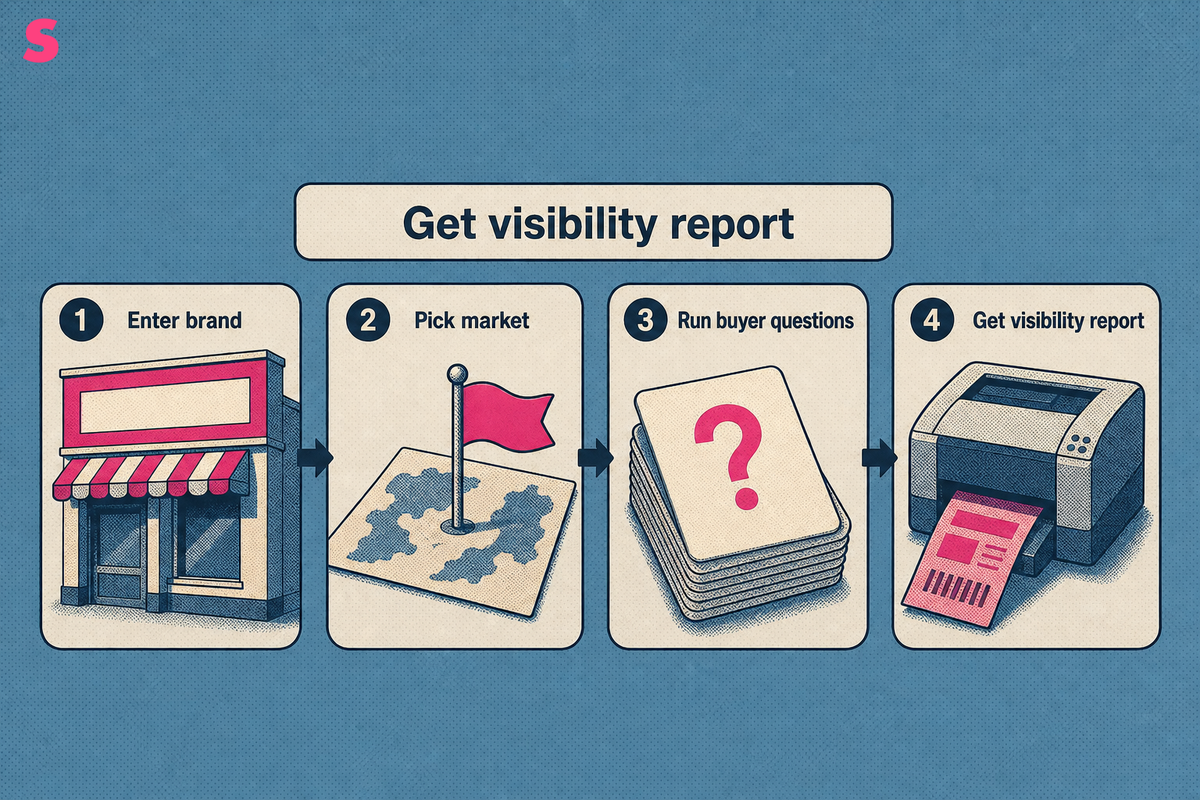
Most tools in this space work from the same premise: enter a brand, pick a market, and get back a report showing where and how often that brand surfaces. Sona AI Visibility applies the same premise but carries it further, connecting each citation and prompt to pipeline and revenue on one account timeline rather than stopping at a mention count, and surfacing the AI crawler and agent activity that precedes those citations. A report broken down to the citation and prompt level is more actionable than a single mention count, because it shows which specific question or source to fix rather than only whether visibility rose or fell.
Why does AI visibility matter for a brand?
AI visibility matters because buyers now form opinions about vendors before they ever reach a company's website. If an AI engine never mentions a brand, or mentions a competitor instead, that brand loses a sale it never knew was in play.
This differs from classic search engine optimization (SEO) in one important way: there is no ranked list of results to check manually. An AI answer is generated, often personalized, and rarely reproducible on demand. A brand that wants to know its standing has to ask the same questions an AI engine gets asked, repeatedly, and track the pattern.
The stakes rise with category competitiveness. In a crowded software category, a small number of vendors tend to dominate most AI answers, and everyone else gets omitted entirely. Visibility checkers exist to tell a brand which side of that line it sits on, and whether that position is improving or slipping over time.
Repeated observation, not a single check, is what separates a genuine pattern from one lucky or unlucky answer. An engine can name a brand on Monday and omit it on Tuesday for the same prompt, so a checker that runs once tells you what happened once.
How does an AI visibility checker actually work?
An AI visibility checker works by running a fixed set of prompts through AI engines on a schedule, then parsing each answer for brand mentions, citations, ranking position, and sentiment. The output is a structured report rather than a raw transcript.
A typical AI visibility checker workflow involves entering a brand or domain, selecting a market, and receiving a visibility report. The steps are consistent enough across vendors to describe as a single procedure:
- Enter the brand name or domain to be tracked.
- Select the target market or language, since answers vary by region.
- Choose or accept a default set of prompts representative of buyer questions in that category.
- Run those prompts against one or more AI engines.
- Parse each answer for mentions, citations, ranking position, and sentiment.
- Aggregate the results into a score and a report.
The archive behind this process can be large. Sona's own AI visibility data, August 2026, covers eight answer surfaces: ChatGPT, Perplexity, Gemini, Google AI Mode, Google AI Overviews, Claude, Mistral and Qwen. Some offerings capture the end-user experience directly, scraping the prompt response the way a person would see it, ads, formatting, and all. Others pull data from the vendor's official API, which returns a structured response that doesn't necessarily match what an end user sees on screen. The two methods don't just collect data differently. They can capture different answers. Sona aims to mirror the end-user experience as closely as possible, and utilizes both methods to do it.
Where this gets useful is at the prompt level rather than the brand level. A single visibility score for a brand tells you almost nothing actionable; it does not say which question is being missed or which competitor is winning that answer. Sona AI Search Insights breaks the report down to the individual prompt, showing which questions surface the brand and which sources the AI engine cited to produce that answer, which turns a score into a list of specific things to fix.
Which AI platforms do these tools monitor?
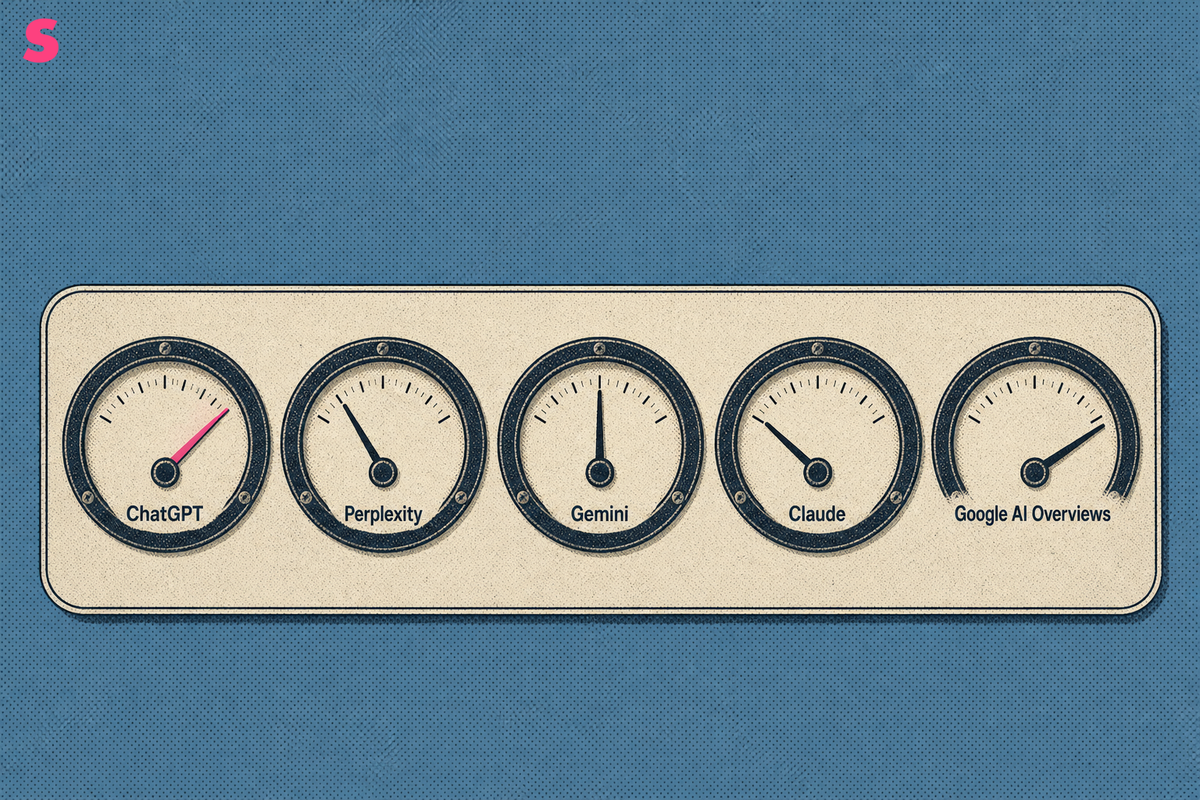
AI visibility checkers analyze brand presence across multiple AI platforms including ChatGPT, Gemini, Perplexity, and Claude. Most vendors monitor a similar core set, then differ in how many additional engines they add beyond it.
Coverage matters because each platform answers differently. Perplexity leans on live web citations and shows its sources plainly. Google AI Overviews draw on Google's search index and appear directly inside search results. ChatGPT and Claude blend training data with retrieval, depending on whether browsing is enabled for a given query. A brand strong in one engine can be invisible in another.
The practical implication is that a single-engine check gives a partial picture. A brand that only checks ChatGPT might miss that it never appears among Perplexity's citations, which matters if a category's buyers lean toward one engine over another. Multi-engine coverage is the only way to see the whole pattern rather than a slice of it.
- ChatGPT: blends trained knowledge with retrieval when browsing is active.
- Perplexity: citation-heavy, sources shown alongside every answer.
- Gemini: integrated with Google's broader search and answer surfaces.
- Claude: strong reasoning over provided or retrieved context.
- Google AI Overviews: appears directly inside Google's search results page.
What does a typical AI visibility report show?
A typical AI visibility report shows mention frequency, ranking position, citation sources, sentiment, and competitor comparison, broken out by prompt and by engine. It reads closer to a dashboard than a single summary paragraph.
An AI visibility checker can evaluate observable signals such as technical access, prompt presence, mentions, citations, and competitor visibility. Technical access covers whether an AI crawler can reach a page in the first place, since a blocked or misconfigured site cannot be cited no matter how good its content is. Prompt presence tracks whether the brand shows up at all for a given question. Citations track which sources the AI engine pulled from.
Most reports also segment results by market or language, since a brand can be dominant in one region's answers and absent in another's. A report limited to one country tells an incomplete story for any brand selling internationally.
How do you interpret an AI visibility score?
An AI visibility score is a percentage or index showing how often a brand appears across the tracked prompts and engines, not a guarantee of business results. Reading it correctly means treating it as a presence measure, not a performance measure.
Vendors generally calculate visibility from the share of tracked answers that contain the brand, but the exact math varies. Some weight ranking position into the score, so a brand mentioned last counts less than one recommended first. Others weight sentiment, so a negative mention counts differently from a neutral one.
The comparison that matters most is not the absolute number but the trend against competitors. A brand trailing its main competitor on visibility might be losing badly, or it might be comfortably ahead of the category average, depending on where that average sits. Context, not the raw figure, is what turns a score into a decision.
Scores also hide the prompt-level detail that decides what to do next. Two brands can share the same overall score while one wins on high-intent, commercial prompts and the other wins only on generic informational ones. That distinction is invisible at the brand level and only shows up when the report is broken down prompt by prompt, which is why a single number should be treated as a starting point for investigation rather than a conclusion.
What do free and paid AI visibility checkers actually cost?
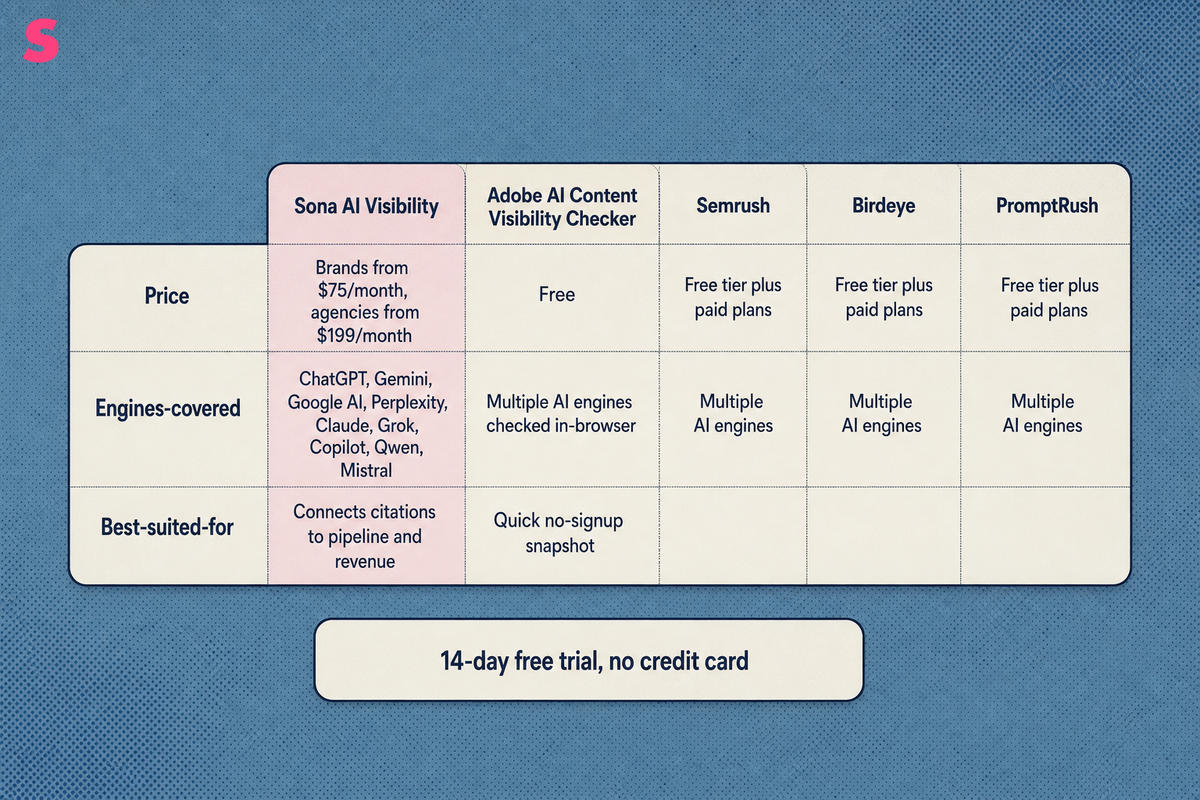
Sona AI Visibility publishes list pricing rather than gating it behind a sales call, and connects the citations it finds to pipeline and revenue rather than stopping at a mention count. Free AI visibility checkers are also available from multiple vendors including Semrush, PromptRush, Birdeye, and Adobe. The gap between free and paid is less about whether a check runs at all and more about scale, history, and competitor tracking.
Free tools tend to run one check at a time, on demand, without saved history. Paid tools add what free tiers generally skip: recurring monitoring, competitor benchmarking, multi-market coverage, and larger prompt sets.
| Tool | Price point | Engines covered | Best suited for |
|---|---|---|---|
| Sona AI Visibility | Brands from $75/month, agencies from $199/month, both billed annually. 14-day free trial, no credit card | ChatGPT, Gemini, Google AI, Perplexity, Claude, Grok, Copilot, Qwen and Mistral | Connecting citations to pipeline and revenue on one account timeline, not just mention counts |
| Adobe AI Content Visibility Checker | Free | Multiple AI engines checked in-browser | A quick, no-signup snapshot with no Adobe license required |
| Semrush | AI visibility is bundled into the main plans, from about $165/month billed annually. Separate free AI visibility checker. 7-day trial | Multiple AI engines | Free and paid AI visibility monitoring |
| Birdeye | Quote-only, priced by number of locations. Free AI visibility checker | Multiple AI engines | Free and paid AI visibility monitoring |
| PromptRush | From $19/month (Lite), $99 (Growth), $279 (Scale). Free one-off report, no signup | Multiple AI engines | Free and paid AI visibility monitoring |
| Category-level paid range | $29 to roughly $295/month, some entry points near $399 | Varies by vendor | General reference across the paid tools above, not tied to any single vendor |
A brand comparing tools should check whether the published price covers one market or several, and whether competitor tracking is bundled in or sold as an add-on, since "paid" can mean very different things across vendors.
Where do AI visibility checkers fall short?
AI visibility checkers fall short on data freshness, on connecting presence to actual business outcomes, and on covering every engine equally well. These are structural limits, not vendor mistakes, and they apply across the category.
Users report that AI visibility data can be slow to update and sometimes inaccurate, with some tools offering 30-day refresh cycles (facebook.com). A brand acting on a report that is several weeks stale might be optimizing against an answer pattern that has already changed, since AI-generated answers shift as models update and as the web pages they cite change.
Multiple research reviews have tested and compared 8 to 10 free and paid AI visibility checkers using standardized scoring frameworks (hamitahm.com). That kind of comparative testing is useful, but it also confirms that no single tool covers every engine with equal depth: coverage and accuracy vary by tool and by category.
The bigger gap is what a visibility score cannot tell a brand on its own: whether a mention led to a visit, a signup, or a closed deal. Most checkers stop at counting citations; Sona AI Attribution ties AI-referred visits to closed pipeline and revenue on an account timeline, which is the step that turns a visibility report into a business case rather than a report read once and set aside.
How is AI visibility different from AI observability?
AI visibility tracks whether a brand appears in AI-generated answers; AI observability tracks how an AI system itself behaves, including its accuracy, bias, and failure modes. The two disciplines share the word "AI" and almost nothing else.
A visibility checker asks whether ChatGPT mentions a brand for a given question, and what it says when it does. An observability tool asks whether a model is producing correct outputs, whether it is drifting from its baseline behavior, and whether its decisions can be explained to a regulator or an internal review board. One is a marketing and demand generation concern; the other is closer to engineering and governance.
The two can coexist inside the same company without overlapping much. A marketing team runs visibility checks to see whether AI engines recommend its product. A platform or data science team runs observability tooling to monitor a model the company itself has deployed, often because compliance or risk management requires it.
Confusing the two leads to buying the wrong tool. A brand asking why it does not show up in Perplexity answers needs a visibility checker. A team asking why an internal model made a particular decision needs an observability platform, and no visibility checker, free or paid, is built to answer that second question.
Frequently Asked Questions
Can a free AI visibility checker replace a paid one?
Free tools such as Adobe's browser-based checker give a useful snapshot, and they require no signup or license to run. But paid tools add scale, historical tracking, and competitor comparison that most free tiers do not offer. A brand checking its status once, casually, can stop at the free tier. A brand that needs to track change over time and against named competitors generally cannot.
How often does AI visibility data update?
Some tools run on roughly 30-day refresh cycles, and users have reported the data can lag or be inaccurate (facebook.com). Treat any single report as a snapshot, not a real-time feed. A number that looked accurate two weeks ago may already be stale, since the underlying AI answers change as models and the pages they cite change.
Do AI visibility checkers work for any industry or brand size?
The underlying method, checking prompts for mentions, citations, and rankings, applies broadly across industries and company sizes. Coverage and accuracy still vary by tool and by how much AI answer volume touches a given category. A niche B2B category with low search volume will produce a thinner dataset than a consumer category buyers ask AI engines about constantly.
Does a high AI visibility score mean more customers?
No. A visibility score reflects presence in AI answers, not proven business outcomes. Connecting that presence to pipeline and revenue requires attribution work beyond what most checkers do on their own. Sona AI Attribution addresses this specific gap by tying AI-referred visits to closed deals on one account timeline, rather than leaving the connection unmeasured.
Can existing SEO tools double as AI visibility checkers?
Yes, to a degree. Major SEO tools including Semrush, Ahrefs, SE Ranking, Moz, and Ubersuggest offer AI visibility monitoring features that differ in database size and platform coverage (youtube.com). It is worth checking exactly which AI engines each one tracks before assuming coverage matches what a dedicated visibility checker provides.
Is AI visibility monitoring the same as AI observability?
No. Visibility checkers track brand mentions and citations in AI answers, while observability tools focus on monitoring and explaining the behavior of AI systems themselves, often for governance or compliance reasons. The two solve different problems for different teams inside the same company.
Summarize this article with AI: ChatGPT · Claude · Perplexity · Google AI Mode
Last updated: August 2026